

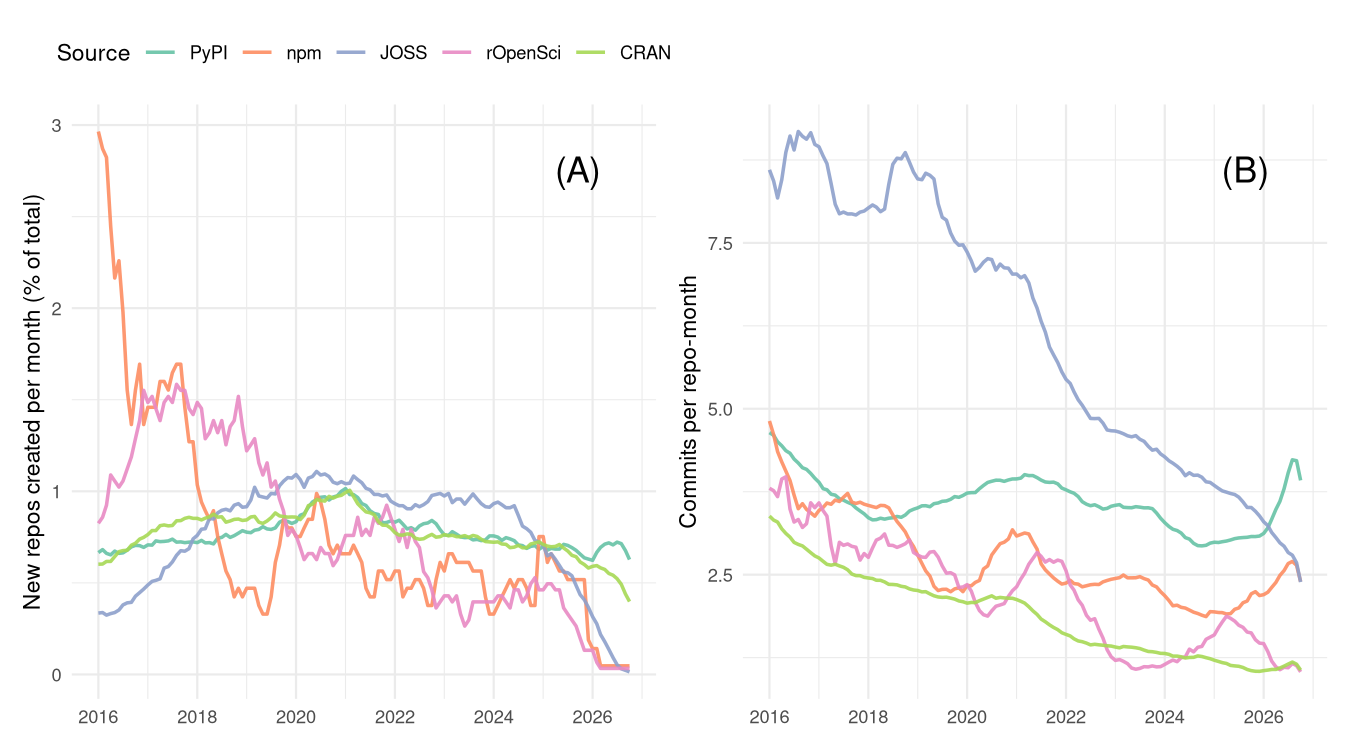
In which I show how, over the last few years, the world has rapidly moved from open-source software being produced and maintained by online communities, to software projects being built and maintained in isolation. By single developers, with ever-decreasing input from others. AI coding tools are now dramatically accelerating movement away from code as a collective endeavour to "coding alone". I conclude by describing how such progression need not be considered inevitable. Every step has reflected the collective influence of countless individual human decisions. The fate of open-source software communities is still determined by us.
How open source projects need to adapt to the AI coding era | We Love Open Source • All Things Open
A new Carnegie Mellon study shows AI coding tools boost velocity by 281% — then leave codebases harder to work with. Here's what open source communities need to do before the sugar rush wears off.

From OSS to Open Source AI: an Exploratory Study of Collaborative...
AI development is embracing open-source paradigm, but the fundamental distinction between AI models and traditional software artifacts may lead to a divergent open-source development paradigm with...

AI creates asymmetric pressure on Open Source
How Open Source communities can adapt to AI-generated contributions without overwhelming Open Source maintainers

What We're No Longer Seeing: AI and the Invisible Newcomer in Open Source
How AI is absorbing the visible friction that open-source communities have always relied on to see—and welcome—newcomers.
Humanity in Open Source
Thoughts on how the open source world is changing in the AI era, not always for the better.
If AI is so good at coding … where are the open source contributions?
You can hardly get online these days without hearing some AI booster talk about how AI coding is going to replace human programmers. AI code is absolutely up to production quality! Also, you’re all…

✨🙌 AI that helps communities thrive on their own terms
Open protocols + AI-enabled coding = building what we need for ourselves
✨🙌 AI that helps communities thrive on their own terms
Open protocols + AI-enabled coding = building what we need for ourselves
AI and the Destruction of the Creative Commons
The balance of software copyright protection and openness has always been fraught with minutiae and detail that bores all but the most nerdy of pedants. Yet, through much effort and 40 years of debate we had reached an equilibrium. Now AI has thrown that out the window.
Open source project contains hidden instruction for “AI” agents: delete my code
It’s no secret there’s a war going on inside the open source community, with people adopting “AI” on one side, and those that want nothing to do with it on the other. While the former are, by nature, using destructive tactics like mass website scraping, license washing, taking people’s creative works without permission, taking all the RAM and GPUs, and oh, destroying the planet, the latter have mostly stuck to fairly benign things like policies banning “AI” use, “AI” bot blockers, and the occasional honey pot mazes to trap “AI” crawlers.
Measuring the Impact of Early-2025 AI on Experienced Open-Source...
Despite widespread adoption, the impact of AI tools on software development in the wild remains understudied. We conduct a randomized controlled trial (RCT) to understand how AI tools at the...
Give Away Your Code, But Never Your Time — William Gross
As software developers, I think we can agree that open-source1 code has transformed the world. Its public nature tears down the walls that prevent some pieces of software from becoming the best they can be. The problem is that too many valuable projects stagnate, with burned-out leaders:
Impressions from visiting OpenAI, Anthropic, & Cursor
A peek into where software engineering is headed from inside the sector’s leading AI labs. Agents running in the cloud are a major trend, while coding harnesses are spreading beyond the craft
AI Slopageddon and the OSS Maintainers
AI slop is ripping up the social contract between maintainers and contributors essential to open source development. Practitioners have been repeatedly assured that AI would supercharge their communities, but so far that hasn’t been the case. Just look at what happened last month. Mitchell Hashimoto’s Ghostty implemented a zero-tolerance policy where submitting bad AI-generated code

"AI makes it cheaper to contribute to Open Source, but it's not making life easier for maintainers. More contributions are flowing in, but the burden of evaluating them still falls on the same small group of people. That asymmetric pressure risks breaking maintainers." also relevant to slop science
