

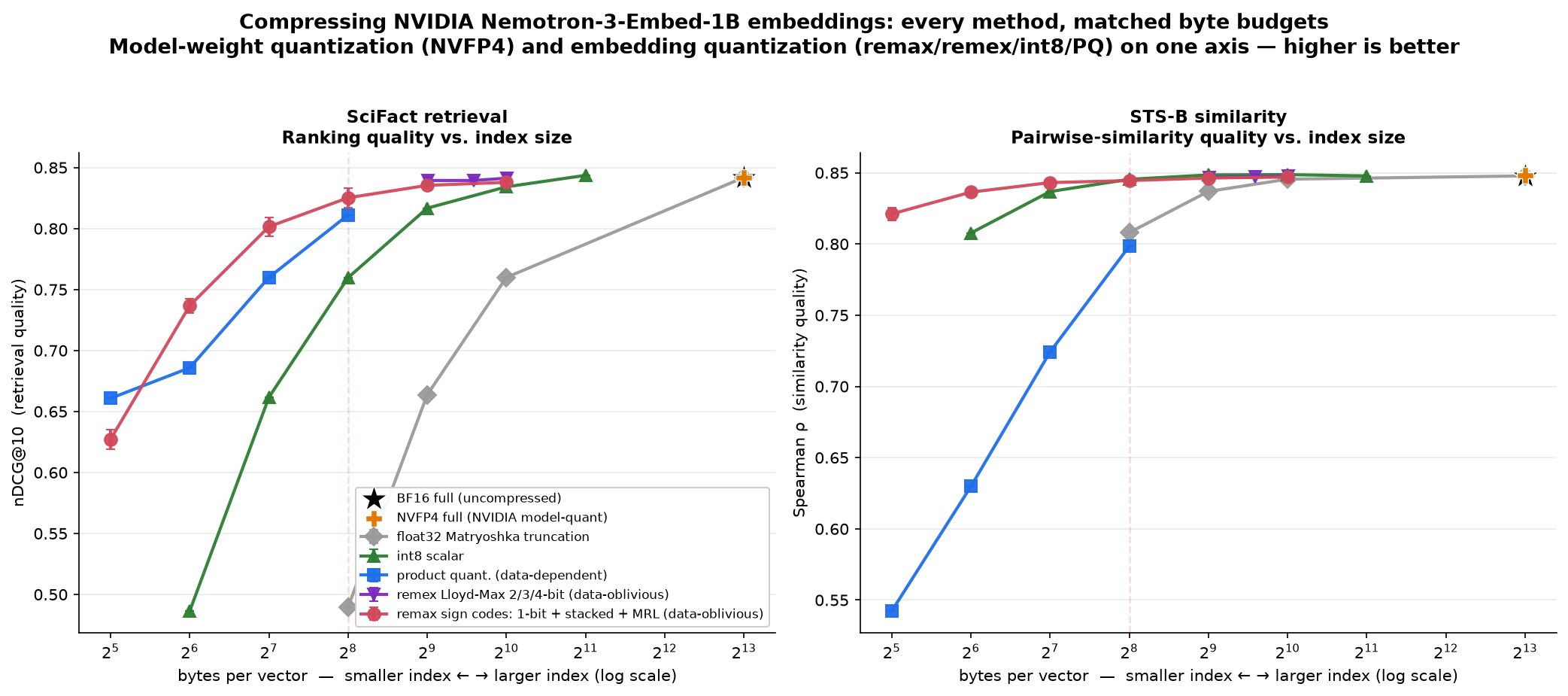
EmbeddingGemma 2’s one advertised way to shrink its vectors, keeping 128 of 768 dimensions, loses about 0.06 nDCG@10. Storing all 768 at 2 bits each is 16× smaller with no measurable loss on SciFact or NFCorpus.
A 4-Bit Model and a 1-Bit Index
Running NVFP4 Nemotron on a CPU, then mapping every embedding-compression method at matched byte budgets. The two quantizations compose.
Linkup - SPARSEUP: Linkup's Open-Source Sparse Embedding Model
Linkup Research releases SPARSEUP, an open-source sparse embedding model under 150M parameters. SOTA on BEIR-13, sub-millisecond retrieval, Apache 2.0 license.
Fast Embeddings on GPUs
Fast and accurate search is vital to all of Perplexity, from Search and Computer to our API Platform. Behind the scenes, the heavy lifting is done by embedding

Google for Developers Blog - News about Web, Mobile, AI and Cloud
EmbeddingGemma 2 is a compact, open-source multimodal embedding model that maps text, code, images, video, and audio into a unified 768-dimensional space. Developers can use the sentence-transformers library to selectively load modular modality encoders—ranging from 270M to 740M parameters—to optimize memory usage. Additionally, Matryoshka Representation Learning enables dynamic dimension truncation down to 128d, significantly reducing vector database storage requirements while maintaining high retrieval performance.
GLEE: Geometric Laplacian Eigenmap Embedding
Graph embedding seeks to build a low-dimensional representation of a graph G. This low-dimensional representation is then used for various downstream tasks. One popular approach is Laplacian Eigenmaps (LE), which constructs a graph embedding based on the spectral properties of the Laplacian matrix of G. The intuition behind it, and many other embedding techniques, is that the embedding of a graph must respect node similarity: similar nodes must have embeddings that are close to one another. Here, we dispose of this distance-minimization assumption. Instead, we use the Laplacian matrix to find an embedding with geometric properties instead of spectral ones, by leveraging the so-called simplex geometry of G. We introduce a new approach, Geometric Laplacian Eigenmap Embedding, and demonstrate that it outperforms various other techniques (including LE) in the tasks of graph reconstruction and link prediction.
I built ChatGPT with Minecraft redstone!
The Kaitchup Index: A Leaderboard for LLMs and Their Quantized Versions
Comparing formats like GGUF, GPTQ, and AWQ, with different bitwidths

EmbeddingGemma: Powerful and Lightweight Text Representations
We introduce EmbeddingGemma, a new lightweight, open text embedding model based on the Gemma 3 language model family. Our innovative training recipe strategically captures knowledge from larger models via encoder-decoder initialization and geometric embedding distillation. We improve model robustness and expressiveness with a spread-out regularizer, and ensure generalizability by merging checkpoints from varied, optimized mixtures. Evaluated on the Massive Text Embedding Benchmark (MTEB) across multilingual, English, and code domains, EmbeddingGemma (300M) achieves state-of-the-art results. Notably, it outperforms prior top models, both proprietary and open, with fewer than 500M parameters, and provides performance comparable to models double its size, offering an exceptional performance-to-cost ratio. Remarkably, this lead persists when quantizing model weights or truncating embedding outputs. This makes EmbeddingGemma particularly well-suited for low-latency and high-throughput use cases such as on-device applications. We provide ablation studies exploring our key design choices. We release EmbeddingGemma to the community to promote further research.

EmbeddingGemma 2: an open, lightweight multimodal embedding model
Introducing EmbeddingGemma 2, an open multimodal embedding model optimized for privacy-first use cases
Better bitmap performance with Roaring bitmaps
Bitmap indexes are commonly used in databases and search engines. By exploiting bit-level parallelism, they can significantly accelerate queries. However, they can use much memory, and thus we might prefer compressed bitmap indexes. Following Oracle's lead, bitmaps are often compressed using run-length encoding (RLE). Building on prior work, we introduce the Roaring compressed bitmap format: it uses packed arrays for compression instead of RLE. We compare it to two high-performance RLE-based bitmap encoding techniques: WAH (Word Aligned Hybrid compression scheme) and Concise (Compressed `n' Composable Integer Set). On synthetic and real data, we find that Roaring bitmaps (1) often compress significantly better (e.g., 2 times) and (2) are faster than the compressed alternatives (up to 900 times faster for intersections). Our results challenge the view that RLE-based bitmap compression is best.
The Beginner’s Guide to Text Embeddings & Techniques | deepset Blog
Text embeddings represent human language to computers, enabling tasks like semantic search. Here, we introduce sparse and dense vectors in a non-technical way.

The Bitter Lesson is coming for Tokenization
Highlights the desire to replace tokenization with a general method that better leverages compute and data. We'll see tokenization's fragility and review the Byte Latent Transformer arch.

Concise Binary Object Representation (CBOR)
The Concise Binary Object Representation (CBOR) is a data format whose design goals include the possibility of extremely small code size, fairly small message size, and extensibility without the need for version negotiation. These design goals make it different from earlier binary serializations such as ASN.1 and MessagePack. This document obsoletes RFC 7049, providing editorial improvements, new details, and errata fixes while keeping full compatibility with the interchange format of RFC 7049. It does not create a new version of the format.
Word embedding
In natural language processing, a word embedding is a representation of a word. The embedding is used in text analysis. Typically, the representation is a real-valued vector that encodes the meaning of the word in such a way that the words that are closer in the vector space are expected to be similar in meaning. Word embeddings can be obtained using language modeling and feature learning techniques, where words or phrases from the vocabulary are mapped to vectors of real numbers.

devs working with bsky image embeds: we are planning to bump the image embed blob max size from 1 MByte to 2 MByte. first in the lexicon schema, and then in the Bluesky Social app. more about impacts, and what this means in terms of lexicon evolution, in this github discussion
Increasing Bluesky Post Image Size Limit · bluesky-social atproto · Discussion #4832
github.com