

The Music Encoding Initiative (MEI) is a community-driven, open-source effort to define a system for encoding musical documents in a machine-readable structure. MEI brings together specialists from various music research communities, including technologists, librarians, historians, and theorists in a common effort to define best practices for representing a broad range of musical documents and structures. The results of these discussions are formalized in the MEI schema, a core set of rules for recording physical and intellectual characteristics of music notation documents expressed as an eXtensible Markup Language (XML) schema. It is complemented by the MEI Guidelines, which provide detailed explanations of the components of the MEI model and best practices suggestions. Read more …
Why are we even doing all this?
[This is a guest post by Rikab Gambhir. This blog post was initially written in a different file format and converted using AI. — T.] First, they came for the artists, and I did not speak out…

The Algorithmic Flattening of Sound: Computational Evidence and Justice Implications of AI Music Homogenization
This paper audits whether large-scale generative music systems exhibit measurable musical homogenization relative to human-produced music, and develops a justice-centered account of why this matters. We audit two commercially deployed systems (Suno and Lyria 3) across four genres (Afrobeats, K-pop, Dance Pop, and Heavy Metal). For each system and genre, we generate 100 tracks and compare them against human corpora of equal size, using 72 music information retrieval (MIR) features and multiple diagnostics of dispersion, redundancy, and separability. We define homogenization as reduced acoustic variation in standard computational audio features including rhythm and timing, timbre/spectral shape, and dynamics, both within genres and across genre boundaries. We also generate tracks using only a genre name as the prompt, with no additional instructions, to reveal each system's default musical tendencies. The results show two structurally distinct homogenizing tendencies. Lyria reduces within-genre acoustic diversity, while Suno collapses the acoustic distinctions between genres without compressing within-genre spread. Neither system follows user prompts faithfully, indicating that the observed patterns reflect learned priors rather than prompt constraints. The two systems do not converge on a common acoustic profile and are more acoustically distant from each other than two random human subsamples would typically be. Nevertheless, a standard classifier distinguishes AI from human tracks near-perfectly on MIR features alone. We argue that these patterns matter not as an aesthetic curiosity but as a justice-relevant condition, shaping which musical styles become legible, valued, and economically rewarded as generated outputs increasingly circulate at scale.

EuterPen: Unleashing Creative Expression in Music Score Writing
The Millions of Songs Mashed Into AI-Generated Music
Explore the astonishing amount of music available to AI developers.

Worth, Stepney : Growing Music
home > publications > non-standard computation > Growing Music > accompanying material
From Prompting to Describing: A Cross-Cultural Study of Language for AI-Generated Music
Recent text-to-music (TTM) systems such as Suno [22], Udio [23], and Google’s MusicFX [7] allow users to generate music from a natural language prompt, lowering the barrier to music creation for users without specialized musical knowledge [27]. Understanding how users write these prompts is therefore a fundamental question for music information retrieval and human-AI interaction research. Yet, prompting a generative system is not the same cognitive or linguistic act as describing music one has heard [12]. When a user writes a prompt, they encode anticipatory intent to steer the system toward a desired or imagined output, whereas when a listener describes a piece of music, their language is grounded in a perceptual experience. We argue that these two acts produce systematically different language—a distinction that, despite being intuitive, has not been quantitatively examined. This gap has practical consequences: recent TTM models are trained predominantly on metadata-centric corpora (genre labels, BPM, descriptive tags) [6] rather than on the kind of language users naturally produce when listening, leaving the prompt-description gap unexamined. Moreover, this gap limits our ability to evaluate and improve human–AI interaction in music generation, as current systems are optimized for prompt input but commonly assessed through human perception.
Malleable Music Ensembles
A framework using generalized algebraic theories and categorical lenses to enable interoperable, local-first networked music ensembles.
Why We’re Taking a Human‑First Stand on AI‑Generated Music — Qobuz Community
Artificial intelligence is transforming the music industry at an unprecedented pace. Faced with the explosion of AI-generated content and the legitimate questions it raises, Qobuz has chosen transparency. This charter establishes our framework: how we use AI, where we draw our lines, and what commi

HAIM: Human-AI Music Datasets for AI Music Production Tracking Benchmark
As generative platforms such as Suno and Udio reach human-grade audio quality, the scope of AI's utility has expanded across the entire music production workflow. Beyond simple track generation, these advancements have catalyzed the adoption of AI-driven methodologies in diverse forms. These include vocal synthesis, arrangement, and professional mastering. However, current detection research remains largely confined to a binary `AI-or-human' paradigm. It fails to reflect the realities of contemporary music production workflows. In real-world production, AI tools are increasingly used to refine or master human-produced tracks, and human engineers likewise post-process AI-generated material to ensure professional quality. Moreover, users often employ adversarial tactics to bypass AI detectors, such as applying human mastering to AI-generated tracks. This creates a grey area that a simple binary classification fails to capture. In this paper, we define and investigate ``AI Music Tracking'': the challenge of identifying specific AI integration across the multifaceted spectrum of music production. To this end, we introduce HAIM, a dataset with diverse labels for stages of music production. It is designed to isolate stages of AI intervention, including hybrid production and agent-level tracking. Our evaluation of state-of-the-art detectors reveals systemic flaws. By releasing HAIM, we propose a new benchmark that shifts the field beyond binary classification toward a granular, structured evaluation of AI music.
Finale - How Music Software Dies
Finale - How Music Software Dies
Composing Music With Recurrent Neural Networks
Writeup for my first major machine learning project.
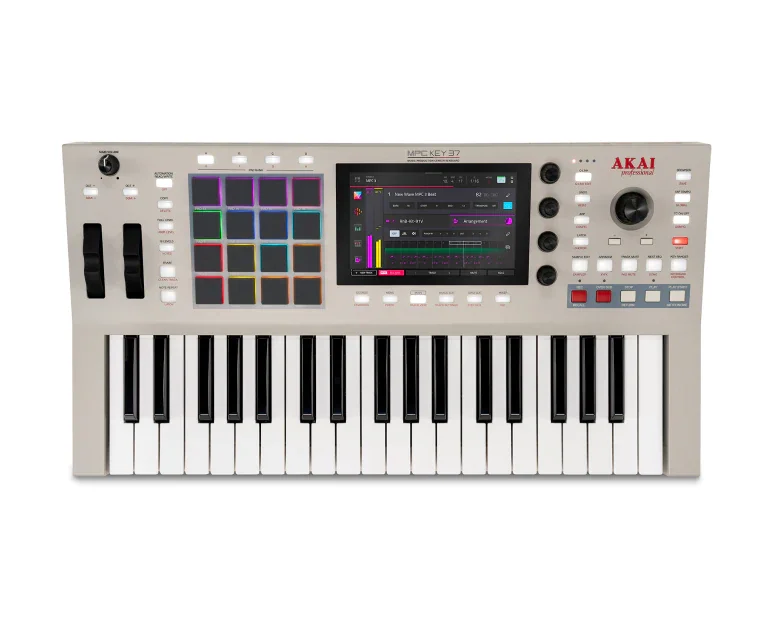
MPC Key 37 G2 | Akai Professional
MPC Key 37 G2 gives you everything you need to create music in a fully standalone workflow
IFPI Rolls Out Global Principles for the Eligibility of Recordings Developed Using AI in Official Music Charts Worldwide - IFPI
~ New principles to be applied across IFPI’s network of official charts ~ 30 July 2026, London – IFPI, the organisation representing the recording industry worldwide, today announced the roll out of a new set of principles to govern the eligibility of recordings developed with generative artificial intelligence (GenAI) services for inclusion in official music […]

Web 2.0 ... The Machine is Us/ing Us