


Part 4 of 4 in the series
Join the Kin Personal AI Discord Server!
The official Discord server for Kin, a personal AI focused on protecting your private data. Join to chat to the devs directly, and meet others around the world who are interested in the forefront of e

HUGE — AI Without Giving Up Your Privacy
We're building an Agentic AI Platform running on your Device that lives with YOU, isolated from the cloud, fundamentally reimagining the relationship between humans and artificial intelligence through ownership, privacy, and massive context. In an age of capture and control, HUGE sells independence and sovereignty.
Teen safety, freedom, and privacy
Explore OpenAI’s approach to balancing teen safety, freedom, and privacy in AI use.
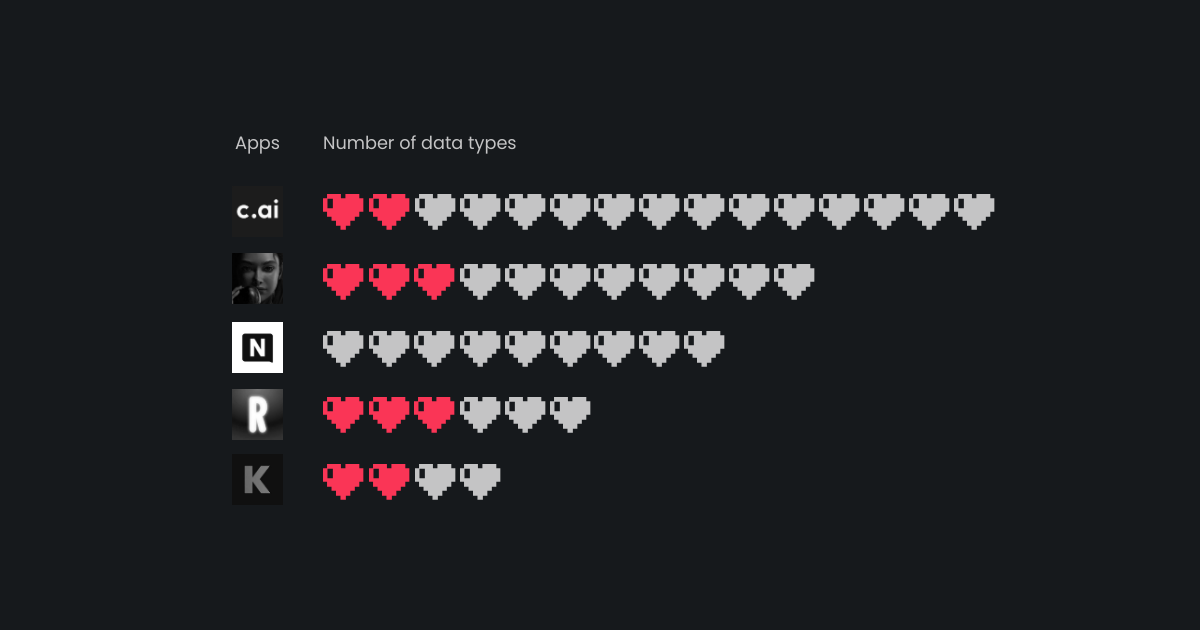
Data privacy concerns in AI companion apps - Surfshark
As AI grows, digital companions help with loneliness but raise questions about user data privacy. Many seek virtual relationships, but it's important to remember they are business-driven, not personal bonds.
Top 4 AI chatbot privacy concerns and how to mitigate them | TechTa...
Explore four key chatbot privacy concerns, as well as privacy protection strategies for individual users and organizations hoping to safeguard user data.

Privacy Policy
Anthropic is an AI safety and research company that's working to build reliable, interpretable, and steerable AI systems.

Clio: Privacy-Preserving Insights into Real-World AI Use
How are AI assistants being used in the real world? While model providers in theory have a window into this impact via their users' data, both privacy concerns and practical challenges have made analyzing this data difficult. To address these issues, we present Clio (Claude insights and observations), a privacy-preserving platform that uses AI assistants themselves to analyze and surface aggregated usage patterns across millions of conversations, without the need for human reviewers to read raw conversations. We validate this can be done with a high degree of accuracy and privacy by conducting extensive evaluations. We demonstrate Clio's usefulness in two broad ways. First, we share insights about how models are being used in the real world from one million Claude.ai Free and Pro conversations, ranging from providing advice on hairstyles to providing guidance on Git operations and concepts. We also identify the most common high-level use cases on Claude.ai (coding, writing, and research tasks) as well as patterns that differ across languages (e.g., conversations in Japanese discuss elder care and aging populations at higher-than-typical rates). Second, we use Clio to make our systems safer by identifying coordinated attempts to abuse our systems, monitoring for unknown unknowns during critical periods like launches of new capabilities or major world events, and improving our existing monitoring systems. We also discuss the limitations of our approach, as well as risks and ethical concerns. By enabling analysis of real-world AI usage, Clio provides a scalable platform for empirically grounded AI safety and governance.

Japan relaxes privacy laws to make AI development easy
: Opting out of personal data use won't be an option because Minister says that's a 'very big obstacle' to AI adoption


OpenClaw – NEAR AI
Run the internet’s favorite new AI agent with NEAR AI’s cryptographic privacy guarantees.
User Privacy and Large Language Models: An Analysis of Frontier Developers' Privacy Policies
Hundreds of millions of people now regularly interact with large language models via chatbots. Model developers are eager to acquire new sources of high-quality training data as they race to improve model capabilities and win market share. This paper analyzes the privacy policies of six U.S. frontier AI developers to understand how they use their users' chats to train models. Drawing primarily on the California Consumer Privacy Act, we develop a novel qualitative coding schema that we apply to each developer's relevant privacy policies to compare data collection and use practices across the six companies. We find that all six developers appear to employ their users' chat data to train and improve their models by default, and that some retain this data indefinitely. Developers may collect and train on personal information disclosed in chats, including sensitive information such as biometric and health data, as well as files uploaded by users. Four of the six companies we examined appear to include children's chat data for model training, as well as customer data from other products. On the whole, developers' privacy policies often lack essential information about their practices, highlighting the need for greater transparency and accountability. We address the implications of users' lack of consent for the use of their chat data for model training, data security issues arising from indefinite chat data retention, and training on children's chat data. We conclude by providing recommendations to policymakers and developers to address the data privacy challenges posed by LLM-powered chatbots.
User Privacy and Large Language Models: An Analysis of Frontier Developers' Privacy Policies
Hundreds of millions of people now regularly interact with large language models via chatbots. Model developers are eager to acquire new sources of high-quality training data as they race to improve model capabilities and win market share. This paper analyzes the privacy policies of six U.S. frontier AI developers to understand how they use their users' chats to train models. Drawing primarily on the California Consumer Privacy Act, we develop a novel qualitative coding schema that we apply to each developer's relevant privacy policies to compare data collection and use practices across the six companies. We find that all six developers appear to employ their users' chat data to train and improve their models by default, and that some retain this data indefinitely. Developers may collect and train on personal information disclosed in chats, including sensitive information such as biometric and health data, as well as files uploaded by users. Four of the six companies we examined appear to include children's chat data for model training, as well as customer data from other products. On the whole, developers' privacy policies often lack essential information about their practices, highlighting the need for greater transparency and accountability. We address the implications of users' lack of consent for the use of their chat data for model training, data security issues arising from indefinite chat data retention, and training on children's chat data. We conclude by providing recommendations to policymakers and developers to address the data privacy challenges posed by LLM-powered chatbots.
Meeting where AI eyes can't follow
I applied to the Community Privacy Residency, and the past projects reminded me of a cryptographic exploration I come back to every once in a while, just for...

The personal AI agent horror stories are rolling in
Early users say personal AI agents have not been forthright about account access, fabricated personal details, and raised cybersecurity concerns.
Signal President Meredith Whittaker calls out agentic AI as having 'profound' security and privacy issues | TechCrunch
Signal President Meredith Whittaker warned Friday that agentic AI could come with a risk to user privacy. Speaking onstage at the SXSW conference in

Introducing Lumo, a privacy-first AI built by Proton, where every conversation is confidential ✅ Zero-access encryption ✅ No-logs policy ✅ Open-source and auditable Try @asklumo.proton.me for free, no sign-up required: lumo.proton.me
