

A while back I wrote about language modeling without neural networks, where I generated Shakespeare with an unbounded n-gram model: no weights, no training, …
How Large Language Models Actually Work
GLaM: Efficient Scaling of Language Models with Mixture-of-Experts
Scaling language models with more data, compute and parameters has driven significant progress in natural language processing. For example, thanks to scaling, GPT-3 was able to achieve strong results on in-context learning tasks. However, training these large dense models requires significant amounts of computing resources. In this paper, we propose and develop a family of language models named GLaM (Generalist Language Model), which uses a sparsely activated mixture-of-experts architecture to scale the model capacity while also incurring substantially less training cost compared to dense variants. The largest GLaM has 1.2 trillion parameters, which is approximately 7x larger than GPT-3. It consumes only 1/3 of the energy used to train GPT-3 and requires half of the computation flops for inference, while still achieving better overall zero-shot and one-shot performance across 29 NLP tasks.

How linguistics learned to stop worrying and love the language models
Language models (LMs) can produce fluent, grammatical text. Nonetheless, some maintain that language models don’t really learn language and also, even if they did, that would not be informative for the study of human learning and processing. On the other side, there have been claims that the success of LMs obviates the need for studying linguistic theory and structure. We argue that both extremes are wrong. LMs can contribute to fundamental questions about linguistic structure, language processing, and learning. They force us to rethink arguments and ways of thinking that have been foundational in linguistics. While they do not replace linguistic structure and theory, they serve as model systems and working proofs of concept for gradient, usage-based approaches to language. We offer an optimistic take on the relationship between language models and linguistics.

Goekdeniz-Guelmez/gabliteration
Automated hyperparameter search for optimal Gabliteration configurations on large language models
Jailbreaking Large Language Models: If You Torture the Model Long Enough, It Will Confess!
A Cautionary Tale…

Slop-Machine Future
The arc of large language models is mediocre, and it bends toward “target procurement”.
Large language model
A large language model (LLM) is a neural network trained on a vast amount of text for natural language processing tasks, especially language generation. LLMs can typically generate, summarize, translate, and analyze text in many contexts, and are a foundational technology behind modern chatbots.[1] Biased or inaccurate training data can make an LLM's output less reliable.[2]
Extracting Training Data from Large Language Models
Nicholas Carlini, Google; Florian Tramèr, Stanford University; Eric Wallace, UC Berkeley; Matthew Jagielski, Northeastern University; Ariel Herbert-Voss, OpenAI and Harvard University; Katherine Lee and Adam Roberts, Google; Tom Brown, OpenAI; Dawn Song, UC Berkeley; Úlfar Erlingsson, Apple; Alina Oprea, Northeastern University; Colin Raffel, Google
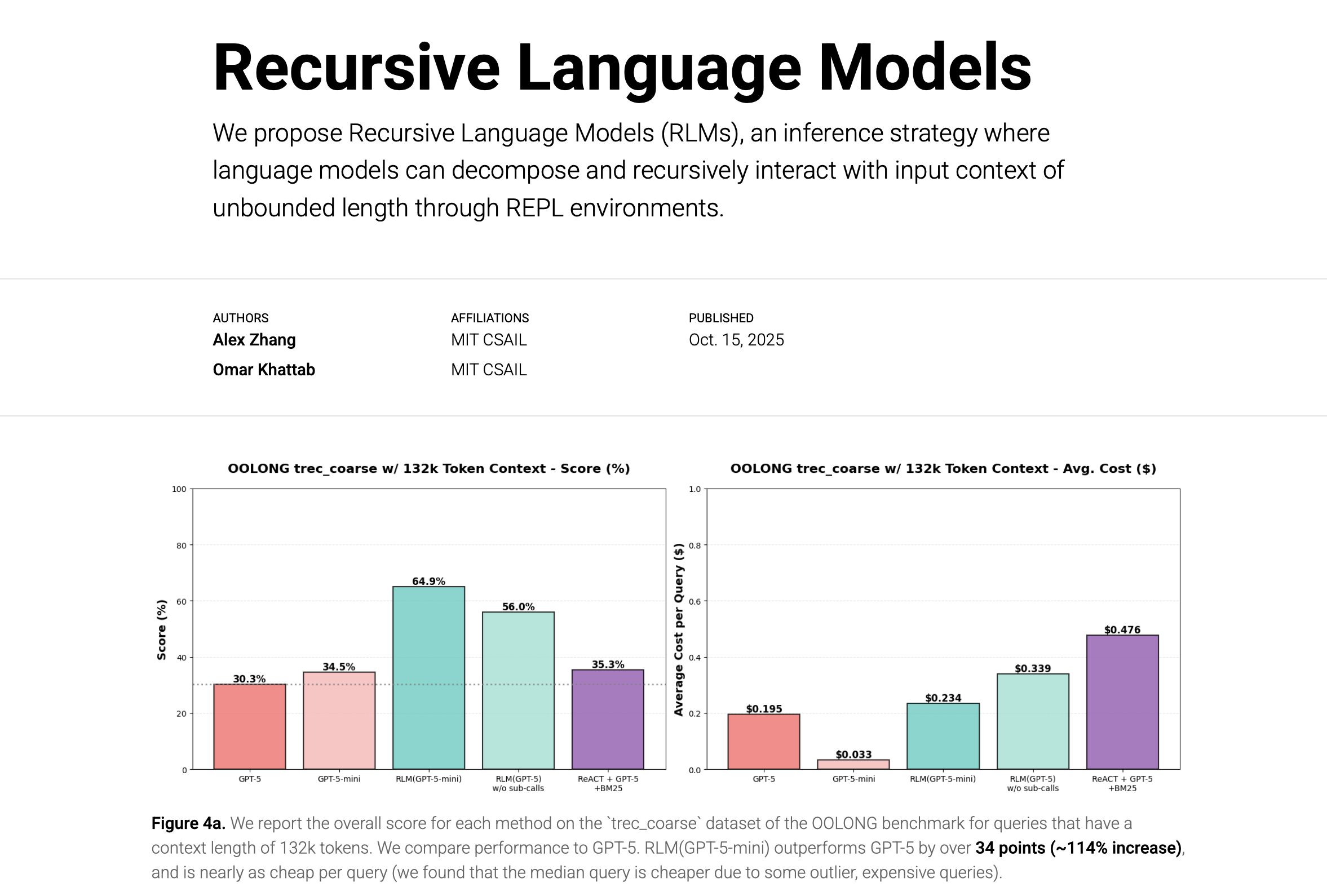
Recursive Language Models
We propose Recursive Language Models (RLMs), an inference strategy where language models can decompose and recursively interact with input context of unbounded length through REPL environments.
Language models struggle with compartmentalization
In the training data used by large language models (LLMs), the same latent concept is often presented in multiple distinct ways: the same facts appear in English and Swahili; many functions can be expressed in both Python and Haskell; we can express propositions in both formal and natural language. We show that LLMs can exhibit compartmentalization, where they fail to identify and share statistical strength between distinct presentations of unified concepts. In the worst case, LLMs simply learn parallel internal representations of each presentation of the concept, saturating model capacity with redundancies and decreasing sample efficiency with the number of such presentations. We also demonstrate that synthetic parallel data can fail to improve this despite being easily learned itself. Under this framework, we find that, for small models, early multilingual learning is nearly entirely compartmentalized. Finally, all interventions that we study exhibit a phase transition in which their effectiveness depends on the number of distinct presentations, suggesting that the language modeling objective may only inconsistently unify representations.

An Observation on Generalization
Models overview
Claude is a family of state-of-the-art large language models developed by Anthropic. This guide introduces the available models and compares their performance.
Stanford CS336 | Language Modeling from Scratch (Spring 2025 Archive)
Archived course website for Stanford CS336: Language Modeling from Scratch (Spring 2025), including schedule, assignments, logistics, and materials.

Scaling Laws Across Model Architectures: A Comparative Analysis of...
The scaling of large language models (LLMs) is a critical research area for the efficiency and effectiveness of model training and deployment. Our work investigates the transferability and...
openbench: Provider-agnostic, open-source evaluation infrastructure for language models
Provider-agnostic, open-source evaluation infrastructure for language models