


Black women are family caregivers – and they need flexibility and economic supports to make the best decisions for themselves and their families
Black Women Are Sounding the Alarm About Voting Rights and America’s Future
A new poll reveals their thoughts on whether the nation is delivering on what Black women need to thrive.

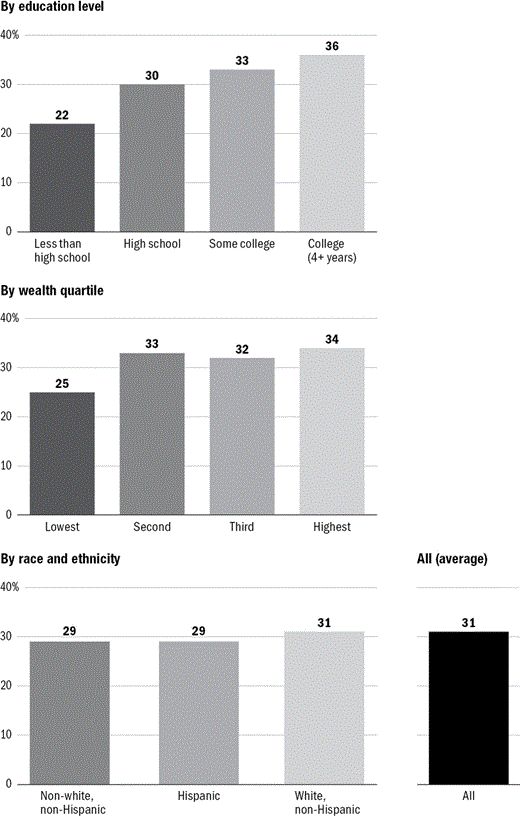
How Caregiving for Parents Reduces Women’s Employment: Patterns across Sociodemographic Groups
Abstract Abstract: This chapter examines the social patterns of elder caregiving among women ages 50 and older in the United States. We find that women who provide personal care for parents or parents-in-law, tend to be from more advantaged sociodemographic groups, with larger differences by socio-economic status than by race and ethnicity. Prior to initiating care, caregivers also have greater labor market attachment than non-caregivers. In contrast, although less likely to provide care, women from less advantaged groups tend to provide more time-intensive care when they do provide care, particularly in the extreme upper-end of the distribution of care hours. We find strong negative associations between caregiving and employment, hours, and earnings, both immediately and over a longer 10-year period. The relationship between care and work is similar across the sociodemographic groups that we examine.
News for Black America - NewsOne
Breaking news for and about Black America: politics, original stories, diverse opinions, current events and their impact on Black lives.

New report examines country’s racial wealth divide
It will take black families 228 years to amass the wealth that white families have today, according to the study's findings.
Black Feminist Thought, 30th Anniversary Edition: Knowledge, Consciousness, and the Politics of Empowerment
Knowledge, Consciousness, and the Politics of Empowerment

Here’s What Matters To Me, The Mother Of Your Child’s Black Friend
My white friends and acquaintances, and the children they raise, play a significant role in shaping how my children see themselves.
How Caregiving for Parents Reduces Women’s Employment: Patterns across Sociodemographic Groups
AbstractAbstract: This chapter examines the social patterns of elder caregiving among women ages 50 and older in the United States. We find that women who
Own Gender, Sibling’s Gender, Parent’s Gender: The Division of Elderly Parent Care among Adult Children
Research on the gender division of family labor largely focuses on housework and childcare in spousal couples. This article advances scholarship by examining the gender division of elderly parent care in sibling groups. Using the Health and Retirement Study, a nationally representative survey of elderly Americans, I find that caregiving to elderly parents varies not only by an adult child’s own gender, but also by the gender of the siblings with whom caregiving is shared and by the gender of the parent to whom care is provided. The salience of an adult child’s gender manifests in two primary ways: not only do daughters provide more care than do sons to their elderly parents, but daughters’ caregiving is also more elastic with respect to their own and their parents’ attributes than is sons’ caregiving. With respect to the gender of the siblings, sons provide relatively less care if they have sisters, whereas daughters provide relatively more care if they have brothers. With respect to the gender of the parent, sons provide relatively more care to fathers, and daughters provide relatively more care to mothers. Finally, analyses did not reveal changes over time.

Beyond the blank slate: Why Black women’s trust is critical for equitable AI | Brookings
Zarah Guillemet and Raj Korpan discuss preliminary research on Black women's trust in AI and implications for policymakers.

National Black Food & Justice Alliance
The National Black Food and Justice Alliance represents hundreds of Black urban and rural farmers, organizers, and land stewards based nationwide working together towards an intergenerational, urban/rural movement to map, assess, train and deepen the organizing, institution building and advocacy work protecting Black land and work towards food sovereignty.

NAACP Unveils Blueprint for Building Black Wealth
The NAACP's new roadmap aims to help Black families build assets, close the racial wealth gap and create generational wealth.

NAACP Unveils Blueprint for Building Black Wealth
The NAACP's new roadmap aims to help Black families build assets, close the racial wealth gap and create generational wealth.
Black Mental Health During the Holidays – The Tennessee Tribune
Creating Caring Institutions: Politics, Plurality, and Purpose
How do we know which institutions provide good care? Some scholars argue that the best way to think about care institutions is to model them upon the family or the market. This paper argues, on the...

How the Black Panthers Revolutionized Self-Care
“The fullness of the Black Panther Party’s legacy […] can be seen everywhere in the wellness space.”

A growing number of Black boys and young men have stepped into the role of caregiver. Most don’t know or consider themselves “youth caregivers.” They’re just “good” sons and grandchildren. bit.ly/4xCDiAF

Young Black Men and Boys Are Quietly Taking On a Caregiving Crisis Few People See
capitalbnews.org