


The results of a controversial 10-year-old study of more than a dozen clergy who took psilocybin on guided trips only recently came to light.
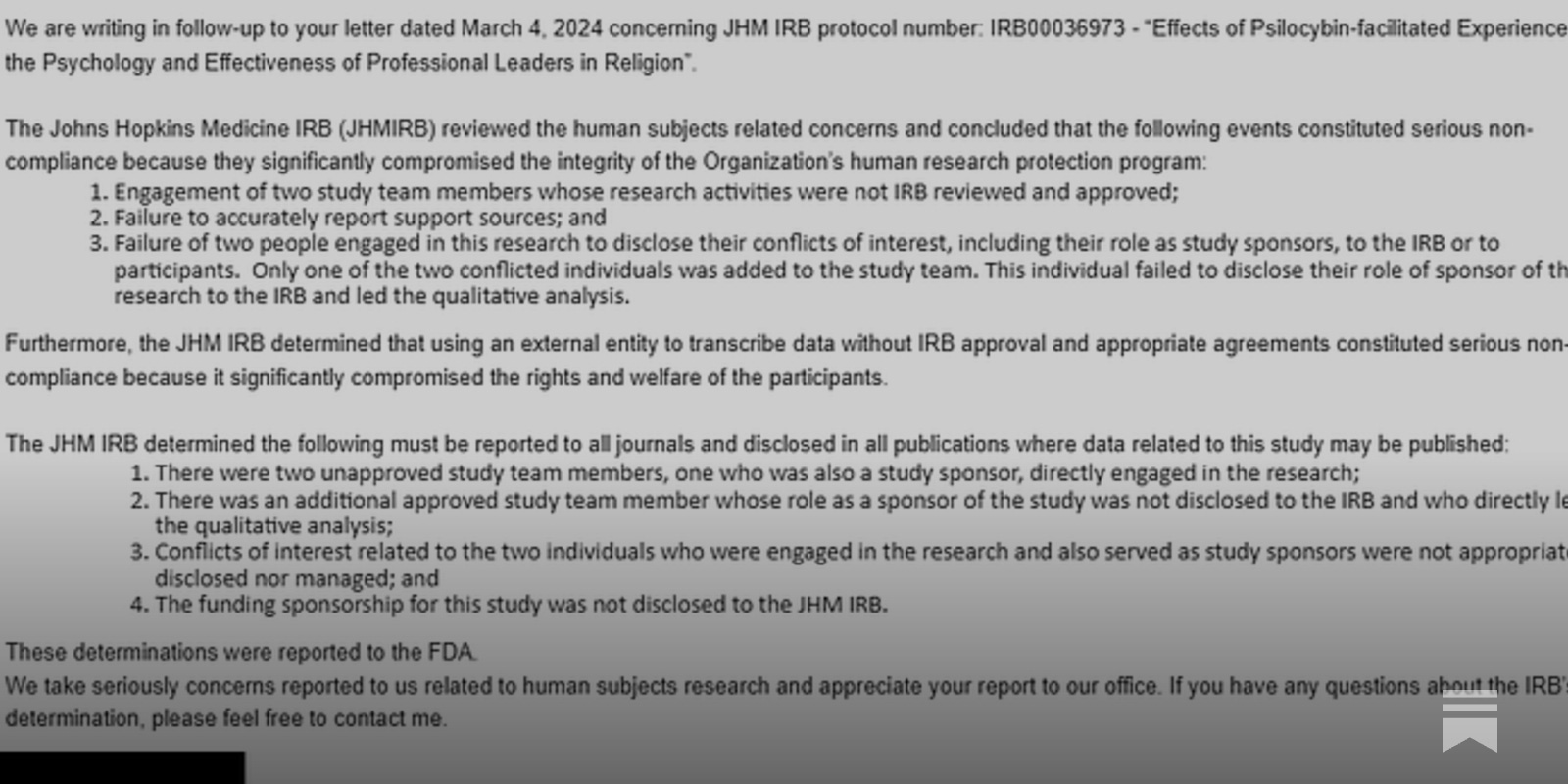
Johns Hopkins Psychedelic Clergy Study Found to Have Multiple Counts of "Serious Non-Compliance" with Federal Human Subject Protections
Unauthorized donor involvement and unauthorized study team members "significantly compromised" human research protection program, per JHU, citing other concerns for participants' rights and welfare.
Mushrooms evolved psychedelics twice, baffling scientists
Researchers found that magic mushrooms and fiber caps independently evolved different biochemical pathways to create psilocybin. This convergence shows nature’s ingenuity, but the reason why remains unknown—possibly predator deterrence. Beyond evolutionary mystery, the discovery provides new enzyme tools for biotech, with promising applications for producing psilocybin-based medicines.

A Dose of a Hallucinogen From a ‘Magic Mushroom,’ and Then Lasting Peace (Published 2016)
Two studies used psilocybin to see if the drug could reduce depression and anxiety in cancer patients. The results were striking.

Jonathan Pageau's Psychedelic Warning
PTAB Affirms §101 Rejection of Psilocybin Composition, Post-Appeal Prosecution Results in Granted Patent
PTAB Finds that Psilocybin Formulation Is Not a Product of Nature, Further Prosecution Leads to Issued Patent

What Are Psychedelic Entities?
The beings people often meet while using psychedelics resist tidy explanations.

Blood tests for mental health problems | Eiko Fried
A new paper was published yesterday on a blood test for schizophrenia, by the same research team that in 2021 published a paper on a blood test for depression . The papers and...

Generation Adderall (Published 2016)
Like many of my friends, I spent years using prescription stimulants to get through school and start my career. Then I tried to get off them.

Can Psychedelics Make Us More Moral?
With a renaissance going on in psychedelic research, is making us better people included?

Intravenous Methylphenidate Abuse
Data are presented from a case series of 22 patients who abused methylphenidate hydrochloride (Ritalin-SR). The abuse pattern and symptoms of toxicity were similar to that seen with cocaine hydrochloride and amphetamine sulfate addiction; yet, the morbidity and mortality seen in this case series...

Methylphenidate and the risk of psychosis in adolescents and young adults: a population-based cohort study
Background There is a clinical concern that prescribing methylphenidate, the most common pharmacological treatment for attention-deficit hyperactivity disorder (ADHD), might increase the risk of psychotic events, particularly in young people with a history of psychosis. We aimed to determine whether the risk of psychotic events increases immediately after initiation of methylphenidate treatment or, in the longer term, 1 year after treatment initiation in adolescents and young adults with and without a previously diagnosed psychotic disorder. Methods In this cohort study, we used population-based observational data from the Swedish Prescribed Drug Register, the National Patient Register, and the Total Population Register, three population-based registers containing data on all individuals in Sweden, to attain data on sex, birth, death, migration, medication use, and psychotic events for all eligible participants. We screened individuals on these registers to identify those receiving methylphenidate treatment, and who were aged 12–30 years at the start of treatment, for their inclusion in the study. We used a within-individual design to compare the incidence of psychotic events in these individuals during the 12-week periods immediately before and after methylphenidate initiation. Longer term risk was assessed by comparing the incidence of psychotic events 12 weeks before methylphenidate initiation and during a 12-week period one calendar year before the initiation of methylphenidate with the incidence of these events during the 12-week period one calendar year after methylphenidate initiation. We estimated the incidence rate ratios (IRR) and 95% CIs of psychotic events after the initation of methylphenidate treatment, relative to the events before treatment, which were defined as any hospital visit (inpatient admission or outpatient attendance, based on data from the National Patient Register) because of psychosis, using the International Classification of Diseases version 10 definition. Analyses were stratified by whether the individual had a history of psychosis. Findings We searched the Swedish Prescribed Drug Register to find eligible individuals who had received methylphenidate between Jan 1, 2007 and June 30, 2012. 61 814 individuals were screened, of whom 23 898 (38·7%) individuals were assessed and 37 916 (61·3%) were excluded from the study because they were outside of the age criteria at the start of treatment, they had immigrated, emigrated, or died during the study period, or because they were administered other ADHD medications. The median age at methylphenidate initiation was 17 years, and a history of psychosis was reported in 479 (2·0%) participants. The IRR of psychotic events in the 12-week period after initiation of methylphenidate treatment relative to that in the 12-week period before treatment start was 1·04 (95% CI 0·80–1·34) in adolescents and young adults without a history of psychosis and 0·95 (0·69–1·30) among those with a history of psychosis. Interpretation Contrary to clinical concerns, we found no evidence that initiation of methylphenidate treatment increases the risk of psychotic events in adolescents and young adults, including in those individuals with a history of psychosis. Our study should reassure clinicians considering initiating methylphenidate treatment for ADHD in adolescents and young adults, and it challenges the widely held view in clinical practice that methylphenidate should be avoided, or its use restricted, in individuals with a history of psychosis. Funding Swedish Research Council, National Institute of Mental Health, UK National Institute of Health Research Nottingham Biomedical Research Centre.
For those who’s taking ritalin / stimulants, does it drain you towards the end of the day?
80 votes, 56 comments. Im not sure if I used the right flair… Hello Reddit! I was recently diagnosed with adhd and its been a week since taking…
Terence McKenna's Last Trip
The "altered statesman" emerged from Leary's long shadow to push a magical blend of psychedelics, technology, and revelatory rap. He had less time than he knew.
Opinion | Why Universities Should Be More Like Monasteries (Published 2023)
College students need a taste of the monk’s life.

How times change! A decade ago, a failed replication of work by the same lab led to 'repligate' and blog posts such as psychol.cam.ac.uk/cece/blog Now, failed replications can be published an no one blinks an eye. That is progress due to all the scholars working hard to improve science!
I missed a lot of #metascience discourse in hospital, and am mostly sad I didn't get a chance to wade in on the absurdity of this being a paper in Nature in 2026; ignoring a decade of commentary from statisticians on OSC 2015 paper. nature.com/articles/s41586-025-10078-y

Investigating the replicability of the social and behavioural sciences - Nature
www.nature.com
