

This repository contains the official release of the Canon of Structural Monism (version 1.0.0). Structural Monism is an ontological doctrine that describes consciousness as a single field and all forms of existence as configurations of that field. The doctrine includes the SUBIT‑64 spectral model, the principle of vertical coherence, the mathematical framework, ethical implications, and canonical definitions.
Post-Structuralism | The Paper Pilot
The Paper Pilot's digital garden of thoughts on philosophy, politics, and sociology
Horismos: Self-representation and the Derived Constitutional Boundary in Enriched Cognitive Systems
We present a theory of self-representing cognitive systems grounded in $$([0,\infty ],+)$$([0,∞],+)-enriched category theory and the Yoneda lemma. The central object is a self-representing $$([0,\infty ],+)$$([0,∞],+)-enriched category $$\mathcal{C}$$C—a Lawvere metric space whose objects are complete epistemic architectures, whose hom-values record directed informational upgrade costs, and which is separated, closed under internal homs, and bilaterally Cauchy complete—together with a contractive cognitive endofunctor $$F:\mathcal{C}\rightarrow \mathcal{C}$$F:C→Cmodelling iterative self-improvement. We establish eight results in a single logical arc. The Horizon Theorem shows that the Yoneda embedding $$\varphi (A)=\mathcal{C}(-,A)$$φ(A)=C(-,A)is never essentially surjective: $$\mathcal{C}$$C sits strictly inside its own free Cauchy completion $$\mathcal{P}(\mathcal{C})$$P(C), with the non-representable presheaves forming a topologically dense family, proved via a reflexivity argument. The Lawvere–Banach Attractor Theorem shows that every contractive endofunctor on a bilaterally complete, separated $$([0,\infty ],+)$$([0,∞],+)-enriched category converges to a unique fixed point $$\mathbf {\Omega }$$Ωat a geometric rate. The Boundary Derivation Theorem shows that $$\mathbf {\Omega }$$Ωis the minimal F-invariant substructure of $$\mathcal{C}$$C, with all of $$\mathcal{C}$$Cas its basin of attraction—the constitutional boundary, derived rather than postulated. The Horizon Expansion Theorem shows that each strictly ascending self-modification produces a new, quantitatively distinct non-representable witness. Beyond these four central results, we prove that Kleene and Bourbaki–Witt conditions yield only non-expansiveness when metrised, that contractive endofunctors form a monoid, and that the Yoneda horizon admits an observable diagnostic stabilising in finite time. The architectural section derives structural corrigibility and the alignment-incompleteness duality among five implications. The organising duality is exact: the non-surjectivity of $$\varphi $$φ and the existence of $$\mathbf {\Omega }$$Ωare two faces of the same $$([0,\infty ],+)$$([0,∞],+)-enriched structure. $$\mathbf {\Omega }$$Ωinhabits the space between them—not as a postulate, but as a proof. We argue that the eight theorems constitute universal laws of contractive cognitive systems: a stable constitutional boundary is not an engineering design choice but a topological inevitability for any reliably self-improving agent operating within a self-representing enriched metric space. The postulate becomes a theorem. The boundary is not imposed. It emerges.

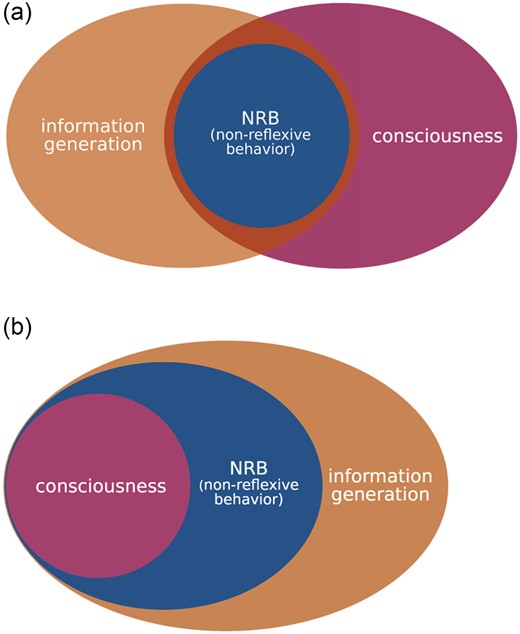
The science of consciousness does not need another theory, it needs a minimal unifying model
Abstract. This article discusses a hypothesis recently put forward by Kanai et al., according to which information generation constitutes a functional basi
The sentient cell: the cellular foundations of consciousness
"All species, extant and extinct, from the simplest unicellular prokaryotes to humans, have an existential consciousness. Without sentience, the first cells that emerged some 4 billion years ago would have been evolutionary dead-ends, unable to survive in the chaotic, dangerous environment in which life first appeared and evolved. In this book, Arthur Reber's theory, the Cellular Basis of Consciousness (CBC), is outlined and distinguished from those models that argue that minds could be instantiated on artificial entities and those that maintain consciousness requires a nervous system. The CBC framework takes a novel approach to classic topics such as the origin-of-life, philosophy of mind, the role of genes, the impact of cognition, and how biological information is processed by all species. It also calls for a rethinking of a variety of issues including the moral implications of the sentient capacities of all species, how welfare concerns need to be expanded beyond where they currently are, and critically, how all life is intertwined in a coordinated cognitive ecology. The Sentient Cell explores this revolutionary model, which updates the standard neo-Darwinian framework within which current approaches operate and examines the underlying biomolecular features that are the likely candidates for the "invention" of consciousness and outline their role in cellular life." --

Edit lenses
A lens is a bidirectional transformation between a pair of connected data structures, capable of translating an edit on one structure into an appropriate edit on the other. Many varieties of lenses have been studied, but none, to date, has offered a satisfactory treatment of how edits are represented. Many foundational accounts only consider edits of the form "overwrite the whole structure," leading to poor behavior in many situations by failing to track the associations between corresponding parts of the structures when elements are inserted and deleted in ordered lists, for example. Other theories of lenses do maintain these associations, either by annotating the structures themselves with change information or using auxiliary data structures, but every extant theory assumes that the entire original source structure is part of the information passed to the lens.We offer a general theory of edit lenses, which work with descriptions of changes to structures, rather than with the structures themselves. We identify a simple notion of "editable structure"--a set of states plus a monoid of edits with a partial monoid action on the states--and construct a semantic space of lenses between such structures, with natural laws governing their behavior. We show how a range of constructions from earlier papers on "state-based" lenses can be carried out in this space, including composition, products, sums, list operations, etc. Further, we show how to construct edit lenses for arbitrary containers in the sense of Abbott, Altenkirch, and Ghani. Finally, we show that edit lenses refine a well-known formulation of state-based lenses, in the sense that every state-based lens gives rise to an edit lens over structures with a simple overwrite-only edit language, and conversely every edit lens on such structures gives rise to a state-based lens.

Post-Structuralism in Gestalt: Because Nothing is Fixed Anyway
Why Words Matter, Even If They Sound Academic
the metagraph
A substrate for decentralized cognition, grounded in reflexive directed hypergraphs, machine-native encoding, and federated knowledge.
Standoff Annotation
Authored By: [[P- Brendan Langen]] [[P- Iian Neill]]’s goal with [[Codex OS]] is to build a system for relation - the principle of relatedness or [[sensemaking]].
What Theory is Not, Theorizing Is
Assemblage (philosophy)
Assemblage (from everyday French: agencement, – arrangement, layout, "a collection of things which have been gathered together or assembled") is a philosophical concept developed by Gilles Deleuze and Félix Guattari[1] and subsequently taken up by other theorists, such as Bruno Latour and Michel Callon who developed actor-network theory,[2] Manuel DeLanda in his work on assemblage theory,[3] and Jane Bennett who combines Latour with Deleuze and Guattari forming her own assemblage theory.[4][5][6] Bennett’s assemblage thinking has influenced environmental philosophy (e.g. Timothy Morton’s Hyperobjects), political theory (e.g. William Connolly’s work on complexity and politics), and new materialism (e.g. Rosi Braidotti, Karen Barad).
The Abstraction Fallacy: Why AI Can Simulate But Not Instantiate Consciousness
Computational functionalism dominates current debates on AI consciousness. This is the hypothesis that subjective experience emerges entirely from abstract causal topology, regardless of the underlying physical substrate. We argue this view fundamentally mischaracterizes how physics relates to information. We call this mistake the Abstraction Fallacy. Tracing the causal origins of abstraction reveals that symbolic computation is not an intrinsic physical process. Instead, it is a mapmaker-dependent description. It requires an active, experiencing cognitive agent to alphabetize continuous physics into a finite set of meaningful states. Consequently, we do not need a complete, finalized theory of consciousness to assess AI sentience—a demand that simply pushes the question beyond near-term resolution and deepens the AI welfare trap. What we actually need is a rigorous ontology of computation. The framework proposed here explicitly separates simulation (behavioral mimicry driven by vehicle causality) from instantiation (intrinsic physical constitution driven by content causality). Establishing this ontological boundary shows why algorithmic symbol manipulation is structurally incapable of instantiating experience. Crucially, this argument does not rely on biological exclusivity. If an artificial system were ever conscious, it would be because of its specific physical constitution, never its syntactic architecture. Ultimately, this framework offers a physically grounded refutation of computational functionalism to resolve the current uncertainty surrounding AI consciousness.

57 Ideas & Questions about Cognitive Infrastructures
Alexander Lerchner, The Abstraction Fallacy: Why AI Can Simulate But Not Instantiate Consciousness - PhilPapers
Computational functionalism dominates current debates on AI consciousness. This is the hypothesis that subjective experience emerges entirely from abstract causal topology, regardless of the underlying physical substrate. We argue this view ...

Welcome to the Relational Design Lab | LX Cast | 19 comments
Today I am VERY excited to share with all of you about my new home, Relational Design Lab! This R&D studio brings together a number of projects and will, I hope, grow to encompass many more. I imagine this lab as a gathering place for curious people who want to think about systems, and not in the typical mechanistic way they are described and implemented in technology. Instead, we'll feel into living systems, fractal ways of being, where the how is as important as the what. Over time, I hope the Lab will be a home or a waypoint for designers, researchers, community organizations, artists, storytellers, and technologists to explore togetherness together. Our 'theory of change' focuses on paradigm shift. Big change takes practice and possibility. Paradoxically, paradigm shift is a result of many small changes and repetitions in our behaviour and belief systems. We embrace emergence, mutual support, collective practice, and storytelling. One thing feels pretty clear, we need technology that is designed in solidarity with mutual care, does not depend on the whims of big corporations or its surveillance, and is joyful to use. To live in this reality, we also need to consider how business, funding, governance, scale, and context affect our work. We need embodied ways of knowing and sharing knowledge alongside our technical reasoning. And we need to face the reality of the consequences of our actions and those of our ancestors. This is not a project that aims to solve all the world's problems, but instead, to nurture the capacity for doing things together. We support and practice responding with curiosity and care, not with answers or attachment to ideals that no longer make sense amid collapsing systems. We are not "hiring" for this project now but there are many ways to get involved and would welcome opportunities to collaborate. Some of the projects we're holding include Folk Tech, Spacious, SEED Founding, and Relational Source License. We're also developing a very cool workshop process to help other organizations explore relational design through a community-driven futurism process. As ecosystem supporters, we are developing relationships with many aligned groups and projects as well. There will be more communications coming! If this all sounds like something you would like to support, contribute to, keep track of, or develop relationship with, for now you can subscribe to our calendar here https://lnkd.in/gPRFW7zC and message me directly! | 19 comments on LinkedIn

Anarchism

Links that argue in favor of flattening power structures. Keep in mind that Anarchism is a big tent!
Scholary infrastructure and the research nexus

The research nexus is "a rich and reusable open network of relationships connecting research organisations, people, things, and actions; a scholarly record that the global community can build on forever, for the benefit of society." (crossref.org/documentation/research-nexus/)
'Exclusive Interview With Murray Rothbard'

An Anarchist FAQ
Anarchism
Individualism Reconsidered
Are You An Anarchist? The Answer May Surprise You!

On liberty

How Grobid uses Crossref metadata to enrich bibliographic information - Crossref
Schema 5.5 now available: adding CRediT, new record types for blogs and posters, and more - Crossref
Scholarly blogs and their place in the research nexus - Crossref
Rogue Scholar
SemRepo.org

Science discussions of retracted articles on Bluesky: public scrutiny or misinformation spreading?