

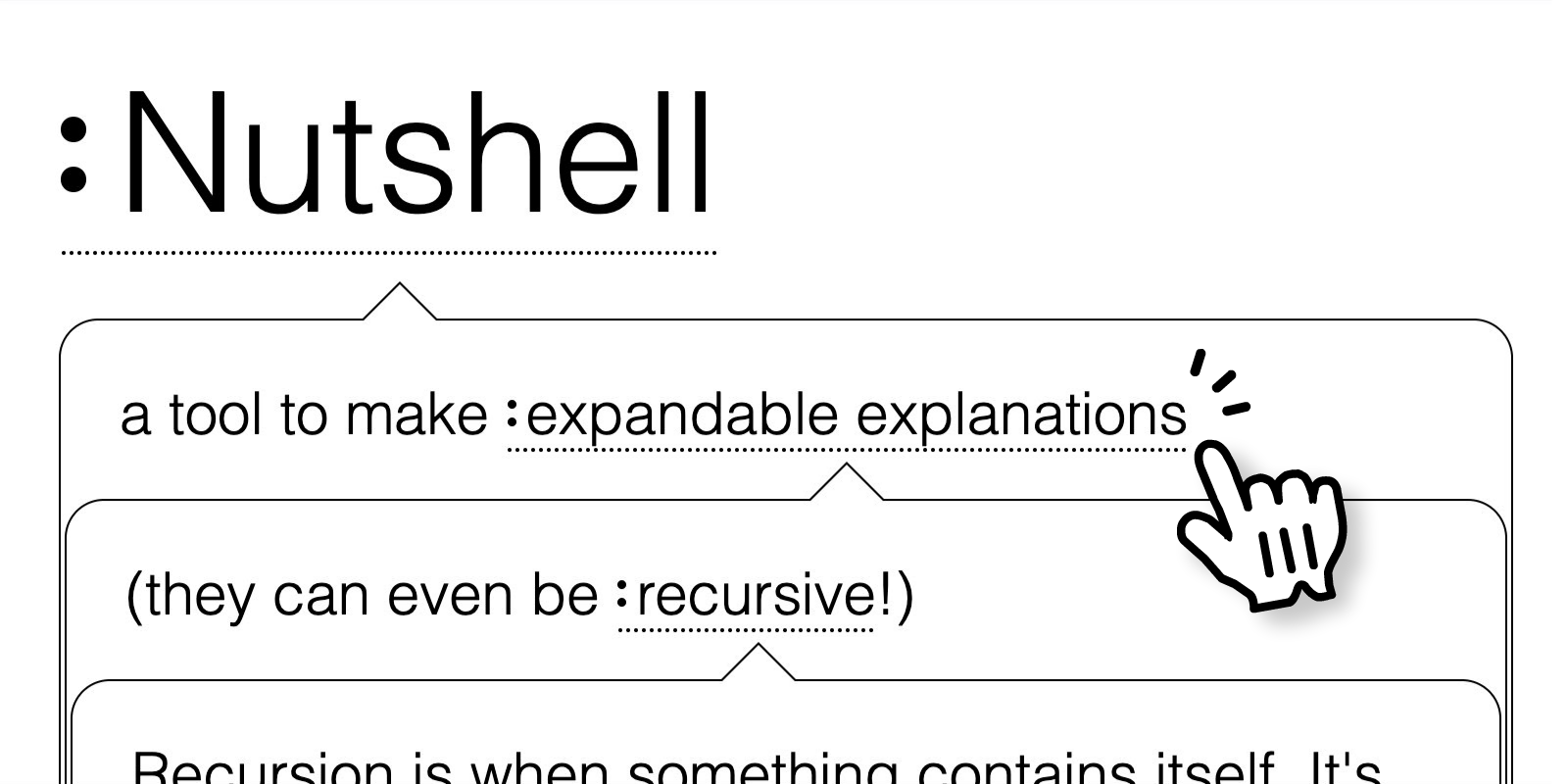
a tool to let your readers dive into details
Explorable Explanations
An active reader asks questions, considers alternatives, questions assumptions, and even questions the trustworthiness of the author. An active reader tries to generalize specific examples, and devise specific examples for generalities. An active reader doesn't passively sponge up information, but uses the author's argument as a springboard for critical thought and deep understanding.
Malleable Overview Detail Interfaces
Wikum: Bridging Discussion Forums and Wikis Using Recursive Summarization
Large-scale discussions between many participants abound on the internet today, on topics ranging from political arguments to group coordination. But as these discussions grow to tens of thousands of posts, they become ever more difficult for a reader to digest. In this article, we describe a workflow called recursive summarization, implemented in our Wikum prototype, that enables a large population of readers or editors to work in small doses to refine out the main points of the discussion. More than just a single summary, our workflow produces a summary tree that enables a reader to explore distinct subtopics at multiple levels of detail based on their interests. We describe lab evaluations showing that (i) Wikum can be used more effectively than a control to quickly construct a summary tree and (ii) the summary tree is more effective than the original discussion in helping readers identify and explore the main topics.
Summarize with built-in AI | AI on Chrome | Chrome for Developers
Distill lengthy articles, complex documents, or even lively chat conversations into concise and insightful summaries.

Creative Reading: Scaffolding Reading for Transformation
However, recent work on augmenting reading largely focuses on making reading more efficient, especially in knowledge-intensive contexts where people must rapidly make sense of research papers and other complex documents (Lo et al., 2024). These systems often aim to help readers skim, summarize, and synthesize large volumes of information in order to reduce cognitive effort and accelerate document- and corpus-level sensemaking at scale (Gu et al., 2025; Lo et al., 2024; Fok et al., 2023). At one extreme, the form of reading implicitly envisioned by these systems may resemble what we call “reading to discard”: extracting the essential, actionable informational core of a document as quickly and efficiently as possible, so that the rest can be swiftly tossed aside—much like we often process inbound mail. This motivates us to ask what scaffolding approaches might resist “reading to discard,” what alternative forms of reading we might scaffold, and what alternative views and values of reading might guide the conversation.
Chasing RATs: Tracing Reading for and as Creative Activity
Creativity research has privileged making over the interpretive labor that precedes and shapes it. We introduce Reading Activity Traces (RATs), a proposal that treats reading -- broadly defined to include navigating, interpreting, and curating media across interconnected sources -- as creative activity both for future artifacts and as a form of creation in its own right. By tracing trajectories of traversal, association, and reflection as inspectable artifacts, RATs render visible the creative work that algorithmic feeds and AI summarization increasingly compress and automate away. We illustrate this through WikiRAT, a speculative instantiation on Wikipedia, and open new ground for reflective practice, reader modeling, collective sensemaking, and understanding what is lost when human interpretation is automated -- towards designing intelligent tools that preserve it.

Yet another snippet extension
Contains an introduction, installation instructions and other important notes.
Potluck: Dynamic documents as personal software
Gradually enriching text documents into interactive applications
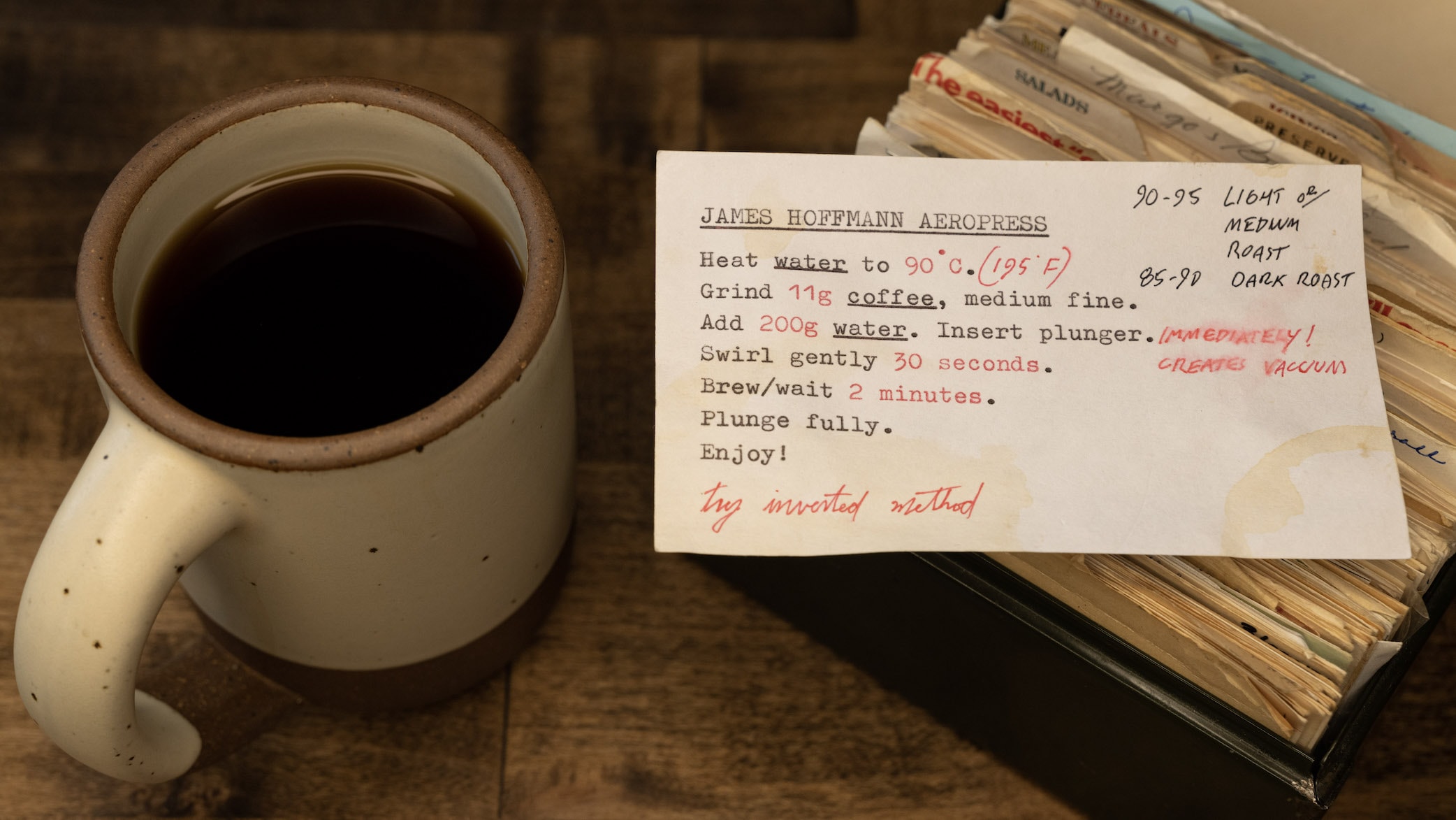
Textoshop: Interactions Inspired by Drawing Software to Facilitate Text Editing
Amelia Wattenberger 🪷 on Twitter / X
exploring ways we can "step back" from text/code and make sense of it,the way do in maps or how we can "fit more" in our visual system, it just gets smaller and decreases resolution.here's a fun one: extract the main concepts and throw them on a sphere, keep spinning to go… pic.twitter.com/yzh42EcBTe— Amelia Wattenberger 🪷 (@Wattenberger) July 6, 2026
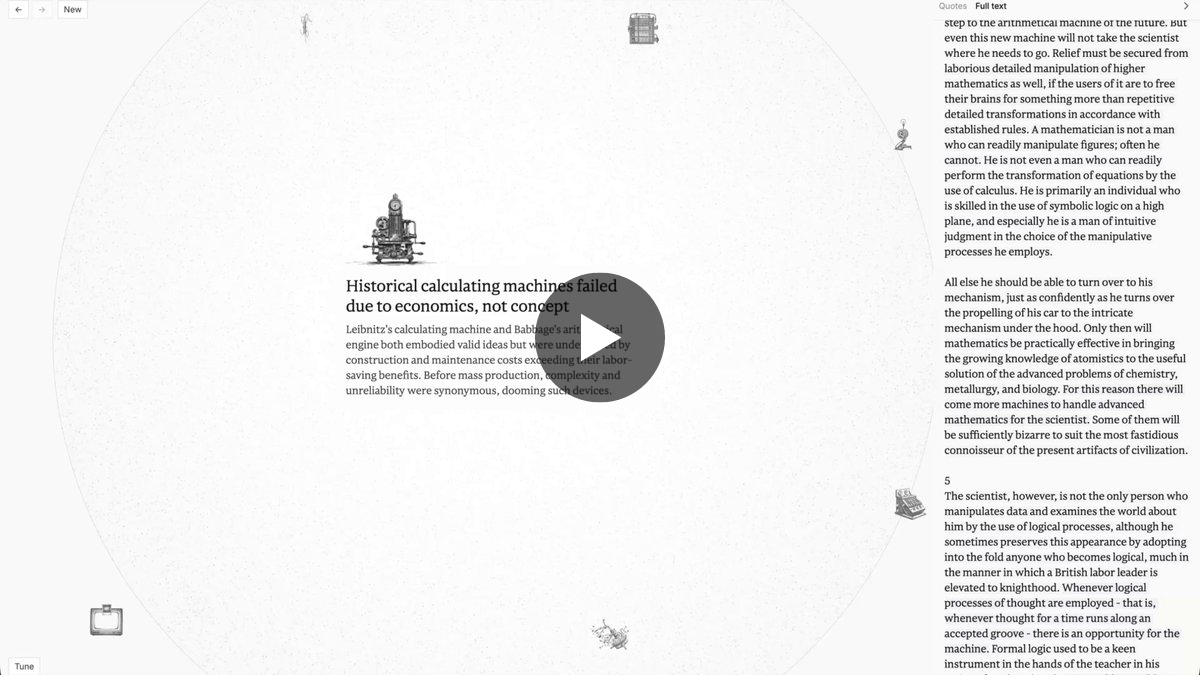
Rethinking the human-readability infrastructure
As part of the Digital Library's transition to Open Access, new features for researchers are available in the Premium Edition. Click here to learn more.
Natural Language Autoencoders Produce Unsupervised Explanations of LLM Activations
We introduce Natural Language Autoencoders (NLAs), an unsupervised method for generating natural language explanations of LLM activations. An NLA consists of two LLM modules: an activation verbalizer (AV) that maps an activation to a text description and an activation reconstructor (AR) that maps the description back to an activation. We jointly train the AV and AR with reinforcement learning to reconstruct residual stream activations. Although we optimize for activation reconstruction, the resulting NLA explanations read as plausible interpretations of model internals that, according to our quantitative evaluations, grow more informative over training.
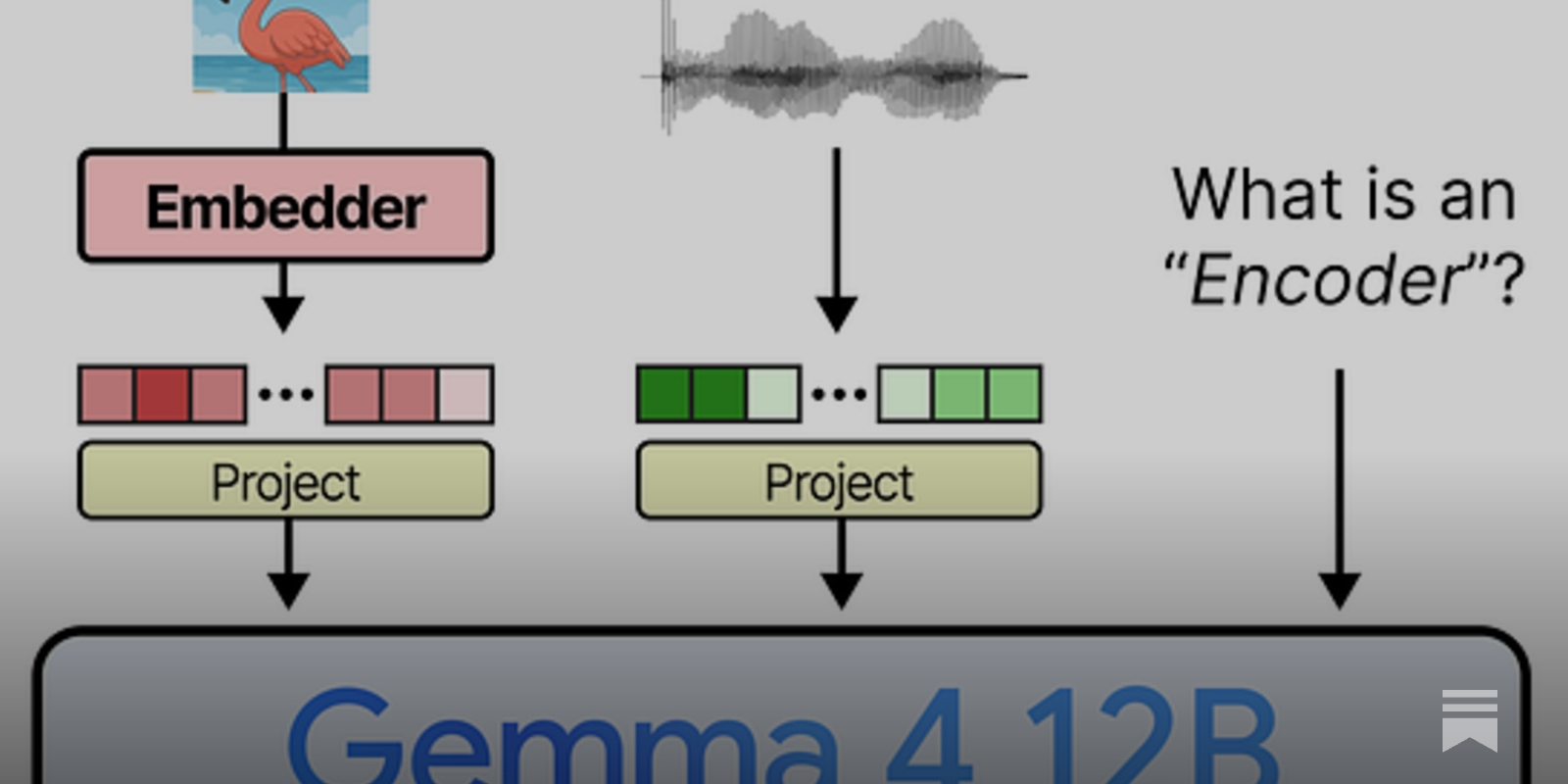
A Visual Guide to Gemma 4 12B
An in-depth explainer to Gemma 4 12B; a unified, encoder-free multimodal model!
AT Protocol: explanation for non-techies? - Debbie's Blatherings - by Debbie Ridpath Ohi
Working on an explanation without tech jargon, for fellow creatives
How to create reading experiences that "go beyond information transmission and toward reader transformation.” Great paper by @blue-phia.bsky.social @lepidopterane.bsky.social @yijunliu.bsky.social Sarah Sterman @sh1m.bsky.social @maxkreminski.bsky.social arxiv.org/abs/2606.04308 >
