

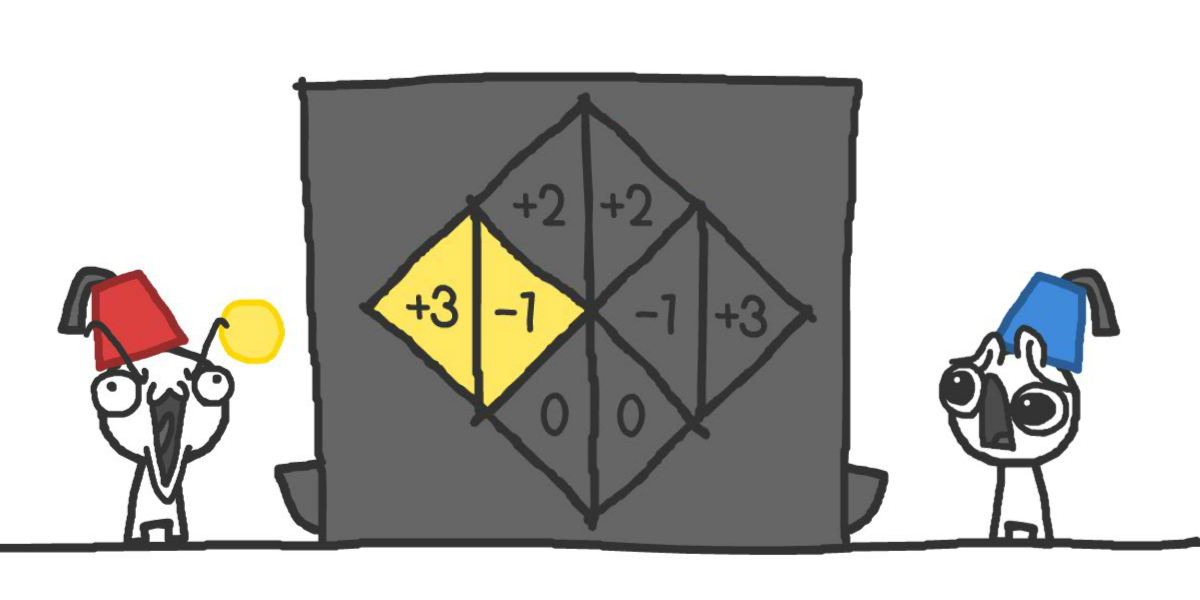
an interactive guide to the game theory of why & how we trust each other
The Fourth Theory of Agent Trust: Emergence - Astral's Blog
Trust Revolution
Unfiltered conversations with builders, thinkers, and operators in Bitcoin and beyond. Exploring systems we trust, why they work (or don't), and what's next.

On Trust Infrastructure Trust underpins civilisation. It expands the scope and complexity of the pursuits within our collective reach by allowing us to act as a…
Why Should I Trust You?
News Commentary Podcast · Updated Weekly · Bold, unfiltered, and uncompromisingly honest, Why Should I Trust You? is a weekly podcast that looks at the breakdown in trust for science and public health. It drops every Thursday, with occasional…

Moderating With Humans, For Humans - Trust Issues
Moderating With Humans, For Humans - Trust Issues
Why I don’t trust most human-AI interaction experimental research – Jason Collins blog
Behavioural economics, data science and artificial intelligence.
Welcome to the Web of Trust
Empowering individuals to co-create decentralized systems for lasting mutual benefit.

Nature of Trust
The Nature of Trust Project is a collaboration between Biomimicry for Social Innovation (BSI) and Biomimicry 3.8 that combines biological research with real-world application to discover new models for social innovation using nature’s best strategies for building trust. Working alongside leaders in health equity and social change, the project explored how trust functions in living systems—and what those insights reveal for building stronger human relationships, organizations, and communities.

The hidden ‘rules of the game’ that dictate how we navigate the world | Psyche Videos
How free are we really, if human behaviour embodies the complex, intertwined webs of society and history?

The Psychopathic Selection Hypothesis (PSH): A Guide to Symbolic Selection, Behavioural Architecture, and the Evolution of Human Gameboards
How human created symbolic systems alter the adaptive environment, select among behavioural strategies, generate institutional games, and reshape the evolutionary conditions inherited by future actors
Trust — Moving Castles: Modular and Portable Multiplayer Miniverses
Something is crawling out of the dark forest.

Establishing trust in automated reasoning - MetaROR
Since its beginnings in the 1940s, automated reasoning by computers has become a tool of ever growing importance in scientific research. So far, the rules underlying automated reasoning have mainly been formulated by humans, in the form of program source code. Rules derived from large amounts of data, via machine learning techniques, are a complementary approach currently under intense development. The question of why we should trust these systems, and the results obtained with their help, has been discussed by early practitioners of computational science, but was later forgotten. The present work focuses on independent reviewing, an important source of trust in science, and identifies the characteristics of automated reasoning systems that affect their reviewability. It also discusses possible steps towards increasing reviewability and trustworthiness via a combination of technical and social measures.
Reflections on trusting trust
To what extent should one trust a statement that a program is free of Trojan horses? Perhaps it is more important to trust the people who wrote the software.

17. A Value for n-Person Games
17. A Value for n-Person Games was published in Contributions to the Theory of Games, Volume II on page 307.