

A Frobenius algebra is a vector space equipped with the structures both of an algebra and of an a coalgebra in a compatible way, where the compatibility is different from (more “topological” than) that in a bialgebra/Hopf algebra:
generalized algebraic theory in nLab
A generalized algebraic theory (GAT, Cartmell 1978/86) is a dependent type theory in the syntactic sense: There are judgments declaring types and terms of types, where, critically, a type AA declared in context Γ\Gamma is allowed to depend on terms of Γ\Gamma. The only other judgments allowed are of equality (judgemental equality) of pairs of types or terms.
quotient object in nLab
product, fiber product, base change, coproduct, pullback, pushout, cobase change, equalizer, coequalizer, join, meet, terminal object, initial object, direct product, direct sum
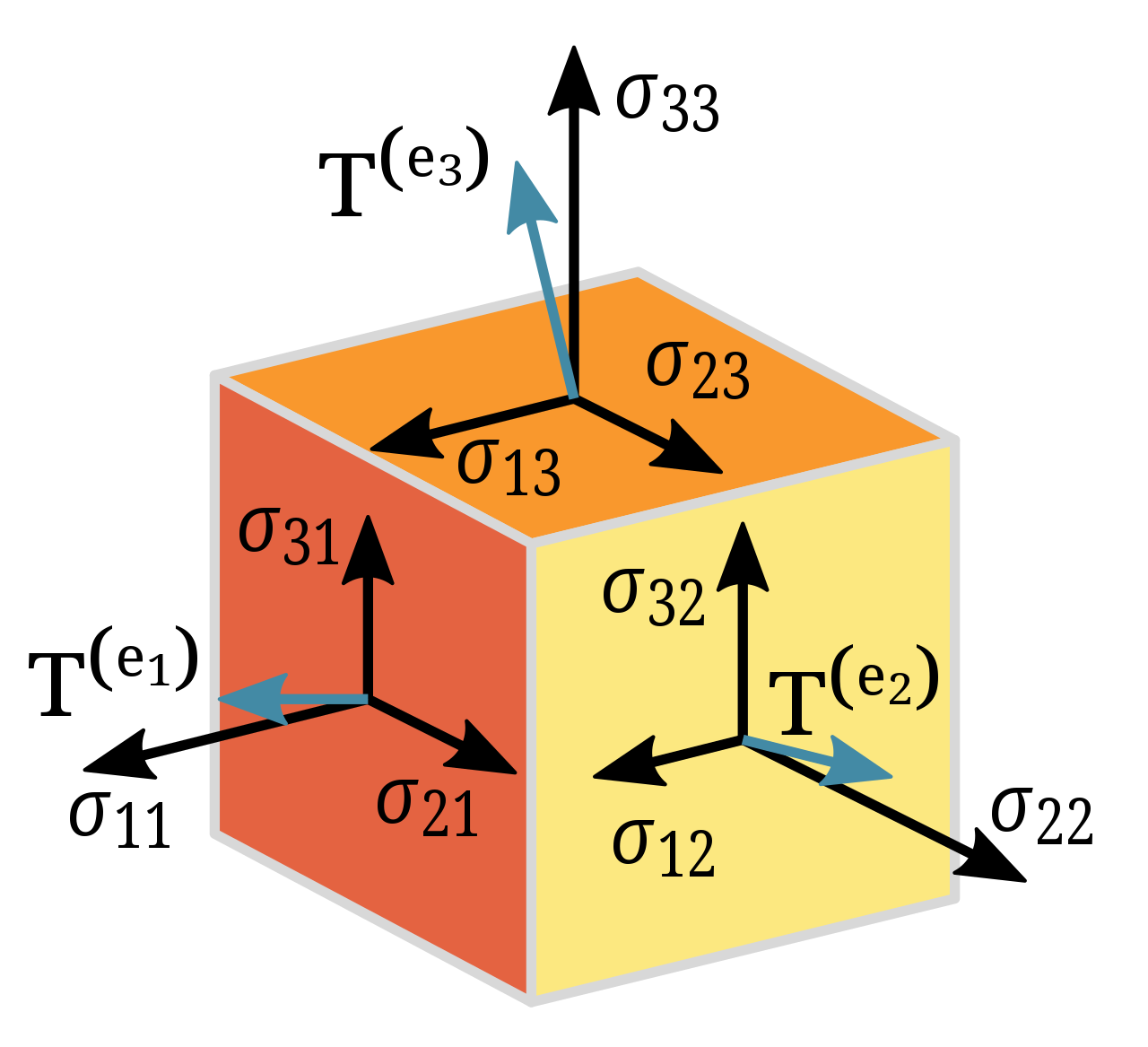
Tensor
In mathematics, a tensor is an algebraic object that describes a multilinear relationship between sets of algebraic objects associated with a vector space. Tensors may map between different objects such as vectors, scalars, and even other tensors. There are many types of tensors, including scalars and vectors, dual vectors, multilinear maps between vector spaces, and even some operations such as the dot product. Tensors are defined independent of any basis, although they are often referred to by their components in a basis related to a particular coordinate system; those components form an array, which can be thought of as a high-dimensional matrix.
Categories for the Working Mathematician
Categories for the Working Mathematician provides an array of general ideas useful in a wide variety of fields. Starting from the foundations, this book illuminates the concepts of category, functor, natural transformation, and duality. The book then turns to adjoint functors, which provide a description of universal constructions, an analysis of the representations of functors by sets of morphisms, and a means of manipulating direct and inverse limits. These categorical concepts are extensively illustrated in the remaining chapters, which include many applications of the basic existence theorem for adjoint functors. The categories of algebraic systems are constructed from certain adjoint-like data and characterized by Beck's theorem. After considering a variety of applications, the book continues with the construction and exploitation of Kan extensions. This second edition includes a number of revisions and additions, including two new chapters on topics of active interest. One is onsymmetric monoidal categories and braided monoidal categories and the coherence theorems for them. The second describes 2-categories and the higher dimensional categories which have recently come into prominence. The bibliography has also been expanded to cover some of the many other recent advances concerning categories.
Elements of ∞-Category Theory in nLab
on (∞,1)-category theory formulated via ∞-cosmoi and the homotopy 2-category of (∞,1)-categories (formal ( ∞ , 1 ) (\infty,1) -category theory).
Categories of Containers
We introduce the notion of containers as a mathematical formalisation of the idea that many important datatypes consist of templates where data is stored. We show that containers have good closure properties under a variety of constructions including the formation of initial algebras and final coalgebras. We also show that containers include strictly positive types and shapely types but that there are containers which do not correspond to either of these. Further, we derive a representation result classifying the nature of polymorphic functions between containers. We finish this paper with an application to the theory of shapely types and refer to a forthcoming paper which applies this theory to differentiable types.

emilyriehl/yoneda
comparative formalizations of the Yoneda lemma for 1-categories and infinity-categories
What you needa know about Yoneda: profunctor optics and the Yoneda lemma (functional pearl) | Proceedings of the ACM on Programming Languages
Profunctor optics are a neat and composable representation of bidirectional data accessors, including lenses, and their dual, prisms. The profunctor representation exploits higher-order functions and higher-kinded type constructor classes, but the ...

Seeing double through dependent optics
Tambara modules are strong profunctors between monoidal categories. They've been defined by Tambara in the context of representation theory, but quickly found their way in applications when it was...

Algebraic data integration
In this paper, we develop an algebraic approach to data integration by combining techniques from functional programming, category theory, and database theory. In our formalism, database schemas and instances are algebraic (multi-sorted equational) theories of a certain form. Schemas denote categories, and instances denote their initial (term) algebras. The instances on a schema S form a category, S–Inst, and a morphism of schemas F : S → T induces three adjoint data migration functors: ΣF : S–Inst → T–Inst, defined by substitution along F, which has a right adjoint ΔF : T–Inst → S–Inst, which in turn has a right adjoint ΠF : S–Inst → T–Inst. We present a query language based on for/where/return syntax where each query denotes a sequence of data migration functors; a pushout-based design pattern for performing data integration using our formalism; and describe the implementation of our formalism in a tool we call AQL (Algebraic Query Language).
nLab
particle, relativistic particle, fundamental particle, spinning particle, superparticle
Algebra of programming
Algebra of programming by Bird, Richard, 1997, Prentice Hall edition, in English

Generalised algebraic theories and contextual categories