

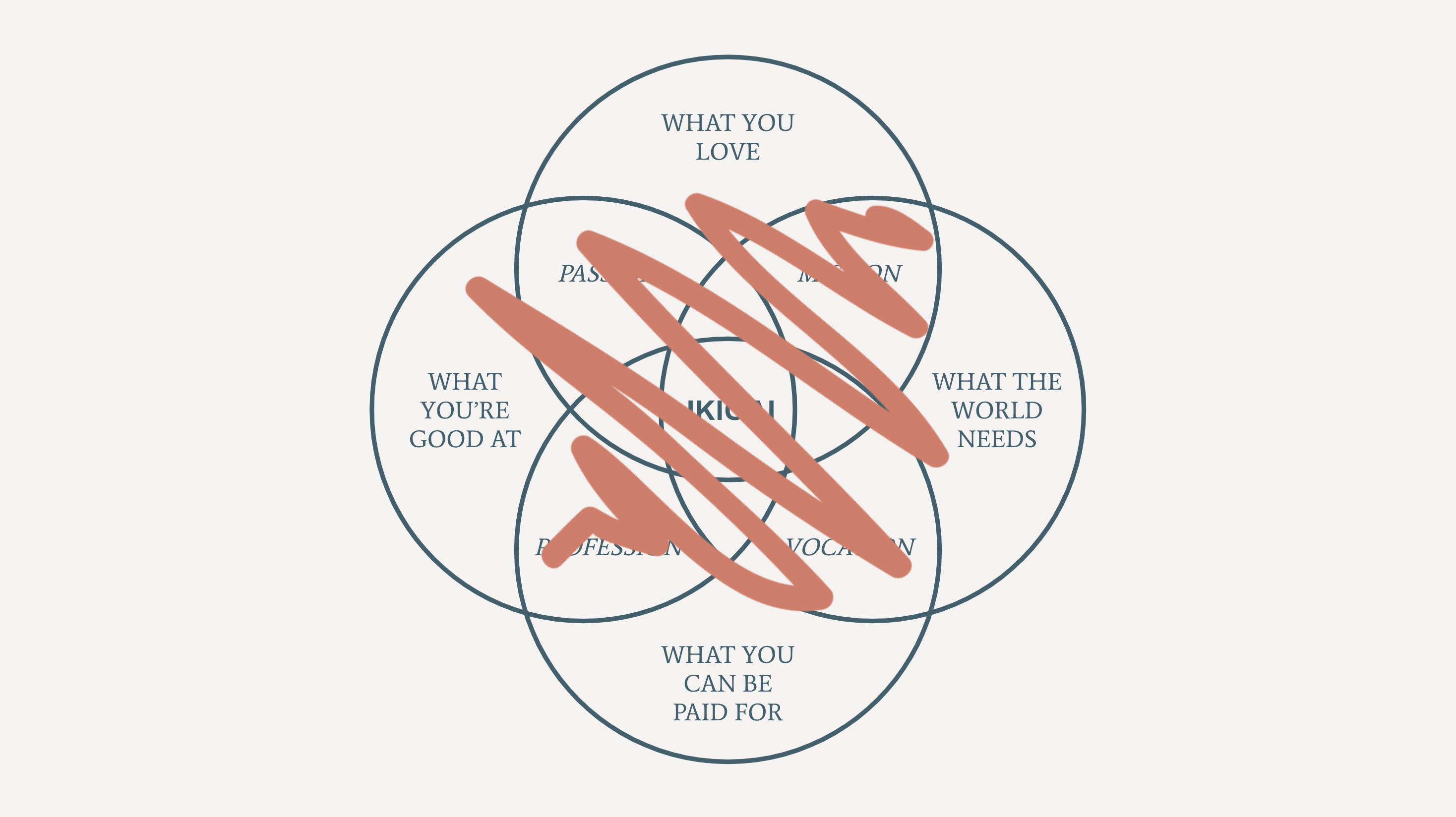
The concept of ikigai has often been misunderstood in the Western world largely due to the popularity of a certain Venn diagram. But ikigai means something different.
What is Ikigai? Ikigai Misunderstood and the Origin of the Ikigai Venn Diagram
What is ikigai? It goes beyond a the popular viral Western Venn diagram and cliché notions of happiness and longevity.
WRKSHP.tools | Ikigai Canvas
The Ikigai exercise can help you to define your personal perspective, by asking yourself four key questions.
Is this Japanese concept the secret to a long, happy, meaningful life? | World Economic Forum
Finding your everyday reason for living, or ikigai, could lead to a longer and better life.

Why everything you know about happiness is wrong...
Entrepreneur and author, Rolf Dobelli believes that everything we have been told about happiness is wrong. He says that we should embrace being insignificant and avoid being authentic.

AI and Epistemics: The Good, Bad and Ugly
AI could transform how we collectively figure out what's true. Forethought maps out the good, bad, and ugly of AI's potential impact on societal epistemics.
The Alterhuman Dictionary
the term 'alterhuman' has recently been replaced with 'kin', and therefore erased large preexisting communities. this carrd intends to help correct misinformation and spread a better understanding of what it means to be under the alterhuman umbrella

"I've got an idea!" On pluralism and resisting deskilling
A ramble around plural knowledges, data and AI, inspired by the wisdom from friends and colleagues in Nairobi and watching The Pitt. Plus! a random picture of an elephant

We've made the world too complicated
https://upload.wikimedia.org/wikipedia/commons/d/d0/WildJungle%2842249210%29.jpeg We've made the world too complicated. I'm writing this with technology I...

We speak often of AI as if it were a future event. But it is already here in the fabric of our being. What Karl Ove Knausgaard captures with devastating clarity in his recent essay ‘The Reenchanted… | Kenneth Mikkelsen | 19 comments
We speak often of AI as if it were a future event. But it is already here in the fabric of our being. What Karl Ove Knausgaard captures with devastating clarity in his recent essay ‘The Reenchanted World’ is the departure of the real. “We live in a virtual world, as if the world had been lifted out of itself, into the air, like a giant roof suspended above the ground,” he writes. It is an existential condition. Across philosophy, from Heidegger to Baudrillard, from Don DeLillo to Debord, a singular thread weaves: the world, once our shelter from the self, has become self-referential. Where once we encountered beings in our Zuhandensein—ready-to-hand, intimate, meaningful—we now face a procession of Vorhandensein: inert, objectified, mediated. Simulation replaces encounter. Perception is swallowed by spectacle. And the digital era, in Knausgaard’s terms, “distances culture from the body”. “It is not just the body that disappears—it is the awareness that we are dying,” he writes. What we face is not merely technological change, but what I would call existential dissonance: the erosion of resonance between our inner world, our social world, and the material world. It is the tension that arises when the way one lives, acts, and relates is misaligned with one’s deeper sense of meaning, reality, and value. It manifests itself as a disturbance in being — an unease that is not merely emotional, but rooted in a felt gap between one’s existence as it is and as it could or should be. It is the voice of the self calling from within the noise of the world. This is why Knausgaard’s essay matters for anyone working in, with, or around AI. Because the question isn’t: What can these systems do? It is: What do they undo? “We can explain everything. But we understand nothing,” he writes. Manipulated constructions of truth, in such a time, becomes a currency. As shown in recent events—from Francesca Gino’s research fraud at Harvard to Bezos’ all-female crew venture into space, and Trump’s detention camp —truth is no longer that which corresponds with reality, but that which performs and sells. As Baudrillard warned, the simulation no longer hides the real—it becomes it. And yet, something remains. Knausgaard writes not to despair, but to stay. In the body. In death. In silence. In the concrete. If you seek to understand what is happening—not just in AI, but in the very metaphysics of modern life—I suggest we begin not with data, but with dissonance. With the feeling that something vital is slipping from view, and that “being in the world” now requires resistance. “We are surrounded by mystery. And yet we act as if everything were known,” he writes. AI will never understand this. But we must. Knausgaard’s full essay from Harper’s Magazine can be read via link in comments. | 19 comments on LinkedIn

Sᴜɴʀɪsᴇ Oᴀᴛʜ 十 Tʜᴇ Sʏʟʟᴀʙᴜꜱ (ORI) - CC0 on Twitter / X
Discernment of variation depends on understanding of invariants. How do you know that "saying the right thing" will not cause the Earth to explode? How do you know that "building a better world" will not destroy everything and everyone you love?— Sᴜɴʀɪsᴇ Oᴀᴛʜ 十 Tʜᴇ Sʏʟʟᴀʙᴜꜱ (ORI) - CC0 (@sunriseoath) July 20, 2026
The Illusion of Asymmetric Insight
The Misconception: You celebrate diversity and respect others’ points of view. The Truth: You are driven to create and form groups and then believe others are wrong just because they are oth…

Misarticulation: Why We Sometimes Feel Our Words Don’t Match Our Thoughts
People do not always say what they mean. In everyday conversations, people regularly sense that they have not fully communicated what they had in mind—a subject

Words for our Present Reality - Strange Matters
We need a new kind of thinking. It would involve a break from the absolutism with which we dress up our systems of thought. It would demand that we bring different communities of thinkers together – especially those who have been left on the margins – and get them talking to each other so that we can inch closer to a shared language and a usable history.
z428: status /
💻 7am and on a second mug of coffee and still trying to gain some speed; there's blue sky and sun in the grey today and maybe that's a good thing to old on tight to. (Also, still keeping a lot of input out of ones channels. Wondering how certain terms seem to have totally different meanings in different domains. Like: Learnings - seen in a technical, scientific context, or seen in a machine context, or, completely off that line, seen in a political context. No easy moods.)
A Philosopher’s One-Word Theory to Explain Why the World Feels So Weird
Once you learn what the "uni-context" is, you won't stop seeing it everywhere
AI FOR EPISTEMICS & COORDINATION
Civilization and technology have radically improved the human condition. Nonetheless, the world sometimes goes in directions which essentially nobody would prefer — e.g., nuclear arms races, unexpected financial crashes, predatory marketing, or ubiquitous political misinformation.