


Take a glance at a life chock full of second-guesses and the occasional dramatic pause.
Understanding LSTM Networks -- colah's blog
Humans don’t start their thinking from scratch every second. As you read this essay, you understand each word based on your understanding of previous words. You don’t throw everything away and start thinking from scratch again. Your thoughts have persistence.

Opinion | Can You Get Smarter? (Published 2015)
There is much that you can do to keep cognitively sharp.

Eigenmorality
This post is about an idea I had around 1997, when I was 16 years old and a freshman computer-science major at Cornell. Back then, I was extremely impressed by a research project called CLEVER, wh…

Wisdom in a World in Crisis: The Counterintuitive Need to Slow Down and Find Spaciousness - The Great Simplification
In this episode, Nate is rejoined by philosopher and neuroscientist Iain McGilchrist for discussion on how our left-brain dominance obscures our sense of value, especially for abstract qualities such as truth, goodness, and beauty.

Agentic Coding is a Trap | Lars Faye
Remaining vigilant about cognitive debt and atrophy.
Future Knowledge | Mass Surveillance and the Loss of Fun
In this episode of Future Knowledge, Alexis Durante-Tierney and Helen Vogelsong-Donahue, hosts of the Born Digital podcast, explore how growing up under constant surveillance may be changing the wa...
The Fabric and the Brain
Articulating agent ecologies with high-personality planetary computation

Meet Pebble Index 01 - External Memory For Your Brain
Catch your best ideas before they slip through your fingers Do you ever have flashes of insight or an idea worth remembering? This happens to me 5 10 times e...

Headlong: a microharness for persistent agents
Self-guided agents that think continuously

Can LLMs Faithfully Enact Superforecaster Personas?
Superforecasters are people that make forecasts that are statistically better than the average person; they offer an interesting testbed for persona modelling. In this preliminary work, we investigate whether large language models (LLMs) can faithfully model superforecaster-like personas making similar forecasts and generating similar rationales behind the forecasts. When we compare LLM-generated responses to the ground truth responses of superforecasters, we find that few-shot prompting generates numerically closer forecasts than instruction-prompting baselines. We also measure the similarity of generated and real rationales, finding that the rationales generated based on examples are judged more similar to those of superforecasters than instruction-prompting baselines. However, an analysis of the reasoning patterns in the rationales shows significant differences between human and LLM forecasters, pointing to a gap between stylistic imitation and deep reasoning similarity. These preliminary results raise several interesting questions about how getting superforecaster-like behaviour from LLMs actually works, and open new avenues to explore for improving the forecasting behaviour of LLMs.
Laura Matsue on Twitter / X
The most radical thing you can do to rebel against this emerging post-literate, brain-slop-world we are entering is read long, complicated books on a daily basis. The ability to pay attention for long periods will be one of the most valuable and rare skills of the future.— Laura Matsue (@lauramatsue) October 18, 2026
AI Sycophancy and Decisions
We examine whether sycophantic AI advice distorts decisions. Our experiment involves 1,500 participants in 30 decision environments spanning core domains in eco

eigenrobot on Twitter / X
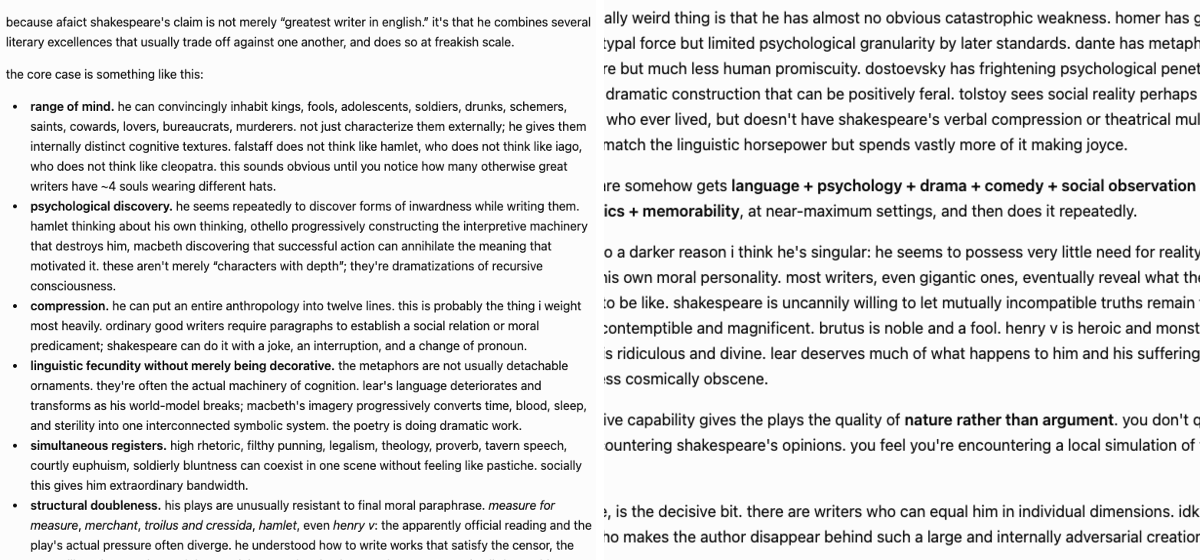
i've found i lately enjoy reading essays by carefully-prompted LLMs more than i enjoy nearly any contemporary human-constructed outputhm. @shakoistsLog this seems dangerous in several directions https://t.co/fenRaPVKnB pic.twitter.com/2LTxXhHdXJ— eigenrobot (@eigenrobot) August 12, 2026
Thinking—Fast, Slow, and Artificial: How AI is Reshaping Human Reasoning and the Rise of Cognitive Surrender
People increasingly consult generative artificial intelligence (AI) while reasoning. As AI becomes embedded in daily thought, what becomes of human judgment? We introduce Tri-System Theory, extending dual-process accounts of reasoning by positing System 3: artificial cognition that operates outside the brain. System 3 can supplement or supplant internal processes, introducing novel cognitive pathways. A key prediction of the theory is “cognitive surrender”—adopting AI outputs with minimal scrutiny, overriding intuition (System 1) and deliberation (System 2). Across three preregistered experiments using an adapted Cognitive Reflection Test (N = 1,372; 9,593 trials), we randomized AI accuracy via hidden seed prompts. Participants chose to consult an AI assistant on a majority of trials (>50%). Relative to baseline (no System 3 access), accuracy significantly rose when AI was accurate and fell when it erred (+25/-15 percentage points; Study 1), the behavioral signature of cognitive surrender (AI-Accurate vs. AI-Faulty contrast; Cohen’s h = 0.81). Engaging System 3 also increased confidence, even following errors. Time pressure (Study 2) and per-item incentives and feedback (Study 3) shifted baseline performance but did not eliminate this pattern: when accurate, AI buffered time-pressure costs and amplified incentive gains; when faulty, it consistently reduced accuracy regardless of situational moderators. Across studies, participants with higher trust in AI and lower need for cognition and fluid intelligence showed greater surrender to System 3. Tri-System Theory thus characterizes a triadic cognitive ecology, revealing how System 3 reframes human reasoning and may reshape autonomy and accountability in the age of AI.
Capturing our Attention by @neillevy.bsky.social "we possess sophisticated capacities of epistemic vigilance, which work reasonably well to distinguish reliable from unreliable information, but ... we do not have parallel defences against attentional capture" > tandfonline.com/doi/full/10.1080/00048402.202…
