

Global Multistakeholder Meeting on the Future of Internet Governance
Internet Governance Forum (IGF)
The IGF is a global multistakeholder platform that facilitates the discussion of public policy issues pertaining to the Internet
The Internet Transition
The Internet is allowing us to build a richer, more complex society but the way in which we Internet today is failing to support the governance systems that a more complex world requires. I take a look at why these issues are related, try to develop an intuition for a way forward, and point at the emerging field that is coming together to build that future.

Opinion | Mark Zuckerberg: The Internet needs new rules. Let’s start in these four areas.
We need a more active role for governments and regulators.

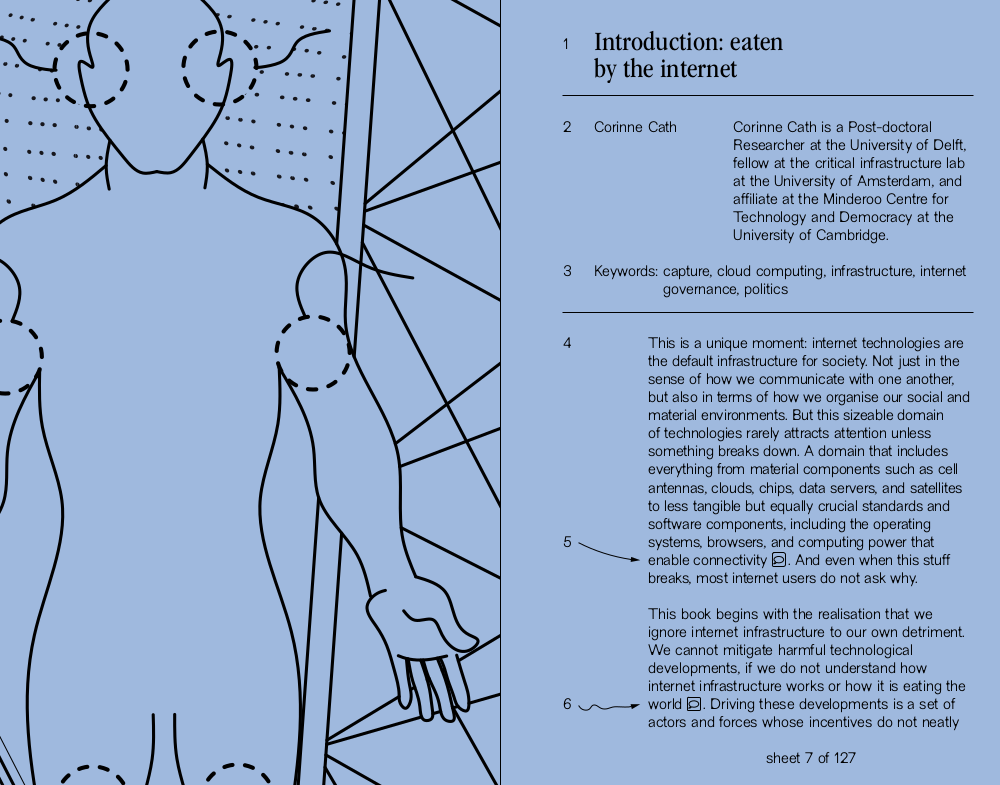
Eaten by the Internet
This book makes internet infrastructure visible as a force of political power, which is transforming the social world, from the bottom up—through fifteen chapters contributed by a global set of researchers, activists, and techies. We are living a unique moment: internet technologies are the default infrastructure for society, not just how we communicate but also how we organise our social life, politics, and economy, all the way down to our material environments, like cities. Our world is eaten by the internet. This means that those who control the internet control the bounds of public speech, economic production, social cohesion, and politics, making its infrastructure a core political terrain in the networked age. The book’s chapters cover a wide set of topics, spanning from the global politics of content moderation by internet infrastructure to the colonialism inherent in the race to plug the moon, from the harms wrought by blockchain companies in rural America to the particularities of online censorship across Asia. The chapters take on thorny topics, discussing power consolidation in the advertisement and cloud industry, the role of internet infrastructure in the war in Ukraine, and tech’s environmental impact—amongst others. In doing so, this book roots contemporary technology debates in the politics of internet infrastructure and urges us to ask how can we ensure our infrastructures sustain us, rather than consume us?
Modular Politics: Toward a Governance Layer for Online Communities
Governance in online communities is an increasingly high-stakes challenge, and yet many basic features of offline governance legacies--juries, political parties, term limits, and formal debates, to name a few--are not in the feature-sets of the software most community platforms use. Drawing on the paradigm of Institutional Analysis and Development, this paper proposes a strategy for addressing this lapse by specifying basic features of a generalizable paradigm for online governance called Modular Politics. Whereas classical governance typologies tend to present a choice among wholesale ideologies, such as democracy or oligarchy, Modular Politics would enable platform operators and their users to build bottom-up governance processes from computational components that are modular and composable, highly versatile in their expressiveness, portable from one context to another, and interoperable across platforms. This kind of approach could implement pre-digital governance systems as well as accelerate innovation in uniquely digital techniques. As diverse communities share and connect their components and data, governance could occur through a ubiquitous network layer. To that end, this paper proposes the development of an open standard for networked governance.

The Yak Online Governance Primer :: The Yak Collective
How do you do online governance? This primer is intended as a guided tour through a curated set of readings — based on a year of study by the Yak Collective1 — that can help groups and organizations navigate this question.
Stuck in the middleware with you: the challenges of capitalizing a market-oriented approach to platform governance
T1 - Stuck in the middleware with you: the challenges of capitalizing a market-oriented approach to platform governance
Centralization, Decentralization, and Internet Standards
This document discusses aspects of centralization that relate to Internet standards efforts. It argues that, while standards bodies have a limited ability to prevent many forms of centralization, they can still make contributions that assist in the decentralization of the Internet.
The web can be weaponised – and we can't count on big tech to stop it | Tim Berners-Lee
It’s dangerous having a handful of companies control how ideas and opinions are shared. A regulator may be needed

\x5bSIG\x5d Data Governance: Data Organisation
Data Organisation Foundational Structures of Asset Governance Key Value Pairs 3 infrastructure Git Wiki Service management Ben Koo, Tim Bansemer, Jared Cordon May 25, 2021 HDX Thread 5: ICT Awareness and Competency in Data Governance

Centralization, Decentralization, and Internet Standards
Despite being designed and operated as a decentralized network-of- networks, the Internet is continuously subjected to forces that encourage centralization. This document offers a definition of centralization, explains why it is undesirable, identifies different types of it, catalogues limitations of common approaches to decentralization, and explores what Internet standards efforts can do to address it.
Findings Report: Governance on Fediverse Microblogging Servers
Research report on Fediverse microblogging server governance: risks and mitigations, moderation, server leadership, federated diplomacy, and governance tooling.

Protocol: How Control Exists after Decentralization
How Control Exists after DecentralizationIs the Internet a vast arena of unrestricted communication and freely exchanged information or a regulated, highly

Intro_to_Awareness_and_Competency_in_Data_Governance
Thread 5 Introduction: ICT Awareness & Competency in Data Governance https://www.aliexpress.com/item/33004770035.html 1 May 4, 2021 Moore’s Law Prepared by: Ken Lazarus Ben Koo

people and governance
researching power and contestation in transnational media infrastructures