

I wrote this book between 2011 and 2015. At the time, I expected AGI systems based on neural networks to be many decades away, but to bring remarkable benefits for humanity. I also expected significant challenges, but believed it likely that, as with other technologies, those challenges would be addressed as the capabilities were developed.
Three Observations
Our mission is to ensure that AGI (Artificial General Intelligence) benefits all of humanity. Systems that start to point to AGI* are coming into view, and so we think it’s important to...
Toward AGI — What is Missing?
Artificial General Intelligence (AGI) is a term for Artificial Intelligence systems that meet or exceed human performance on the broad…

DeepMind Institute
Bold, well-evidenced thinking on AGI from the lab that pioneered the field. Read the latest essays from the DeepMind Institute.

Planning for AGI and beyond
Our mission is to ensure that artificial general intelligence—AI systems that are generally smarter than humans—benefits all of humanity.


Meredith Whittaker (@Mer__edith@mastodon.world)
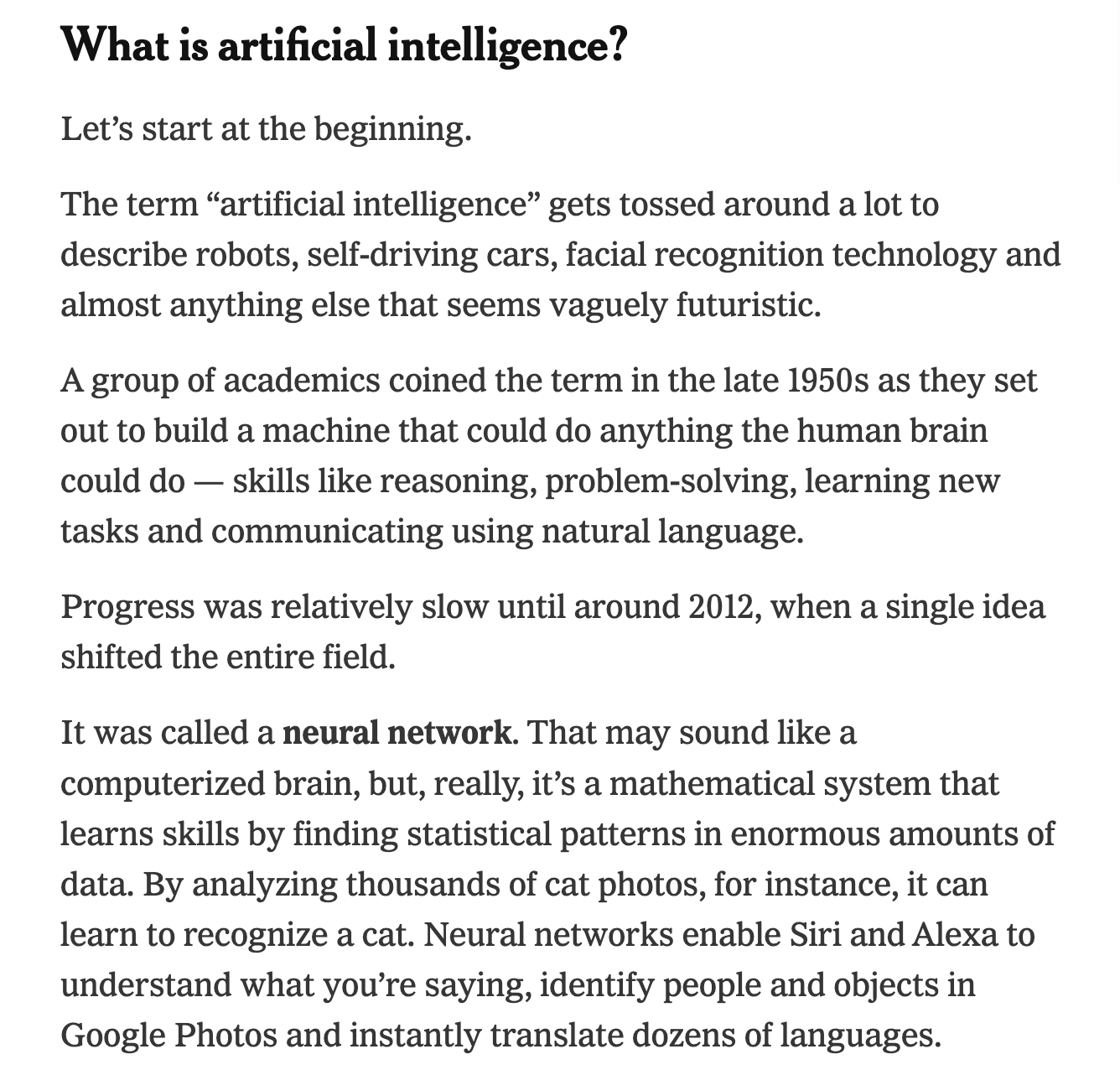
Attached: 1 image NYT "AI" explainer misleads. Deep learning techniques date from the 1980s, & "AI" had been hot/cold for decades, not slow until 2012. There was no new "single idea" in 2012. What WAS new, & propelled the AI boom, was concentrated resources (data/compute) controlled by tech cos.
Human Life in a Post-AGI World - Google DeepMind Talk
Tyler Cowen at Google DeepMind on life after AGI: rebuilding every institution, the rise of "AI maniacs," and why the future will be drenched in meaning.

AI Isn't as Powerful as We Think | Hannah Fry
Why tech is racing to adopt AI coding
The head of AI coding platform Cursor on what’s next for programming, whether AGI is imminent, and competing with Anthropic and OpernAI.

How AGI Made the Future Unthinkable
Advanced artificial intelligence will change everything, we are told. Do we get a say?
From AGI to ASI
Over the last decade, building human-level artificial general intelligence has moved from far-fetched speculation to being a concrete next-decade target for many of the largest AI organisations. Achieving this goal would have profound and far-reaching impacts on human society, which raises many complex questions for the decade ahead. This report investigates how AI itself might continue to develop in a post-AGI world along the continuum of machine intelligence. The endpoint of this continuum, Universal AI, is theoretically well understood, which provides some formal grounding for the main focus of this report: the transition from human-level AGI to artificial general superintelligence, which can intuitively be understood as a system that is more intelligent and cognitively capable than large organisations of humans. After characterizing ASI, the report discusses four potential pathways from AGI to ASI: scaling AGI, AI paradigm shifts, recursive improvement, and ASI emerging from large-scale multi-agent collectives. The report then discusses possible frictions and bottlenecks along these pathways. Determining whether the impact of these frictions will be negligible or substantial raises a number of concrete open research questions. Due to large uncertainties for predicting ASI progress, it cannot be ruled out that AI progress might continue to accelerate over the next years. This could imply that the image of a single transformative step change, caused by the introduction of human-level AGI into our society, could be inaccurate. More apt might be the prospect of a series of transformative societal changes caused by AI-enabled progress and breakthroughs across many areas of science and technology. Preparing for this prospect requires a massively interdisciplinary endeavour of global scope and interest.

The Era of Experience & The Age of Design: Richard S. Sutton, Upper Bound 2025
II. From AGI to Superintelligence: the Intelligence Explosion - SITUATIONAL AWARENESS
AI progress won’t stop at human-level. Hundreds of millions of AGIs could automate AI research, compressing a decade of algorithmic progress (5+ OOMs) into ≤1 year. We would rapidly go from human-level to vastly superhuman AI systems. The power—and the peril—of superintelligence would be dramatic. Let an ultraintelligent machine be defined as a machine that

IV. The Project - SITUATIONAL AWARENESS
As the race to AGI intensifies, the national security state will get involved. The USG will wake from its slumber, and by 27/28 we’ll get some form of government AGI project. No startup can handle superintelligence. Somewhere in a SCIF, the endgame will be on. "We must be curious to learn how such a set

From AGI to ASI
Over the last decade, building human-level artificial general intelligence has moved from far-fetched speculation to being a concrete next-decade target for many of the largest AI organisations. Achieving this goal would have profound and far-reaching impacts on human society, which raises many complex questions for the decade ahead. This report investigates how AI itself might continue to develop in a post-AGI world along the continuum of machine intelligence. The endpoint of this continuum, Universal AI, is theoretically well understood, which provides some formal grounding for the main focus of this report: the transition from human-level AGI to artificial general superintelligence, which, intuitively, can be understood as a system that is more intelligent and cognitively capable than large organisations of humans. After characterizing ASI, the report discusses four potential pathways from AGI to ASI: scaling AGI, AI paradigm shifts, recursive improvement, and ASI emerging from large-scale multi-agent collectives. The report then discusses possible frictions and bottlenecks along these pathways. Determining whether the impact of these frictions will be negligible or substantial raises a number of concrete open research questions. Due to large uncertainties for predicting ASI progress, it cannot be ruled out that AI progress might continue to accelerate over the next years. This could imply that the image of a single transformative step change, caused by the introduction of human-level AGI into our society, could be inaccurate. More apt might be the prospect of a series of transformative societal changes caused by AI-enabled progress and breakthroughs across many areas of science and technology. Preparing for this prospect requires a massively interdisciplinary endeavour of global scope and interest.