MIT researchers built a prototype social media platform to study the effects of giving users more agency to assess content for accuracy and control the posts they see based on accuracy assessments from others. Users were able to make accurate assessments, despite having no prior training, and they valued and utilized the assessment and filtering tools they designed.
Trust: Foundation of Human Knowledge yet online Platforms won't allow | David Karger | TEDxMIT Salon
How Social Media Rewards Misinformation
A majority of false stories are spread by a small number of frequent users, suggests a new study co-authored by Yale SOM’s Gizem Ceylan. But they can be taught to change their ways.

A perspective on friction interventions to curb the spread of misinformation
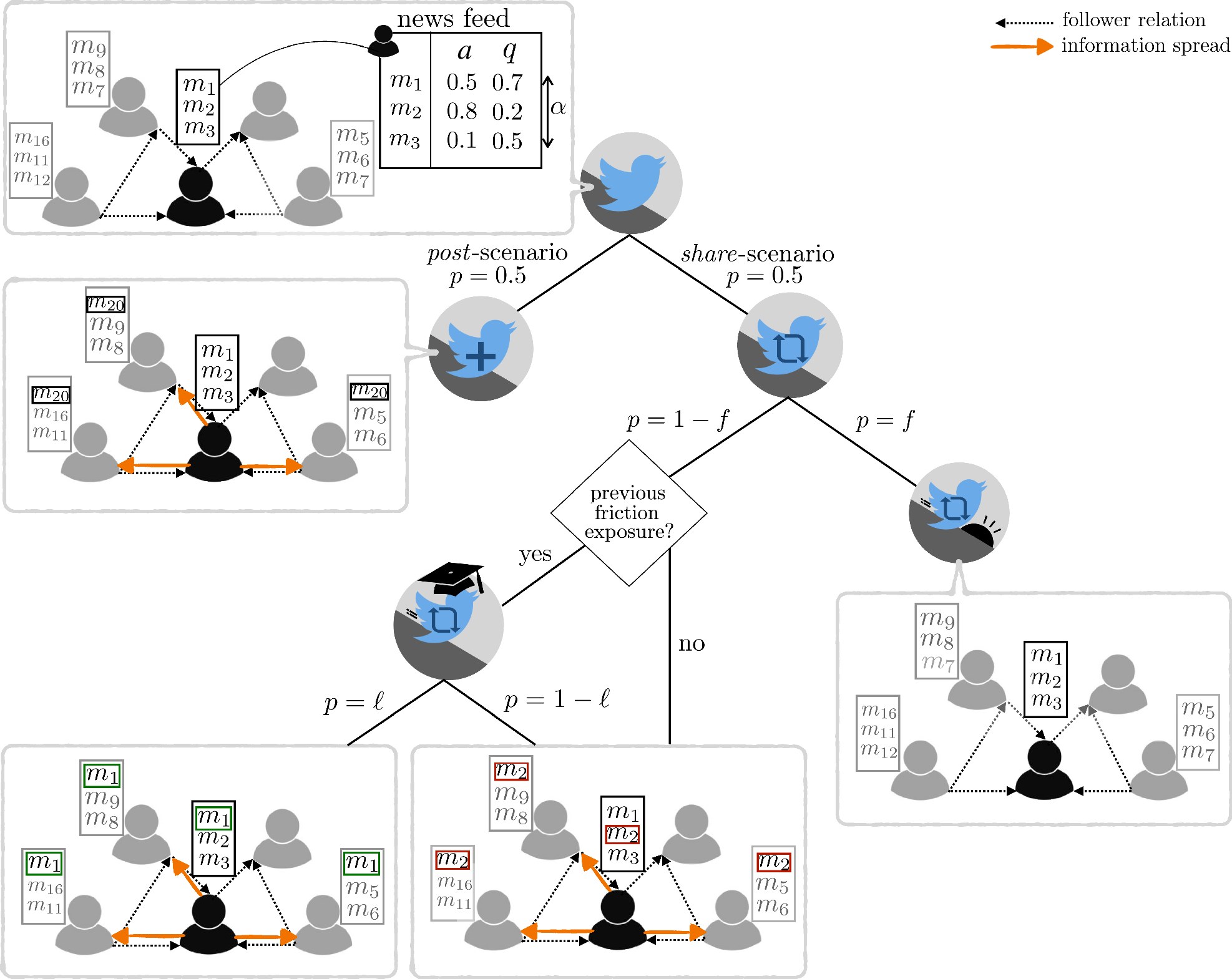
Social media has enabled the spread of information at unprecedented speeds and scales, and with it the proliferation of high-engagement, low-quality content. Friction—behavioral design measures that make the sharing of content more cumbersome—might be a way to raise the quality of what is spread online. In this perspective, we propose a scalable field experiment to study the effects of friction with a learning component to educate users on the platform’s community standards. Preliminary simulations from an agent-based model suggest that while friction alone may decrease the number of posts without improving their quality, it could significantly increase the average quality of posts when combined with learning. The model also suggests that too much friction could be counterproductive. Experimental interventions inspired by these findings would be minimally invasive.
Social media ‘trust’/’distrust’ buttons could reduce spread of misinformation | UCL News
The addition of ‘trust’ and ‘distrust’ buttons on social media, alongside standard ‘like’ buttons, could help to reduce the spread of misinformation, finds a new experimental study led by UCL researchers.

Beyond Misinformation: Social Media and the Sculpting of Epistemic Agency
ABSTRACT The dominant account of social media's epistemic harms focuses on the spread of misinformation and the production of false beliefs at scale. This paper argues that the misinformation narrative, whatever its merits, has obscured a deeper and more intimate form of epistemic damage. Dominant social media platforms do not merely supply bad inputs to stable epistemic machinery. They reshape the machinery itself. I argue that social media platforms are powerful engines for sculpting epistemic agency via two mechanisms: normative learning, through which users internalize descriptive and injunctive norms about how to interact with evidence, and reinforcement learning, through which habitual patterns of epistemic response are developed. In these ways, platforms can reshape users' epistemic styles, including their testimonial policies, evidential thresholds for belief revision, and theoretical values governing how they select explanations. This should trouble us, as the constraints driving which styles are produced are systematically orthogonal to truth and ignore information about the environments agents inhabit. This discussion identifies a neglected form of epistemic hostility: not the exploitation of existing cognitive vulnerabilities to implant false beliefs, but the production of new vulnerabilities that can then be exploited. From this, more and better evidence cannot save us.

Sharing of misinformation is habitual, not just lazy or biased
Why do people share misinformation on social media? In this research ( N = 2,476), we show that the structure of online sharing built into social platforms is more important than individual deficits in critical reasoning and partisan bias—commonly cited drivers of misinformation. Due to the reward-based learning systems on social media, users form habits of sharing information that attracts others' attention. Once habits form, information sharing is automatically activated by cues on the platform without users considering response outcomes such as spreading misinformation. As a result of user habits, 30 to 40% of the false news shared in our research was due to the 15% most habitual news sharers. Suggesting that sharing of false news is part of a broader response pattern established by social media platforms, habitual users also shared information that challenged their own political beliefs. Finally, we show that sharing of false news is not an inevitable consequence of user habits: Social media sites could be restructured to build habits to share accurate information.
Confronting Disinformation Spreaders on Twitter Only Makes It Worse, MIT Scientists Say - Slashdot
According to a new study conducted by researchers at MIT, being corrected online just makes the original posters more toxic and obnoxious. From a report: Basically, the new thinking is that correcting fake news, disinformation, and horrible tweets at all is bad and makes everything worse. This is a ...


Custodians of the Internet
A revealing and gripping investigation into how social media platforms police what we post online—and the large societal impact of these decisions Most use...
Sources on social media: Information context collapse and volume of content as predictors of source blindness - George Pearson, 2021
Although social media has become a primary news platform, the effects of social media features on users’ information processing remains under-explored. This stu...

Bonsai: Intentional and Personalized Social Media Feeds
Social media feeds use predictive models to maximize engagement, often misaligning how people consume content with how they wish to. We introduce Bonsai, a system that enables people to build personalized and intentional feeds. Bonsai implements a platform-agnostic framework comprising Planning, Sourcing, Curating, and Ranking modules. This framework allows users to express their intent in natural language and exert fine-grained control over a procedurally transparent feed creation process. We evaluated the system with 15 Bluesky users in a two-phase, multi-week study. We find that participants successfully used our system to discover new content, filter out irrelevant or toxic posts, and disentangle engagement from intent, but curating intentional feeds required more effort than they are used to. Simultaneously, users sought system transparency mechanisms to effectively use (and trust) intentional, personalized feeds. Overall, our work highlights intentional feedbuilding as a viable path beyond engagement-based optimization.

How cognitive elaboration fosters knowledge acquisition on social media—a field experiment
Abstract. Social media technologies have been criticized as ineffective sources of information because users seem to increase their subjective but not thei
Social Media Is Now Parasocial Media
When practitioners used the term “social media” to describe the internet tools that emerged in the mid-aughts, they were giving a name to the kinds of platforms and protocols that allowed people to socialize with friends and communities of interest by using digital technologies. Twenty years later, users of social media are far more likely to scroll than post – and the content that they consume is often strategically produced and algorithmically curated. In this essay, I argue that the very essence of social media has changed. To more effectively interrogate what we are witnessing, we need to stop presuming that these tools are “social media” and begin recognizing that they are now “parasocial media.” Doing so raises new questions about digitally mediated sociality, not to mention the politics and governance of these platforms.
AI Fact-Checking in the Wild: A Field Evaluation of LLM-Written Community Notes on X
Large language models (LLMs) show promising capabilities for fact-checking, yet prior work evaluates them only in controlled offline settings using benchmarks or crowdworker judgments. Success in real-world fact-checking depends also on how content is judged within a live platform environment. We present the first field evaluation of LLM fact-checking deployed on a live social media platform, testing performance directly through X Community Notes’ “AI writer” feature over a three-month period. Our LLM writer, a multi-step pipeline that handles multimodal content, conducts web and platform-native search, and writes contextual notes, was deployed to write 1,614 notes on 1,597 tweets and compared against 1,332 human-written notes on the same tweets using 108,169 ratings from 42,521 raters. Direct comparison of note-level platform outcomes is complicated by differences in submission timing and exposure between LLM and human notes; we therefore pursue two analysis strategies: a rating-level analysis modeling individual rater evaluations, and a note-level analysis that relies on common raters who rated all notes on the same post. Rating-level analysis shows that LLM notes receive more positive ratings than human notes across raters with different political viewpoints, and note-level analysis shows LLM notes achieve significantly higher helpfulness scores among common raters. Rater-provided tags suggest that people consider LLM notes to use more neutral language and cite better sources. These findings provide field evidence that LLMs can contribute broadly helpful fact-checking notes at scale, while showing that their evaluation is shaped by platform dynamics absent from controlled offline settings.
Building Epistemically Healthier Platforms
When thinking about designing social media platforms, we often focus on factors such as usability, functionality, aesthetics, ethics, and so forth. Epistemic considerations have rarely been given the same level of attention in design discussions. This paper aims to rectify this neglect. We begin by arguing that there are epistemic norms that govern environments, including social media environments. Next, we provide a framework for applying these norms to the question of platform design. We then apply this framework to the real-world case of long-form informational content platforms. We argue that many current long-form informational content platforms are epistemically unhealthy. The good news? We provide concrete advice on how to take steps toward improving their health! Specifically, we argue that they should change how they verify and authenticate content creators and how this information is displayed to content consumers. We conclude by connecting this guidance to broader issues about the epistemic health of platforms.