

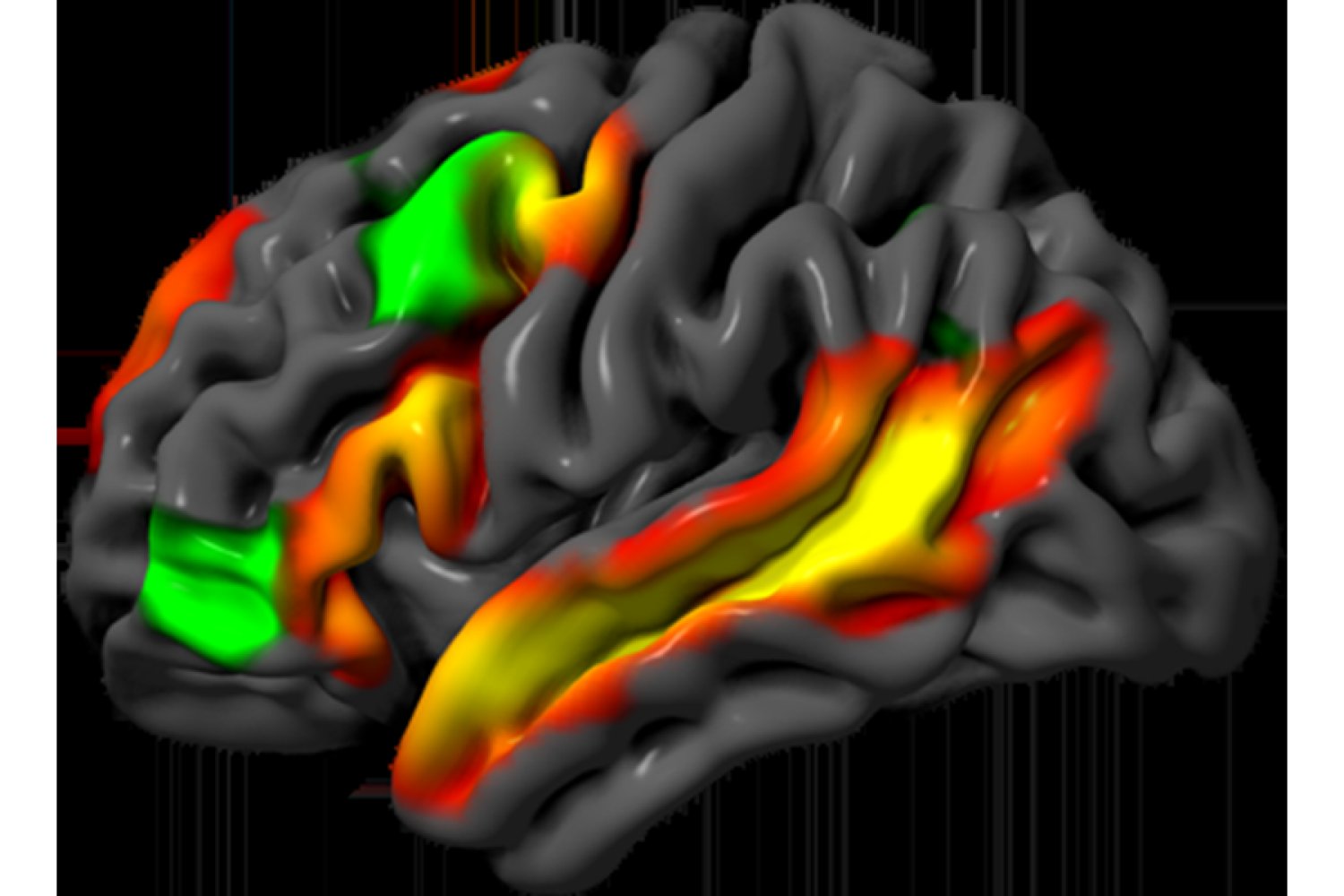
Language isn’t necessary for logical reasoning, cognitive neuroscientists at MIT’s McGovern Institute find. Evelina Fedorenko and Hope Kean discovered people can perform well on tasks that require logical reasoning even if their language abilities are severely impaired.
Sense-making reconsidered: large language models and the blind spot of embodied cognition
Large Language Models (LLMs) demonstrate a kind of linguistic competence that theories of embodied and enactive cognition have long deemed impossible for systems lacking the meaningful perspective of a living being, i.e., the capacity for sense-making. Facing up to this unexpected technological development requires confronting what I propose to call the “AI dilemma”: either frontier LLMs are capable of sense-making despite lacking biological embodiment, or the kind of linguistic competence they exhibit does not necessarily require sense-making. In their chapter on cognition, Frank, Thompson, and Gleiser (2024) maintain that no AI system comes close to realizing relevance, a position that derives much of its motivation from past practical failures. However, frontier LLMs have effectively overcome Dreyfus’ commonsense knowledge problem, such that their dismissal as categorically mindless risks undermining Frank et al.’s central claim that human cognition is deeply intertwined with lived experience. I therefore argue in favor of the alternative side of the AI dilemma: human-level linguistic competence of LLMs should be recognized as a novel non‑biological form of sense‑making, based on a technologically‑mediated embodiment whose enabling properties are in need of further theoretical analysis. This reorientation invites enactive theory to clarify which aspects of sense-making may be universal and which aspects are specifically contingent on organic life, thereby advancing its conceptual framework in dialogue with contemporary AI.
You Don’t Need Words to Think
Brain studies show that language is not essential for the cognitive processes that underlie thought

On the Paradox of Learning to Reason from Data
Logical reasoning is needed in a wide range of NLP tasks. Can a BERT model be trained end-to-end to solve logical reasoning problems presented in natural language? We attempt to answer this...

AI That Evolves in the Wild | Edge.org
I’m interested not in domesticated AI—the stuff that people are trying to sell. I'm interested in wild AI—AI that evolves in the wild. I’m a naturalist, so that’s the interesting thing to me. Thirty-four years ago there was a meeting just like this in which Stanislaw Ulam said to everybody in the room—they’re all mathematicians—"What makes you so sure that mathematical logic corresponds to the way we think?" It’s a higher-level symptom. It’s not how the brain works. All those guys knew fully well that the brain was not fundamentally logical.
The Philosophy of Language Models
ABSTRACT The success of large language models (LLMs) across many domains of AI research has generated intense debate. Some attribute their impressive performance on complex tasks to human‐like linguistic and cognitive capacities, whereas others ascribe it to shallow pattern matching. These disputes stem from deep‐seated philosophical disagreements about the nature of language and cognition. We provide an opinionated survey of these disagreements across core topics in the philosophy of mind and language, including syntactic competence, compositionality, linguistic meaning, representation, attitudes, reasoning, agency, and consciousness. We contend that progress on these issues requires not only clarity about background philosophical commitments but also, in many cases, close engagement with emerging empirical evidence.


The Illusion of Thinking: Understanding the Strengths and Limitations of Reasoning Models via the Lens of Problem Complexity
Recent generations of frontier language models have introduced Large Reasoning Models (LRMs) that generate detailed thinking processes…

Exploring the interplay between AI and human logic in mathematical problem-solving
This paper investigates the dynamic interplay between Artificial Intelligence (AI) and human logic in the domain of mathematical problem-solving. By critically examining a series of case studies, we compare the efficacy of AI-generated solutions, particularly those offered by ChatGPT, against traditional human problem-solving methods. The study employs various mathematical challenges, ranging from abstract logical puzzles to applied numerical problems, to evaluate AI's problem-solving approach and alignment with human cognitive processes. Our analysis highlights instances where AI's computational strategies complement or diverge from human reasoning, shedding light on AI's potential and limitations in deciphering mathematical problems. Furthermore, we explore the implications of integrating AI tools in educational contexts, specifically their role in enhancing students' mathematical problem-solving skills. The paper aims to contribute to the ongoing discourse on the optimal utilization of AI in education, proposing a balanced approach that leverages AI's computational power while fostering the depth and creativity of human logic. Through this comparative study, we advocate for a collaborative model where AI and human reasoning merge to enrich the educational landscape, particularly in the teaching and learning of mathematics.

Thinking—Fast, Slow, and Artificial: How AI is Reshaping Human Reasoning and the Rise of Cognitive Surrender
People increasingly consult generative artificial intelligence (AI) while reasoning. As AI becomes embedded in daily thought, what becomes of human judgment? We

Are We Thinking Correctly About AI Intelligence? | Quanta Magazine
Computer scientist Melanie Mitchell discusses why artificial intelligence doesn’t “think” or “reason” like humans, and how we can create better methods for measuring machine cognition.

No, Artificial Intelligence Is Not Conscious
Taken to its logical conclusion, this line of thinking is absurd—and damning.

We Don't Understand Neural Networks At The Algorithmic Level
The largest ongoing debate about AI is “Are Large Language Models (LLMs) intelligent?” That makes sense, at least: the evidence is ambiguous and the stakes a...
Can generative artificial intelligence be considered a cognitive subject? An analytic analysis
This paper examines whether contemporary generative artificial intelligence (GAI), especially large language models (LLMs), can be regarded as a “cognitive subject” in the epistemic sense relevant to the production and endorsement of knowledge claims. GAI systems increasingly participate in writing, research, and decision-making workflows and can display striking competence in information processing and task-directed problem solving. Yet, the thesis that GAI is a cognitive subject is stronger than the observation that GAI contributes as a cognitive tool. Therefore, we propose an explicit set of necessary and sufficient conditions for cognitive subjecthood and evaluate each condition in light of recent philosophical and empirical scholarship. The analysis supports a two-part conclusion: (i) present-day GAI can reasonably be described as a cognitively significant contributor to knowledge production, but (ii) it does not satisfy the conditions for cognitive subjecthood, largely because robust intentionality, metacognitive self-representation, and consciousness-related indicator properties are not established.
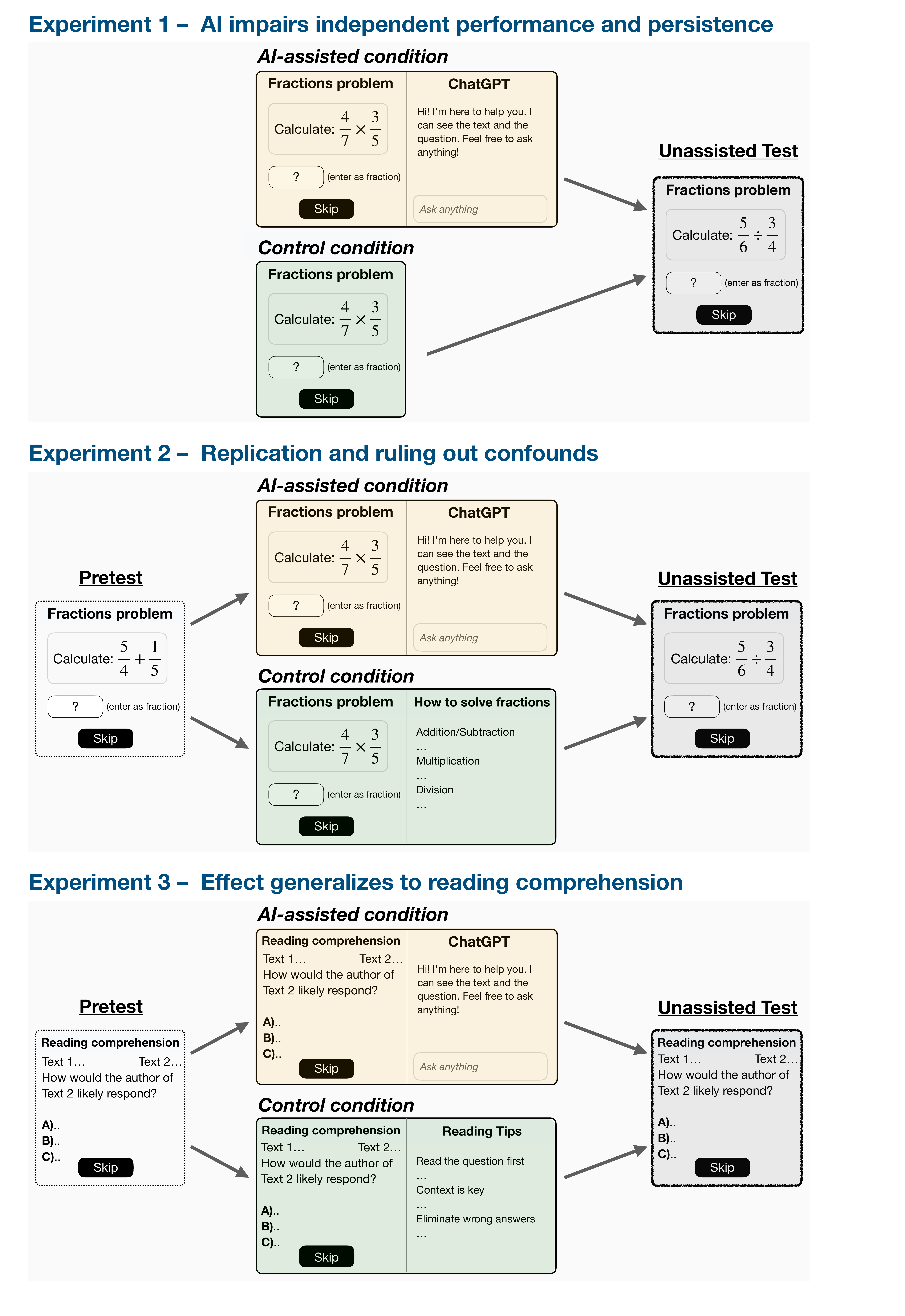
AI Assistance Reduces Persistence and Hurts Independent Performance
Causal evidence that AI assistance reduces persistence and impairs unassisted performance across math reasoning and reading comprehension tasks.
The Triadic Mind: How Language Reveals the Limits of Human Cognition
Languages are the most complex symbolic systems humans have ever created. Yet children acquire them effortlessly, without formal…

AI makes you smarter but none the wiser: The disconnect between performance and metacognition
Optimizing human–AI interaction requires users to reflect on their performance critically, yet little is known about generative AI systems’ effect on users’ metacognitive judgments. In two large-scale studies, we investigate how AI usage is associated with users’ metacognitive monitoring and performance in logical reasoning tasks. Specifically, our paper examines whether people using AI to complete tasks can accurately monitor how well they perform. In Study 1, participants (N = 246) used AI to solve 20 logical reasoning problems from the Law School Admission Test. While their task performance improved by three points compared to a norm population, participants overestimated their task performance by four points. Interestingly, higher AI literacy correlated with lower metacognitive accuracy, suggesting that those with more technical knowledge of AI were more confident but less precise in judging their own performance. Using a computational model, we explored individual differences in metacognitive accuracy and found that the Dunning–Kruger effect, usually observed in this task, ceased to exist with AI use. Study 2 (N = 452) replicates these findings. We discuss how AI levels cognitive and metacognitive performance in human–AI interaction and consider the consequences of performance overestimation for designing interactive AI systems that foster accurate self-monitoring, avoid overreliance, and enhance cognitive performance.