

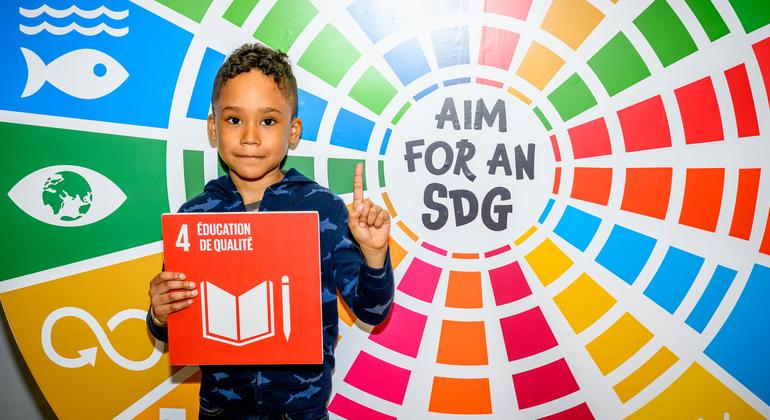
The world is “woefully off track” to achieve the Sustainable Development Goals (SDGs) by the 2030 deadline, top United Nations officials said on Monday, as ministers and policy makers gathered in New York to examine how countries can get back on track and make the transformative development agenda a reality.
Sustainable Development Goals
The 2030 Agenda for Sustainable Development was adopted by all United Nations Member States in 2015. It is built around 17 Sustainable Development Goals (SDGs) and 169 targets that represent an ambitious plan for achieving sustainable development and serves as the basis for countries to shape their national policies and priorities. At the heart of the agenda is the recognition that truely sustainable development must combine economic growth and poverty alleviation with strategies that improve health and education, reduce inequality, while addressing climate change and protecting nature. Thus, the interlinked nature of the SDGs calls for an integrated approach to policy decisions. As the international statistical standard for measuring the environment and its relationship with the economy, the SEEA is well positioned to support integrated policies based on a better understanding of the interactions and trade-offs between the environment and economy. Progress toward the 17 goals and 169 targets of the 2030 Agenda are monitored through 244 indicators, entailing the collection of substantial amounts of data. The UN Statistical Commission (UNSC) has encouraged the Inter-Agency and Expert Group on SDG Indicators (IAEG-SDGs), the body tasked with developing and implementing the global indicator framework for the 2030 Agenda, to consider existing standards and frameworks that can improve SDG monitoring, including the System of Environmental-Economic Accounting (SEEA). System of Environmental-Economic Accounting (SEEA). Recently, the Secretariat of the Convention on Biological Diversity (CBD), UN Environment and the UN Statistics Division brought a proposal on upgrading the status of Indicator 15.9.1 to the tenth meeting of the IAEG-SDGs, where the group agreed to the proposal and reclassified the indicator from Tier III to Tier II. The United Nations Committee of Experts on Environmental-Economic Accounting (UNCEEA), an intergovernmental body established by the UNSC to provide overall vision, coordination, prioritization and direction in the field of environmental economic accounting and supporting statistics, has assessed that currently 40 indicators for nine Sustainable Development Goals can be informed by the SEEA. The SEEA is particularly well-suited for deriving ratio indicators that compare environmental and economic information.

We’re going to miss the 1.5 °C climate target. Now what?
The United Nations Environment Program released a report earlier this month saying the world – which is already experiencing roughly 1.3˚C of warming – will miss the 1.5˚C climate change target set by international negotiators over a decade ago.

Mapping citizen science contributions to the UN sustainable development goals
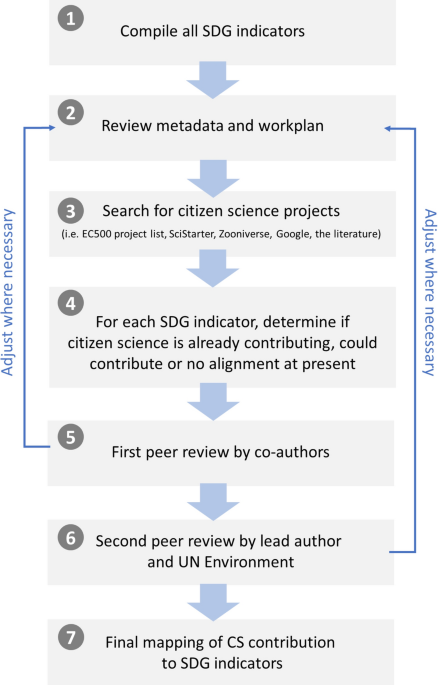
The UN Sustainable Development Goals (SDGs) are a vision for achieving a sustainable future. Reliable, timely, comprehensive, and consistent data are critical for measuring progress towards, and ultimately achieving, the SDGs. Data from citizen science represent one new source of data that could be used for SDG reporting and monitoring. However, information is still lacking regarding the current and potential contributions of citizen science to the SDG indicator framework. Through a systematic review of the metadata and work plans of the 244 SDG indicators, as well as the identification of past and ongoing citizen science initiatives that could directly or indirectly provide data for these indicators, this paper presents an overview of where citizen science is already contributing and could contribute data to the SDG indicator framework. The results demonstrate that citizen science is “already contributing” to the monitoring of 5 SDG indicators, and that citizen science “could contribute” to 76 indicators, which, together, equates to around 33%. Our analysis also shows that the greatest inputs from citizen science to the SDG framework relate to SDG 15 Life on Land, SDG 11 Sustainable Cities and Communities, SDG 3 Good Health and Wellbeing, and SDG 6 Clean Water and Sanitation. Realizing the full potential of citizen science requires demonstrating its value in the global data ecosystem, building partnerships around citizen science data to accelerate SDG progress, and leveraging investments to enhance its use and impact.
What Humanity Needs To Flourish In The Next Decade
We are headed toward a world of productivity without prosperity, execution without verification and capacity without constraint. But this outcome is not inevitable.

What Humanity Needs To Flourish In The Next Decade
We are headed toward a world of productivity without prosperity, execution without verification and capacity without constraint. But this outcome is not inevitable.
Aspiration | Better Tools for a Better World
It's our 23rd Anniversary! Nonprofit staff, developers, capacity builders, and grassroots activists will convene at the 2026 Nonprofit Software Development Summit, 18-20 November, 2026, to share knowledge, build capacity, and collectively envision the future of free, open and equitable digital tools and practices to support social change efforts.
Europe 2031 — What getting AI wrong means for us
A five-year scenario about AI and Europe's impending slide into irrelevance, with a 2034 epilogue that describes how the collapse of the European model could have been prevented.
The Limits to Growth: A report for the Club of Rome's project on the predicament of mankind
"I do not wish to seem overdramatic, but I can only conclude from the information that is available to me as Secretary–General, that the Members of the United Nations have perhaps ten years left in which to subordinate their ancient quarrels and launch a global partnership to curb the arms race, to improve the human environment, to defuse the population explosion, and to supply the required momentum to development efforts. If such a global partnership is not forged within the next decade, then I very much fear that the problems I have mentioned will have reached such staggering proportions that they will be beyond our capacity to control."
The Gargantuan Lie That is Collapsing The World’s Climate
Thinking we have time left to address climate change, or that “Net Zero by 2050” will save us, is driving us toward full social collapse in ways that become more obvious with every new broken temperature record.

Doughnut of social and planetary boundaries monitors a world out of balance
The doughnut-shaped framework of social and planetary boundaries (the ‘Doughnut’) provides a concise visual assessment of progress towards the goal of meeting the needs of all people within the means of the living planet1–3. Here we present a renewed Doughnut framework with a revised set of 35 indicators that monitor trends in social deprivation and ecological overshoot over the 2000–2022 period. Although global gross domestic product (GDP) has more than doubled, our median results show a modest achievement in reducing human deprivation that would have to accelerate fivefold to meet the needs of all people by 2030. Meanwhile, the increase in ecological overshoot would have to stop immediately and accelerate nearly two times faster towards planetary boundaries to safeguard Earth-system stability by 2050. Disaggregating these global findings shows that the richest 20% of nations, with 15% of the global population, contribute more than 40% of annual ecological overshoot, whereas the poorest 40% of countries, with 42% of the global population, experience more than 60% of the social shortfall. These trends and inequalities reaffirm the case for overcoming the dependence of nations on perpetual GDP growth4,5 and reorienting towards regenerative and distributive economic activity—within and between nations—that assigns priority to human needs and planetary integrity.

Deliberation forums: Australasia Pacific Extension Network (APEN) International Conference
This output contributes to the following UN Sustainable Development Goals (SDGs)
Project 2025 Tracker
A comprehensive, community-driven initiative to track the implementation of Project 2025's policy proposals
"Smart City Wien" and the UN Agenda 2030
Many objectives from the 2030 Agenda had already been covered by the strategies and activities of the City of Vienna. In the course of updating the Smart City Wien framework strategy, the SDGs were strategically integrated in all target areas.
Beyond GDP: Measuring and Valuing What Really Matters
Rethinking the UN’s “beyond GDP” agenda and the case for putting wealth at the centre
Toward a New Global Security Paradigm. Task Force 06: Strengthening Multilateralism and Global Governance
Amidst increasing global connectivity and accelerating global change, the global security framework has become insufficient, contributing to a crippling dysfunctionality in international cooperation. The current security framework, focused almost exclusively on a narrow notion of military security, is insufficient to address escalating ‘threats without enemy,’ such as climate change, biodiversity loss, and pollution, which increasingly endanger the lives and dignity of all populations. This policy brief recommends a global social-ecological security framework, rooted in the science informed understanding of social and biophysical realities, to address the evolving needs and challenges of the 21st century. Our recommendations to operationalise this paradigm include: a reinvigorated commitment to multilateralism and peace as a pre-requisite; public participation in shaping the new inclusive international governance framework; development aid and green finance as key levers; a focus on building resilience (especially food security); and, strengthening anticipation of and response to interconnected global shocks. We propose a G20-initiated formation of a high-level working group to catalyse the creation of this new framework. Such a process must involve relevant stakeholders, leveraging new possibilities afforded by technological tools (such as AI). Implementing this ambitious agenda will be challenging, but continuing on a business as- usual trajectory is a ‘lose-lose’ spiral likely to trigger social and ecological crises. Bold leadership from the G20 is needed more than ever to reinvent multilateralism and thus ensure sustainable well-being for all.
The Portfolio Ideal Worker: Insecurity and Inequality in the New Economy
This output contributes to the following UN Sustainable Development Goals (SDGs)