Throughout the Holocene, societies developed additional layers of administration and more information-rich instruments for managing and recording transactions and events as they grew in population and territory. Yet, while such increases seem inevitable, they are not. Here we use the Seshat database to investigate the development of hundreds of polities, from multiple continents, over thousands of years. We find that sociopolitical development is dominated first by growth in polity scale, then by improvements in information processing and economic systems, and then by further increases in scale. We thus define a Scale Threshold for societies, beyond which growth in information processing becomes paramount, and an Information Threshold, which once crossed facilitates additional growth in scale… We also suggest a mechanism to help explain social collapses with no evident external causes.
Thinking together
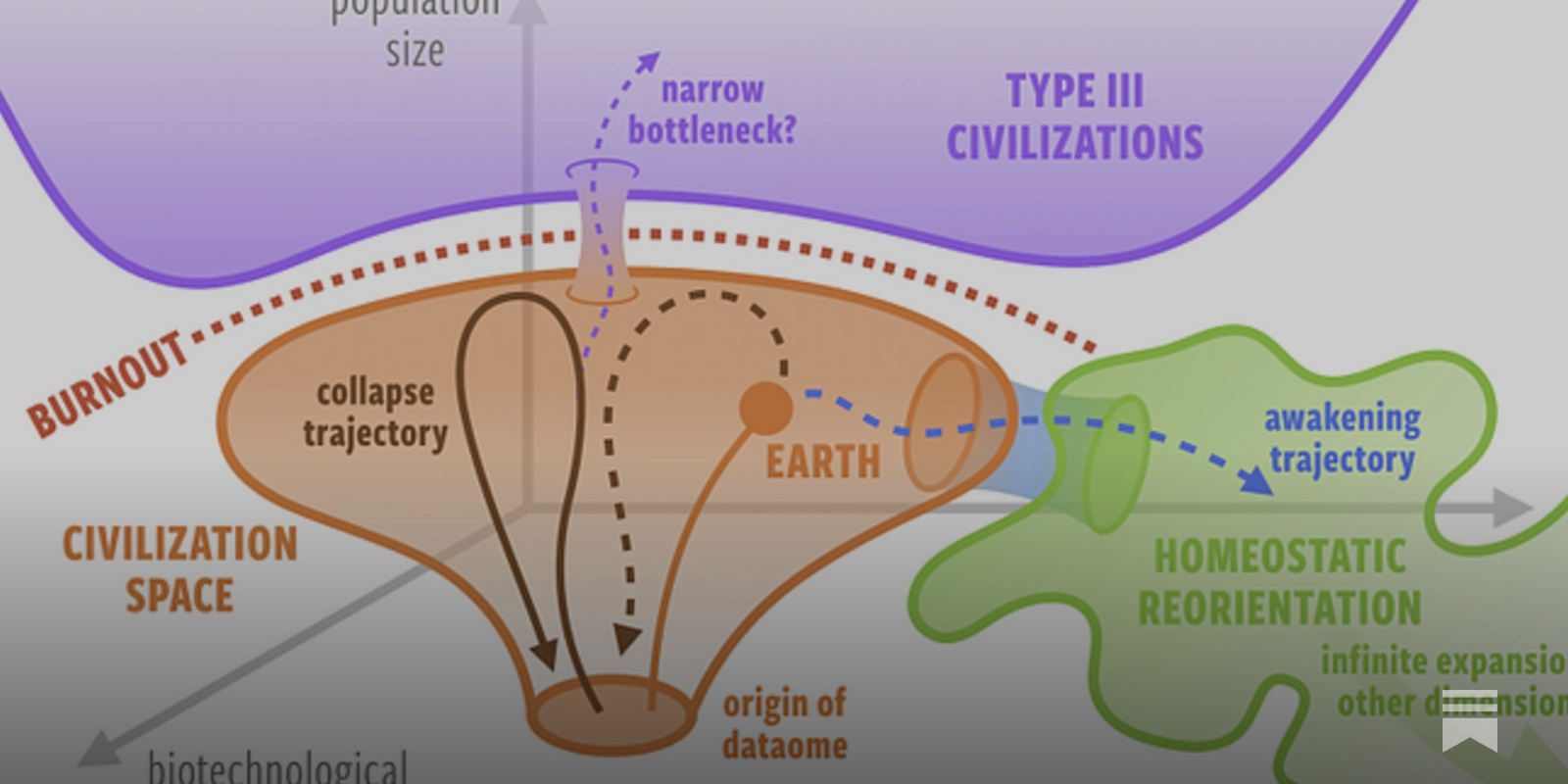
While analyzing a global history databank spanning 10,000 years, Shin, et al found a disconcerting pattern. Civilizations scale until they are overwhelmed by the information environment they create. This is The Information Scaling Threshold.
Historical pragmatism and the internet
This article argues that the literature describing the internet revolution in the 1990s was characterized by the rhetoric of the technological sublime. This rhetoric suffered from three fatal flaws: (1) it was not sufficiently grounded in the historical development of technology; (2) it viewed the internet in isolation, failing to consider the wider technological context; and (3) it failed to examine the internet in view of the social, economic, religious and political circumstances of its users. Several examples from history are cited, demonstrating that changes in various systems for the production, dissemination and preservation of cultural information both border and deborder the world. The article suggests that if internet researchers take a pragmatic, historically grounded approach, they will discover that the introduction of internet technology can be seen to have similar consequences. While the technology overcomes many boundaries (of space and time, politics and economics), other social borders may be created at the same time. It is easier to see old boundaries coming down than to see new ones being erected. Rather than being swept by utopian or dystopian enthusiasms, the article insists that the really interesting discoveries are to be made in locating the subtle social shifts taking place, relatively unnoticed, as a consequence of technological change.


Computing, Complexity and Degrowth : Systemic Considerations for Digital De-escalation
Research on digital degrowth predominantly critiques digital expansion or presents alternative digital practices. Yet, analyzing the link between digital technologies and complexity is crucial to overcome systemic obstacles hindering digital de-escalation. This article presents the different types of links between complexity and computing observed in the literature: the infrastructural complexity inherent in digital technologies, the socio-political complexity induced by them, and finally, the ontological complexity (individual’s ways of relating to their environment) hindered by digitization. The paper explores these links to identify ways to reduce infrastructural and socio-political complexities, and to move away from the reductionist paradigm, in order to support digital degrowth. Its development shows that complexity induces ratchet effects (i.e. irreversibilities in the development of a technique in a society), rendering degrowth efforts difficult to handle by individuals. Therefore, strategies to overcome these barriers are proposed, suggesting that bottom-up simplification approaches stand a greater chance of making alternatives emerge from different stakeholders (including users). This digital shift assumes the development of methods and technical tools that enable individuals to disengage from their attachments to digital habits and infrastructure, opening a substantial field of study.
Calculating Empires: A Genealogy of Technology and Power since 1500
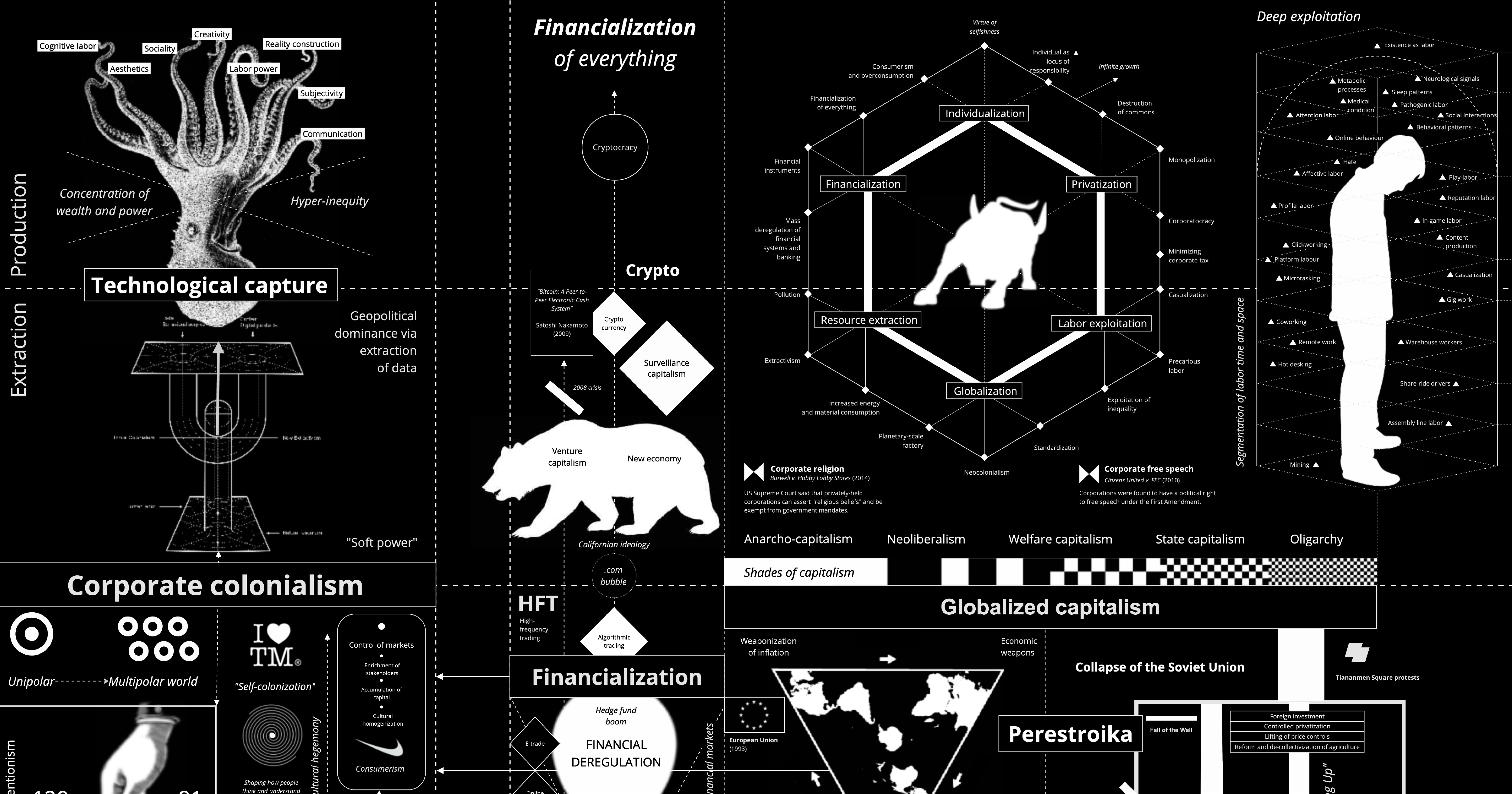
Explore how technical and social structures co-evolved over five centuries in this large-scale research visualization.
Stewardship of global collective behavior
Collective behavior provides a framework for understanding how the actions and properties of groups emerge from the way individuals generate and share information. In humans, information flows were initially shaped by natural selection yet are increasingly structured by emerging communication technologies. Our larger, more complex social networks now transfer high-fidelity information over vast distances at low cost. The digital age and the rise of social media have accelerated changes to our social systems, with poorly understood functional consequences. This gap in our knowledge represents a principal challenge to scientific progress, democracy, and actions to address global crises. We argue that the study of collective behavior must rise to a “crisis discipline” just as medicine, conservation, and climate science have, with a focus on providing actionable insight to policymakers and regulators for the stewardship of social systems.

The problem of knowledge in the Anthropocene
In the twentieth century, debates about economic planning were largely shaped by arguments concerning knowledge and the acquisition of information. As the century drew to a close, the dispute was a...

HOME - Daniel Schmachtenberger
EXPLORATIONS ON THE FUTURE OF CIVILIZATION Some of the central questions being explored here: With the first fully globalized civilization, how do we avoid the collapse fate that has befallen all previous civilizations? What are effective types of immune systems for identifying and correcting corruption in governance systems? How do we comprehensively disincentivize misinformation and harm to … HOME Read More »

A fact-based worldview for all | Gapminder
We live in a globalized world, not only in terms of trade and migration. More people than ever care about global development. But most people have severe misconceptions about contemporary global development. We know, because we have tested people’s knowledge. One of the main reasons for this is that students don’t learn to understand the world based on statistics and facts. Instead, we have a dramatic worldview formed by outdated school books and sensationalist news-stories. People intuitively believe that most things are getting worse. The dramatic worldview leads to irrational decisions by individuals, nonprofits, governments and business. For the first time in human history reliable statistics exist. There’s data for almost every aspect of global development. The data shows a very different picture: a world where most things improve; a world that is not divided; and a world where the fast population growth will soon be over. The world has never been less bad. But that doesn’t mean it’s perfect.
The limits of social media as a source of political information during routine and crisis times across 17 countries
Recent studies on political knowledge suggest people learn little about political events and societal issues from social media. Potentially, social media are a more effective source of information ...

We May Be Entering A Second Axial Age
The transition from small hunter-gatherer societies into complex civilizations gave rise to the first Axial Age. Today, the planetary polycrisis of climate chaos, mass migration, increasing warfare and transformative AI represents a rupture of comparable magnitude.

Planetary carambolage: The evolutionary political economy of technology, nature and work
The following editorial introduces the special issue (SI) on “Work, Environment and Planetary-scale Computation in Political-Economic Evolution”. Here, however, we go beyond an outline of what each contribution to the SI addresses, and attempt to draw a more pronounced shared embedding of the arguments that have come to the fore. The original idea of this SI was to synthesize a range of contemporary global political-economic challenges, i.e. (1) technology (esp. digital transformation), (2) nature (esp. ecological crisis) and (3) work (esp. precarization via the evolving platform economy). The main argument developed in this editorial reflection focuses on the common ground and origin of those processes found in the complex evolution of capitalist development. We frame the latter by assigning it a new term, i.e. “planetary carambolage”.
CYBER-COMMUNISM by Richard Barbrook | Imaginary Futures
‘…is the impact of the …information revolution on capitalism not the ultimate exemplification of… Marx’s thesis that: “at a certain stage of their development, the material productive forces come into conflict with the existing relations of production…”? …does the prospect of the… “global village” not signal the end of market relations… at least in the sphere of digitalised information?’ (Zizek 1998: 33-4)
‘Self-termination is most likely’: the history and future of societal collapse
An epic analysis of 5,000 years of civilisation argues that a global collapse is coming unless inequality is vanquished

How statistics lost their power – and why we should fear what comes next | William Davies
The Long Read: The ability of statistics to accurately represent the world is declining. In its wake, a new age of big data controlled by private companies is taking over – and putting democracy in peril

The Panoptic Sort: A Political Economy of Personal Information
A Political Economy of Personal Information