

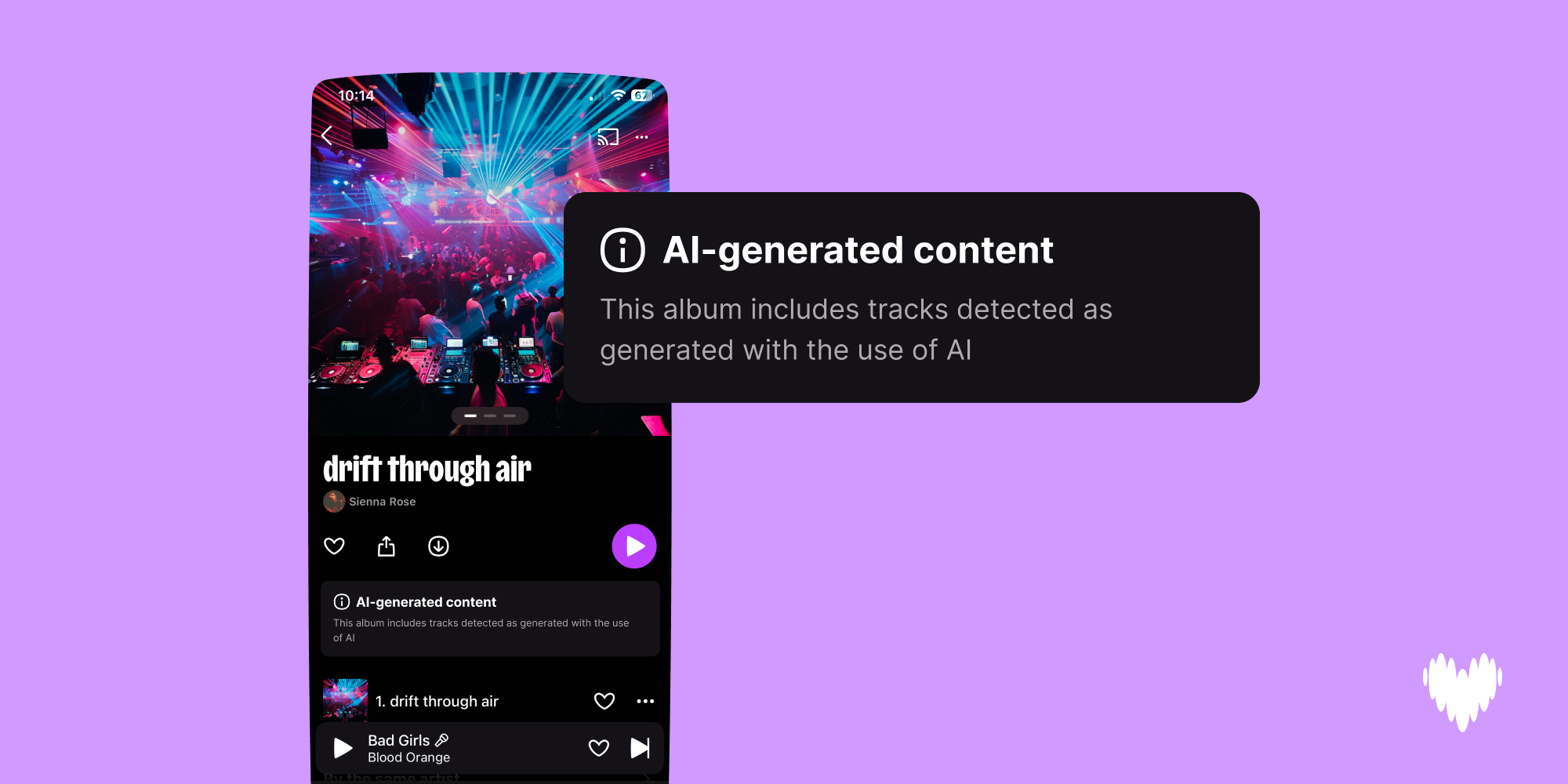
As the only streaming platform tagging AI-generated music, Deezer now reveals that nearly 75,000 AI-tracks are uploaded every day
Deezer says 44% of new music uploads are AI-generated, most streams are fraudulent
AI tracks account for a small fraction of Deezer streams, and most are demonetized for fraud.

Deezer Launches Free AI Music Detector for Playlists
43% of people joining Deezer from other streaming platforms already have AI music in their playlists

The Millions of Songs Mashed Into AI-Generated Music
Explore the astonishing amount of music available to AI developers.

Deezer launches an AI music detector for other streaming services
Feed Deezer your playlists to find the AI slop.

SlopTracker — Exposing AI-Generated Artists on Spotify
AI-generated artists are flooding Spotify, racking up millions of streams, and siphoning revenue from real musicians. See the receipts.

Millions of Copyrighted Songs Were Fed to AI Music Generators – Now There's Proof
Millions of copyrighted songs trained AI music generators, and new searchable databases from The Atlantic now confirm which tracks were used.

AI music is flooding streaming platforms. But listeners like it less and less
Music fans are becoming increasingly uncomfortable with AI songs, according to a recent study.

HAIM: Human-AI Music Datasets for AI Music Production Tracking Benchmark
As generative platforms such as Suno and Udio reach human-grade audio quality, the scope of AI's utility has expanded across the entire music production workflow. Beyond simple track generation, these advancements have catalyzed the adoption of AI-driven methodologies in diverse forms. These include vocal synthesis, arrangement, and professional mastering. However, current detection research remains largely confined to a binary `AI-or-human' paradigm. It fails to reflect the realities of contemporary music production workflows. In real-world production, AI tools are increasingly used to refine or master human-produced tracks, and human engineers likewise post-process AI-generated material to ensure professional quality. Moreover, users often employ adversarial tactics to bypass AI detectors, such as applying human mastering to AI-generated tracks. This creates a grey area that a simple binary classification fails to capture. In this paper, we define and investigate ``AI Music Tracking'': the challenge of identifying specific AI integration across the multifaceted spectrum of music production. To this end, we introduce HAIM, a dataset with diverse labels for stages of music production. It is designed to isolate stages of AI intervention, including hybrid production and agent-level tracking. Our evaluation of state-of-the-art detectors reveals systemic flaws. By releasing HAIM, we propose a new benchmark that shifts the field beyond binary classification toward a granular, structured evaluation of AI music.

Inside the Don’t Ask, Don’t Tell Era of AI in Music
From juicing demos to cloning vocals, AI music tools are creeping into the workflows of top producers, songwriters and artists. It’s mostly happening behind closed doors — for now

YouTube Music adds new labels for AI music
We’re introducing new labels and details in YouTube Music to give you more transparency when songs are created primarily using generative AI.

Soulless: List of AI Artists Hiding on Spotify
Soulless: AI music is stealing from real artists. AI music analyzer (open source).
Soulless: List of AI Artists Hiding on Spotify
Soulless: AI music is stealing from real artists. AI music analyzer (open source).
Spotify's AI Problem Is So Bad Random People Are Stepping In to Track the Slop
Spotify doesn’t label AI music on its platform, so websites like SoullessMusic.com and SlopTracker.org do it instead.

Deezer and Ipsos study: AI fools 97% of listeners
Deezer and Ipsos unveil a unique study exploring perceptions around AI and music, conducted across 8 countries. Discover the surprising results!

AI has already ruined music
How Much AI Is in This Track? Quantifying the Proportion of AI-Generated Stems in Hybrid Music Mixtures
AI-generated music is increasingly used at the stem level, with producers integrating synthetic drums, basslines, or vocals alongside human-performed instruments. However, current AI music detection systems are binary, treating tracks as either fully AI or fully human. In this paper, we reformulate AI music detection as a regression problem on a continuous AI energy ratio, alpha in [0, 1]. We propose a methodology that leverages a multi-track music dataset to assemble mixtures of human-performed and AI-reconstructed stems (obtained using a neural audio codec) with known proportions of each content type. Using this approach, we first show that a CNN-based model trained on fully AI-generated or human-performed tracks, which achieves >99% accuracy as a binary detector, when faced with mixed content, yields an output that rises with the AI stems' energy contribution, acting as a noisy and miscalibrated estimator. Our analysis of the influence of different stems shows that detection sensitivity depends on the instrument and reflects its frequency content: drums and guitar carry strong codec-artifact signatures, while vocals and bass are less detectable. Based on these insights, we train a similar CNN-based model for regression of alpha, achieving MAE = 0.076 and R^2 = 0.85 on held-out mixtures from the same pipeline. These results suggest that the regression formulation is an initial promising step towards AI-music detection in realistic music production workflows.