

Serving LLMs at scale is hard. Learn how inference works and how vLLM uses continuous batching, PagedAttention, prefix caching, and more to keep GPUs busy.
Demystifying llm-d and vLLM: The race to production
Learn how vLLM and llm-d work together for efficient and scalable large language model (LLM) inference. Discover the benefits of disaggregated scaling, expert-parallel scheduling, and KV cache-aware routing.
How To Scale Your Model
Training LLMs often feels like alchemy, but understanding and optimizing the performance of your models doesn't have to. This book aims to demystify the science of scaling language models: how TPUs (and GPUs) work and how they communicate with each other, how LLMs run on real hardware, and how to parallelize your models during training and inference so they run efficiently at massive scale. If you've ever wondered “how expensive should this LLM be to train” or “how much memory do I need to serve this model myself” or “what's an AllGather”, we hope this will be useful to you.
Docker Model Runner Integrates vLLM for High-Throughput Inferencing
How Docker Model Runner integrates vLLM as an inference backend, letting developers run safetensors models with high-throughput serving, PagedAttention, streami
vllm-project/vllm
A high-throughput and memory-efficient inference and serving engine for LLMs
An Internet for the KV Cache: Rethinking Classical Infrastructure Boundaries in the LLM Inference Age
LLM inference has become a global-scale, heterogeneous workload spanning agents, retrieval, tool-use, code execution and multi-modal reasoning. These workloads naturally enable context reuse from overlapping inputs, creating a major opportunity to store and reuse the contexts' KV Caches instead of recomputing them. However, model-side advances that shrink the KV Cache and system-side advances that reduce compute, storage, and transfer costs are evolve independently within legacy cloud boundaries. We argue that future inference infrastructure should allow decoupling of compute and KV Cache storage across cloud and datacenters. The network becomes an active distribution channel; bandwidth, latency and pricing directly determines how the KV Cache should be managed. We propose a vision for an Internet for the KV Cache, with KV Cache management working as a content-distribution system. In this view, KV Cache storage and recompute decisions are driven by model, infrastructure, and application metrics, to enable adaptive, content-driven decisions for minimizing latency and cost.

Prompt caching: 10x cheaper LLM tokens, but how? | ngrok blog
A far more detailed explanation of prompt caching than anyone asked for: how tokens, embeddings, and attention make cached LLM tokens 10x cheaper and faster.
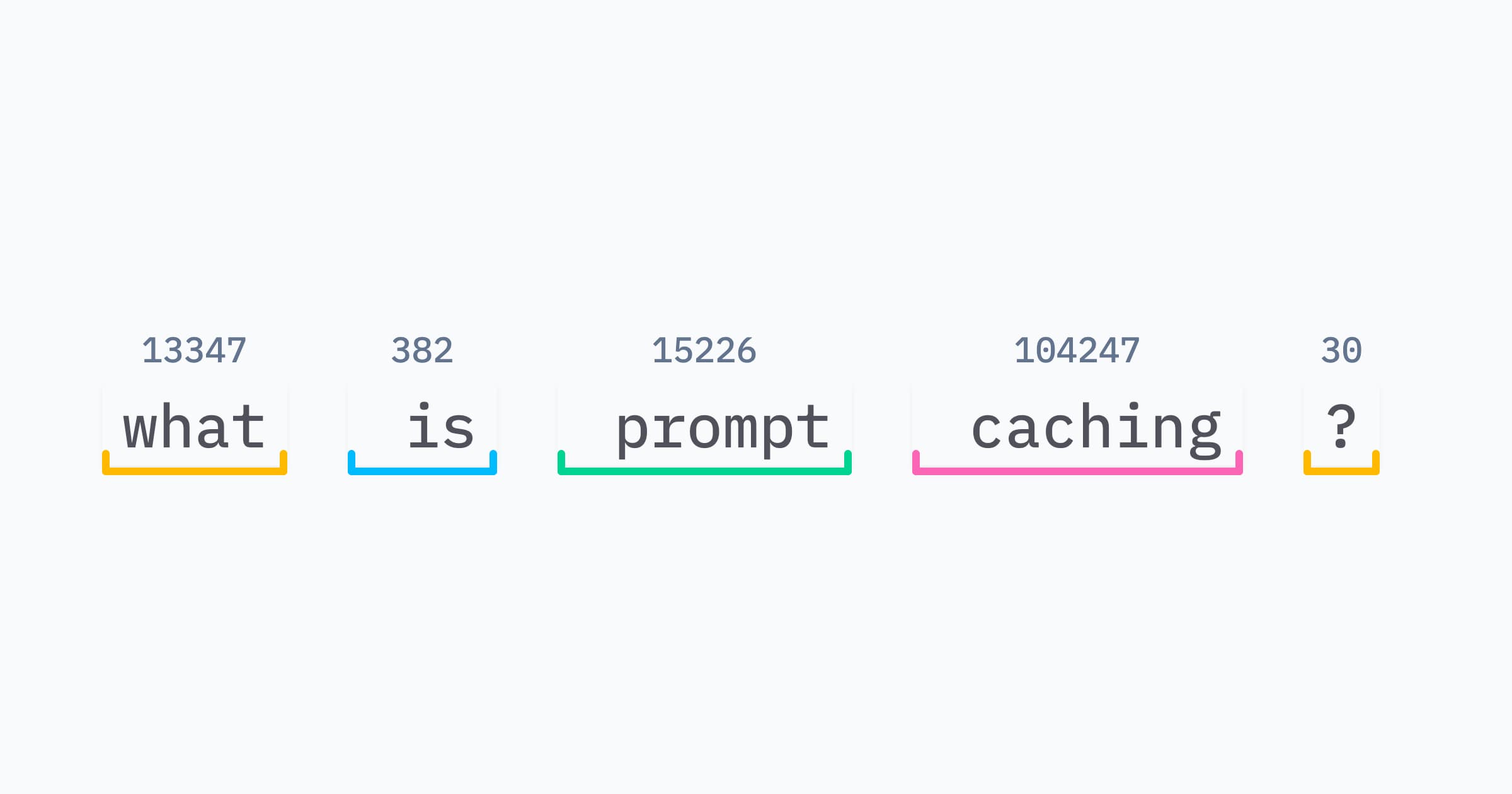
Prompt caching: 10x cheaper LLM tokens, but how? | ngrok blog
A far more detailed explanation of prompt caching than anyone asked for: how tokens, embeddings, and attention make cached LLM tokens 10x cheaper and faster.
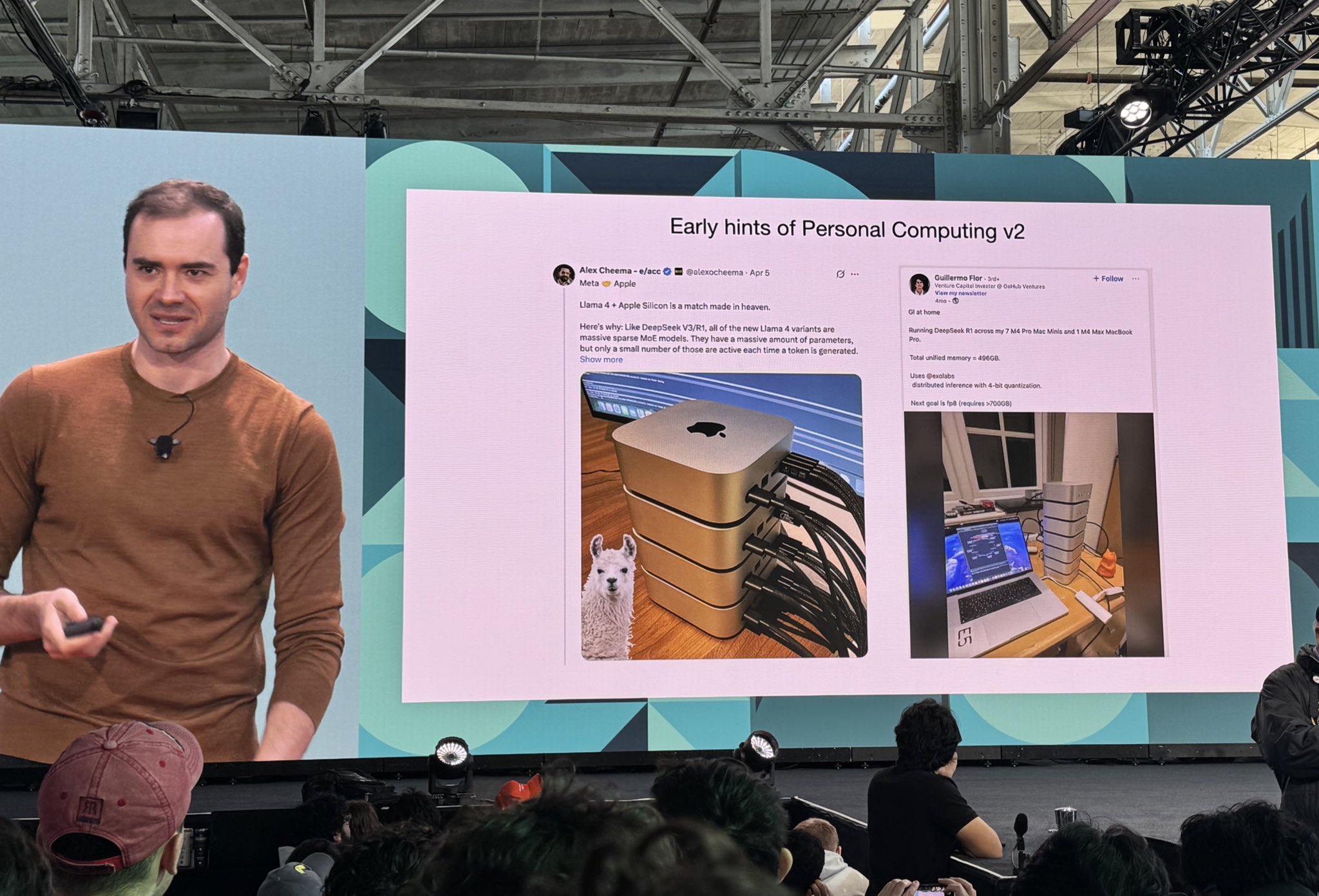
Alex Cheema on Twitter / X
.@karpathy shouted out my work on @exolabs at @ycombinator AI SUS!“we use LLMs similarly to mainframes in the ‘70s - compute is timeshared by having a slice in the batch dimension. models will compress over time, and with this we’ll be able to run more on-device” pic.twitter.com/UKSrquQGAL— Alex Cheema (@alexocheema) June 18, 2025
Compression is prediction | ngrok blog
Compression and LLMs are trying to solve the exact same problem: predicting what comes next. Learn the fundamentals of compression and how better prediction leads to better shrinkage.
Pools: Our Newest Primitive - exe.dev blog
A new way to group VMs, with shared resources and predictable pricing. Plus new Personal and Work plans.

Minions: where local and cloud LLMs meet· Ollama Blog
Avanika Narayan, Dan Biderman, and Sabri Eyuboglu from Christopher Ré's Stanford Hazy Research lab, along with Avner May, Scott Linderman, James Zou, have developed a way to shift a substantial portion of LLM workloads to consumer devices by having small on-device models (such as Llama 3.2 with Ollama) collaborate with larger models in the cloud (such as GPT-4o).

Mesh LLM: distributed AI computing on iroh
How Mesh LLM pools existing GPU resources across machines into a single OpenAI-compatible API, built on iroh.
BerriAI/litellm
Python SDK, Proxy Server (AI Gateway) to call 100+ LLM APIs in OpenAI (or native) format, with cost tracking, guardrails, loadbalancing and logging. [Bedrock, Azure, OpenAI, VertexAI, Cohere, Anthropic, Sagemaker, HuggingFace, VLLM, NVIDIA NIM]
Instant LLM Updates with Doc-to-LoRA and Text-to-LoRA
Recent LLM agents have shown impressive capabilities on complex computer use and long-horizon tasks. Yet, they still struggle with long-term memory and adaptation--two of the most important cognitive capabilities that still limit LLMs today. Without long-term memory, users have to provide LLMs with relevant content at the start of every new session, creating friction, discontinuity, and longer time-to-response. Additionally, due to the lack of adaptation, they do not learn from mistakes or user preferences from previous sessions, making each interaction as cumbersome as the first. Traditionally, these two problems are tackled by "updating" the model.
Overview - GroqDocs
Fast LLM inference, OpenAI-compatible. Simple to integrate, easy to scale. Start building in minutes.

Hi protocol friends! I've been cooking up a Very Large PDS (vlpds) implementation capable of scaling up to billions of accounts and down to just one. It uses Object Storage as its only state, supports HA operation, live scaling up and down, is feature-complete with the reference PDS, and is FOSS.

Overview · vlpds docs
vlpds.jazco.dev