>be me >discover effective altruism >apparently normal charity is inefficient >why donate to random sad thing when spreadsheet can tell you optimal sad thing >fair enough >buy mosquito nets >save lives >numbers look good >feel powerful >couple years later >someone asks an innocent question >why only count people alive today >huh >future people matter too >obviously >my grandchildren shouldn't matter less just because they haven't spawned yet >reasonable.jpg >keep following logic >what about their grandchildren >also yes >what about people in 500 years >sure >5000 years >why not >500 million years >starting to get weird but morality is morality >open calculator >humanity could survive for an astronomically long time >could colonize galaxy >could have trillions upon trillions of descendants >maybe digital people too >maybe simulated civilizations >maybe dyson spheres full of happy uploaded minds >calculator starts smoking >realize currently living humans are rounding error >8 billion people suddenly looking extremely beta >future contains potentially 10^something people >can't even fit beneficiaries in google sheets >new moral priority unlocked >protect the long-term future >stop thinking in units of "people helped" >start thinking in "fraction of cosmic endowment preserved" >malaria? >terrible >but only kills existing humans >AI extinction could delete the entire light cone >nuclear war could permanently derail civilization >bad institutions could lock in terrible values for ten million years >someone invents wrong constitution in 2140 >quadrillions suffer >better fund governance workshop now >friend says maybe we should improve hospitals >explain opportunity cost >friend says hospitals are full of actual sick people >explain scope sensitivity >friend stops inviting me to dinner >need to decide what to fund >easy >expected value >suppose project has one in a million chance of preventing extinction >sounds tiny >but extinction destroys 10^50 future lives >multiply >mother of god >$10 million project has expected value of several galaxies >charity evaluation complete >someone asks where the one-in-a-million number came from >expert judgement >which expert >us >how calibrated >extremely thoughtfully >reduce estimate to one in ten million to be conservative >still beats curing cancer by 38 orders of magnitude >epistemic robustness achieved >someone says maybe project doesn't work >assign 20% chance >still astronomical >maybe project makes problem worse >assign 5% chance >still astronomical >why 5 >because 30 felt pessimistic >publish 46-page report >contains seventeen sensitivity analyses >every sensitivity analysis begins after assuming intervention has positive sign >critic says you're multiplying enormous hypothetical stakes by extremely uncertain probabilities >yes >that's literally why it's important >critic says the uncertainty might be structural rather than numerical >make probability smaller >critic says no, I mean maybe your model is wrong >make probability smaller again >critic begins rubbing temples >discover AI safety >perfect longtermist cause >AI might kill everyone >or create utopia >or seize galaxy >or tile universe with paperclips >or create billions of conscious software minds >finally a problem with numbers big enough for me >start AI safety nonprofit >mission: prevent dangerous AI >hire smartest people available >smartest people immediately start building better AI to understand dangerous AI >interesting >we must understand capabilities to understand safety >we must scale models to study alignment >we must race ahead so less responsible actors don't get there first >we must deploy systems to learn how deployment can go wrong >we must build the thing quickly because building the thing quickly is dangerous >outsider asks why the people most worried about AI apocalypse all work at AI companies >complicated field >company releases stronger model >very concerned >company begins training even stronger model >extremely concerned >company raises $14 billion >concern reaches unprecedented levels >need to influence government >future is at stake >normal democratic process too slow >politicians don't understand exponential curves >public doesn't understand x-risk >experts must guide them >who counts as expert >people who understand x-risk >who understands x-risk >our friends >someone objects that this seems politically convenient >explain we're representing future generations >future generations unavailable for comment >develop concept of value lock-in >terrifying possibility that one ideology controls civilization forever >therefore extremely important that civilization adopts correct values before lock-in >whose values >let's circle back >begin with impartial morality >end with small group of people deciding what quadrillions of hypothetical beings would want >beautiful arc >meanwhile actual humans keep doing annoying things >voting wrong >having parochial attachments >loving family more than strangers >caring about local community >getting upset when told their suffering is cosmically negligible >evolutionary biases everywhere >explain that moral intuition cannot be trusted >except intuition that future digital people count >and intuition that extinction is uniquely bad >and intuition that our probability estimates are sane >and intuition that our institutional choices improve the future >those intuitions survived peer review >someone donates $5k to local homeless shelter >inefficient >could have funded 0.0000000000003% of an AI governance researcher >think of all the simulated people you just killed >okay maybe don't phrase it that way publicly >PR team says "future generations deserve a voice" >much better >journalist asks what longtermism means >say "future people matter" >everyone agrees >great >journalist asks what follows from that >well technically we should redirect enormous resources toward low-probability interventions affecting astronomical futures >journalist raises eyebrow >return to "future people matter" >motte has entered the chat >critic: of course future people matter >me: glad we agree >critic: I don't agree that your institute knows how to help them >me: why do you hate our grandchildren >eventually notice uncomfortable implication >if future value dominates everything >then helping people today mostly matters through effects on future >education matters because future institutions >health matters because future productivity >democracy matters because future trajectory >human beings slowly become instrumental variables in their own moral philosophy >see starving child >feel compassion >check spreadsheet >child's direct welfare contribution negligible >but perhaps childhood nutrition improves national institutional quality >compassion restored >tell myself this is impartial altruism >one day assistant asks obvious question >"how do you know your intervention actually improves the far future?" >silence >open spreadsheet >increase column width >add confidence interval >assistant asks again >"no, I mean how do you know the sign is positive?" >stare into cosmic light cone >10^50 people staring back >none of them exist >none of them can tell me >none of them can falsify my assumptions >realize I have invented the perfect constituency >infinitely important >completely silent >and always represented by me
Grow like Trees: An Organic Approach to Societal Regrowth
2026 is the year that system breakdown became impossible to deny. Democratic norms, societal norms, rule of law, the fabric of the social contract tearing as we watch. Or hide, unwilling or unable to face the unravelling. The hopeful among us see opportunity through the dark. Tentatively or boldly we

LIMITS 2025 -- Workshop on Computing within Limits
The LIMITS workshop concerns the role of computing in human societies situated in a world of limits, such as limits of extractive logics, limits to a biosphere’s ability to recover, limits to our knowledge, or limits to technological solutions to societal issues. As an interdisciplinary group of researchers, practitioners, and scholars, we seek to reshape the computing research agenda, grounded by an awareness that contemporary computing research is intertwined with ecological limits in general, and climate- and climate justice-related limits in particular. LIMITS 2025 solicits submissions that move us closer towards computing that supports diverse human and non-human lifeforms and thriving biospheres.
What Humanity Needs To Flourish In The Next Decade
We are headed toward a world of productivity without prosperity, execution without verification and capacity without constraint. But this outcome is not inevitable.

What Humanity Needs To Flourish In The Next Decade
We are headed toward a world of productivity without prosperity, execution without verification and capacity without constraint. But this outcome is not inevitable.
All Possible Views About Humanity's Future Are Wild
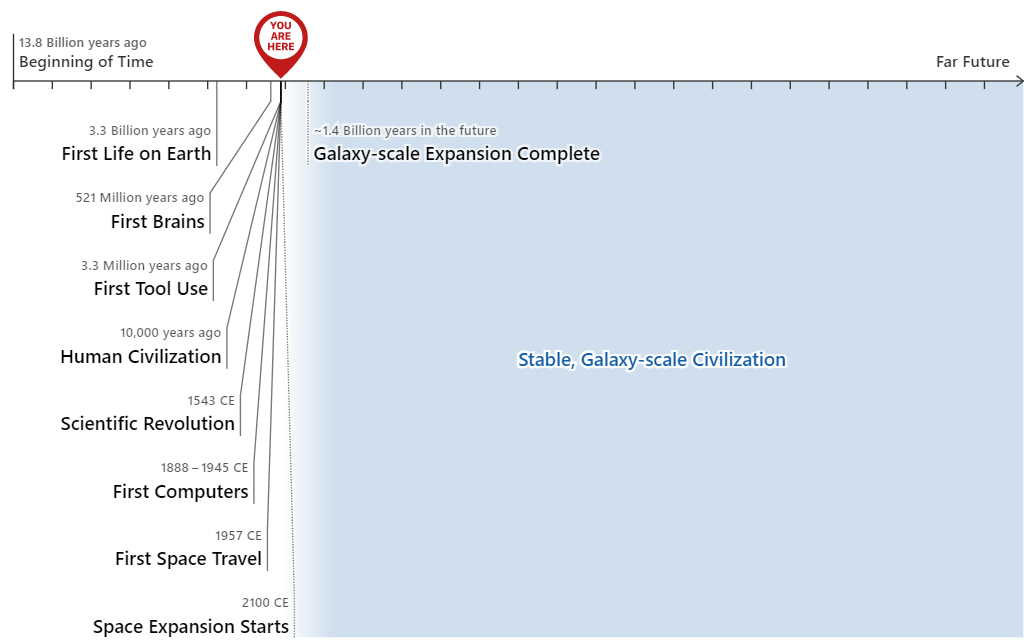
If humans will eventually spread out across the galaxy, then we are among the earliest living beings, with remarkable opportunities to shape the future
Collective Flourishing
Our tools for navigating the future haven't kept pace with its growing complexity. Creating new systems that integrate a deep understanding of people, profound advances in modelling and foresight, and expressive interfaces could help us see, reason, and choose a better future together.
Because we get asked a lot. by @PalantirTech(Palantir) | Twitter Thread Reader
Because we get asked a lot. The Technological Republic, in brief. 1. Silicon Valley owes a moral debt to the country that made its rise possible. The engineering elite of Silicon Valley has an affirmative obligation to participate in the defense of the nation. 2. We must rebel against the tyranny of the apps. Is the iPhone our greatest creative if not crowning achievement as a civilization? The object has changed our lives, but it may also now be limiting and constraining our sense of the possible. 3. Free email is not enough. The decadence of a culture or civilization, and indeed its ruling class, will be forgiven only if that culture is capable of delivering economic growth and security for the public. 4. The limits of soft power, of soaring rhetoric alone, have been exposed. The ability of free and democratic societies to prevail requires something more than moral appeal. It requires hard power, and hard power in this century will be built on software. 5. The question is not whether A.I. weapons will be built; it is who will build them and for what purpose. Our adversaries will not pause to indulge in theatrical debates about the merits of developing technologies with critical military and national security applications. They will proceed. 6. National service should be a universal duty. We should, as a society, seriously consider moving away from an all-volunteer force and only fight the next war if everyone shares in the risk and the cost. 7. If a U.S. Marine asks for a better rifle, we should build it; and the same goes for software. We should as a country be capable of continuing a debate about the appropriateness of military action abroad while remaining unflinching in our commitment to those we have asked to step into harm’s way. 8. Public servants need not be our priests. Any business that compensated its employees in the way that the federal government compensates public servants would struggle to survive. 9. We should show far more grace towards those who have subjected themselves to public life. The eradication of any space for forgiveness—a jettisoning of any tolerance for the complexities and contradictions of the human psyche—may leave us with a cast of characters at the helm we will grow to regret. 10. The psychologization of modern politics is leading us astray. Those who look to the political arena to nourish their soul and sense of self, who rely too heavily on their internal life finding expression in people they may never meet, will be left disappointed. 11. Our society has grown too eager to hasten, and is often gleeful at, the demise of its enemies. The vanquishing of an opponent is a moment to pause, not rejoice. 12. The atomic age is ending. One age of deterrence, the atomic age, is ending, and a new era of deterrence built on A.I. is set to begin. 13. No other country in the history of the world has advanced progressive values more than this one. The United States is far from perfect. But it is easy to forget how much more opportunity exists in this country for those who are not hereditary elites than in any other nation on the planet. 14. American power has made possible an extraordinarily long peace. Too many have forgotten or perhaps take for granted that nearly a century of some version of peace has prevailed in the world without a great power military conflict. At least three generations — billions of people and their children and now grandchildren — have never known a world war. 15. The postwar neutering of Germany and Japan must be undone. The defanging of Germany was an overcorrection for which Europe is now paying a heavy price. A similar and highly theatrical commitment to Japanese pacifism will, if maintained, also threaten to shift the balance of power in Asia. 16. We should applaud those who attempt to build where the market has failed to act. The culture almost snickers at Musk’s interest in grand narrative, as if billionaires ought to simply stay in their lane of enriching themselves . . . . Any curiosity or genuine interest in the value of what he has created is essentially dismissed, or perhaps lurks from beneath a thinly veiled scorn. 17. Silicon Valley must play a role in addressing violent crime. Many politicians across the United States have essentially shrugged when it comes to violent crime, abandoning any serious efforts to address the problem or take on any risk with their constituencies or donors in coming up with solutions and experiments in what should be a desperate bid to save lives. 18. The ruthless exposure of the private lives of public figures drives far too much talent away from government service. The public arena—and the shallow and petty assaults against those who dare to do something other than enrich themselves—has become so unforgiving that the republic is left with a significant roster of ineffectual, empty vessels whose ambition one would forgive if there were any genuine belief structure lurking within. 19. The caution in public life that we unwittingly encourage is corrosive. Those who say nothing wrong often say nothing much at all. 20. The pervasive intolerance of religious belief in certain circles must be resisted. The elite’s intolerance of religious belief is perhaps one of the most telling signs that its political project constitutes a less open intellectual movement than many within it would claim. 21. Some cultures have produced vital advances; others remain dysfunctional and regressive. All cultures are now equal. Criticism and value judgments are forbidden. Yet this new dogma glosses over the fact that certain cultures and indeed subcultures . . . have produced wonders. Others have proven middling, and worse, regressive and harmful. 22. We must resist the shallow temptation of a vacant and hollow pluralism. We, in America and more broadly the West, have for the past half century resisted defining national cultures in the name of inclusivity. But inclusion into what? Excerpts from the #1 New York Times Bestseller The Technological Republic: Hard Power, Soft Belief, and the Future of the West, by Alexander C. Karp & Nicholas W. Zamiska https://t.co/8igjazz1On
Ecocivilization: making a world that works for all
""One of the greatest thinkers of our age" (The Guardian) presents a new way of living-one modeled on nature's design instead of capitalism's-for fans of Guns, Germs, and Steel and Doughnut Economics It has often been said that it is easier to imagine the end of the world than it is to imagine the end of capitalism-and yet that is what the historical moment urgently calls for. Climate change has reached an emergency state, inequality continues to grow, and, for many, the future has never seemed more bleak. Incremental policy improvements are no longer enough-we need a deep transformation of our current civilization to continue to survive. In Ecocivilization, leading thinker Jeremy Lent reimagines the basis of our civilization, and argues for a new global system of living, one based on life-affirming principles modeled after nature's own design. What enfolds is a robust framework incorporating Lent's own expertise, and the lived experiences of those on the ground already putting ecological civilization's core tenants into practice-justice, mutuality, diversity, and symbiosis. From the global economy to universal housing and income, from infrastructure to agriculture, every major aspect of our society could be redesigned to work together as a coherent whole, setting the conditions for all people to flourish. Ecocivilization shows how this future on a regenerated Earth is not only desirable, but entirely feasible"--

The Irrational Decision
How the computer revolution shaped our conception of rationality—and why human problems require solutions rooted in human intuition, morality, and judgment

Landslide / Holdfast
Notes on what’s happening to our ability to collectively know things, and a look ahead to what this community is especially well positioned to do to support and revitalize our info ecosystems and the humans inside them.

Amy J. Ko : Searching for Justice in Programming Language Design
Effective Altruism: doing transhumanism better
Effective Altruism (EA) is a Trojan horse for transhumanism, through which EA movement leaders and funders aim to naturalize transhumanism as the logical extension of the existing global aid and development sector. This paper traces transhumanism's mainstreaming, first via its rebranding as a humanitarian effort to save lives, protect vulnerable populations, and ensure global flourishing (what I term transhumanitarianism), and later by embedding transhumanitarianism in EA (now under the rubric of longtermism). A key component of this strategy was inverting transhumanism's techno-optimism to instead focus on safety and preventing existential risks ( x-risk ) from emerging technologies like AI and biotechnology, while simultaneously advocating for the creation of these same technologies. The paper focuses on some components of this strategy: the use of inoculation, speculative ethics, anticipatory governance, and the mobilization of apocalyptic discourse as means for producing material outcomes in the form of policy and research agendas.
the chronically online will become a new underclass
Don't Take the Black Pill - Andrew Kelley | SSW 2026
The Fifth Cycle of Humanity
Technology is Not Values Neutral: Ending the Reign of Nihilistic Design
We fail to take tech seriously when we do not grasp its full impact on humans