


Performing groundbreaking Natural Language Processing research since 1999.
Stanford CS336 Language Modeling from Scratch I 2025
Named Entity Recognition with NLTK and SpaCy
NER is used in many fields in Natural Language Processing (NLP)
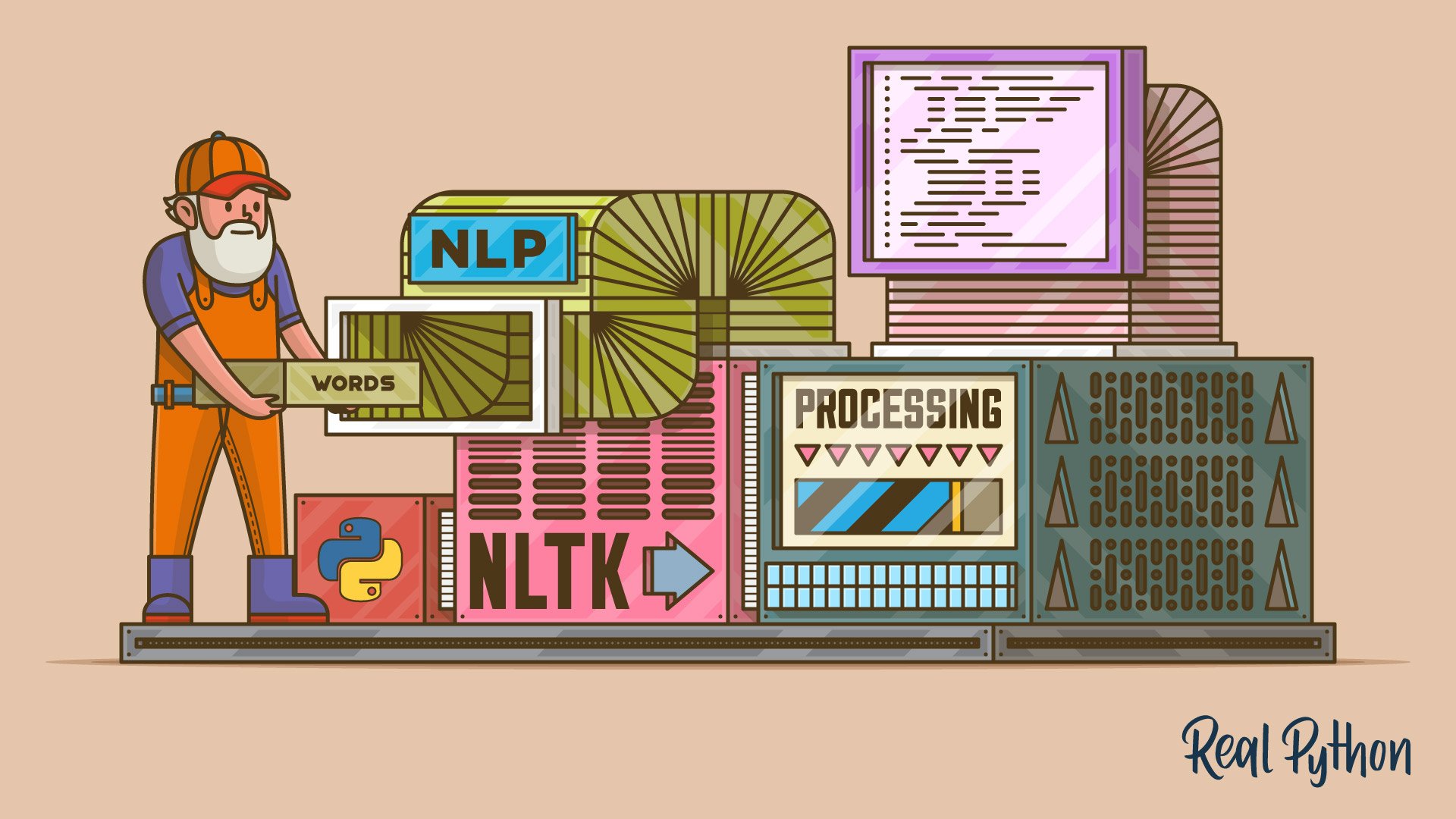
Natural Language Processing With Python's NLTK Package – Real Python
In this beginner-friendly tutorial, you'll take your first steps with Natural Language Processing (NLP) and Python's Natural Language Toolkit (NLTK). You'll learn how to process unstructured data in order to be able to analyze it and draw conclusions from it.
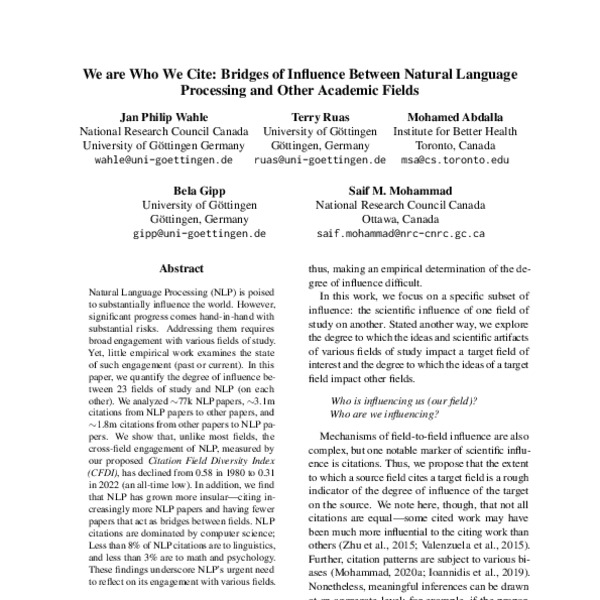
We are Who We Cite: Bridges of Influence Between Natural Language Processing and Other Academic Fields
Natural Language Processing (NLP) is poised to substantially influence the world. However, significant progress comes hand-in-hand with substantial risks. Addressing them requires broad engagement with various fields of study. Yet, little empirical work examines the state of such engagement (past or current). In this paper, we quantify the degree of influence between 23 fields of study and NLP (on each other). We analyzed \textasciitilde77k NLP papers, \textasciitilde3.1m citations from NLP papers to other papers, and \textasciitilde1.8m citations from other papers to NLP papers. We show that, unlike most fields, the cross-field engagement of NLP, measured by our proposed Citation Field Diversity Index (CFDI), has declined from 0.58 in 1980 to 0.31 in 2022 (an all-time low). In addition, we find that NLP has grown more insular—citing increasingly more NLP papers and having fewer papers that act as bridges between fields. NLP citations are dominated by computer science; Less than 8% of NLP citations are to linguistics, and less than 3% are to math and psychology. These findings underscore NLP's urgent need to reflect on its engagement with various fields.
Elias Stengel-Eskin, Aaron Steven White, Sheng Zhang, Benjamin Van Durme · Universal Decompositional Semantic Parsing · SlidesLive
Professional Conference Recording
Big AI is accelerating the metacrisis: What can we do?
The world is in the grip of ecological, meaning, and language crises that are converging into a metacrisis. Big AI is accelerating them all. LLM engineering sits at the core. Despite the public good motives of language engineers and the promise of LLMs, this work is being leveraged to create unprecedented wealth and power for a handful of individuals and corporations while causing existential harm to life on earth. As a profession, we urgently need to come together to explore alternatives and to design a life-affirming future for our field of natural language processing that is centered on human flourishing on a living planet.

Exploring the Limits of Transfer Learning with a Unified Text-to-Text Transformer
Transfer learning, where a model is first pre-trained on a data-rich task before being fine-tuned on a downstream task, has emerged as a powerful technique in natural language processing (NLP). The effectiveness of transfer learning has given rise to a diversity of approaches, methodology, and practice. In this paper, we explore the landscape of transfer learning techniques for NLP by introducing a unified framework that converts all text-based language problems into a text-to-text format. Our systematic study compares pre-training objectives, architectures, unlabeled data sets, transfer approaches, and other factors on dozens of language understanding tasks. By combining the insights from our exploration with scale and our new “Colossal Clean Crawled Corpus”, we achieve state-of-the-art results on many benchmarks covering summarization, question answering, text classification, and more. To facilitate future work on transfer learning for NLP, we release our data set, pre-trained models, and code.
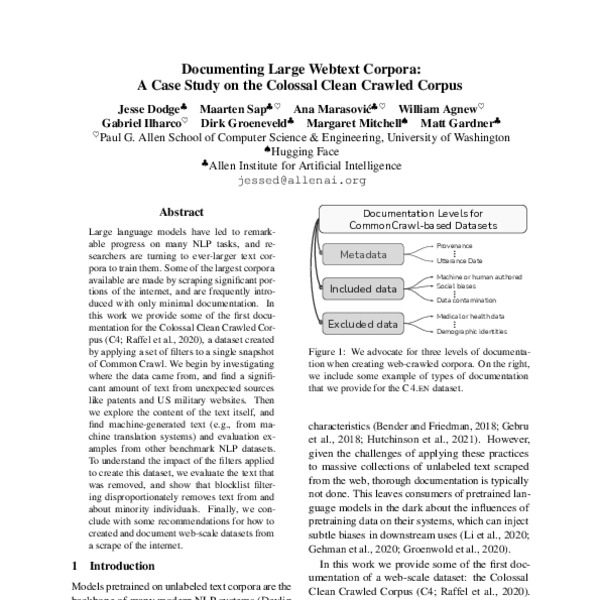
Documenting Large Webtext Corpora: A Case Study on the Colossal Clean Crawled Corpus
Large language models have led to remarkable progress on many NLP tasks, and researchers are turning to ever-larger text corpora to train them. Some of the largest corpora available are made by scraping significant portions of the internet, and are frequently introduced with only minimal documentation. In this work we provide some of the first documentation for the Colossal Clean Crawled Corpus (C4; Raffel et al., 2020), a dataset created by applying a set of filters to a single snapshot of Common Crawl. We begin by investigating where the data came from, and find a significant amount of text from unexpected sources like patents and US military websites. Then we explore the content of the text itself, and find machine-generated text (e.g., from machine translation systems) and evaluation examples from other benchmark NLP datasets. To understand the impact of the filters applied to create this dataset, we evaluate the text that was removed, and show that blocklist filtering disproportionately removes text from and about minority individuals. Finally, we conclude with some recommendations for how to created and document web-scale datasets from a scrape of the internet.
A multiclass Q-NLP sentiment analysis experiment using DisCoCat
Sentiment analysis is a branch of Natural Language Processing (NLP) which goal is to assign sentiments or emotions to particular sentences or words. Performing this task is particularly useful for...
The 2026 AI Index Report | Stanford HAI
Get the latest news, advances in research, policy work, and education program updates from HAI in your inbox weekly.

Artificial Writing and Automated Detection
Artificial intelligence (AI) tools are increasingly used for written deliverables. This has created demand for distinguishing human-generated text from AI-generated text at scale, e.g., ensuring assignments were completed by students, product reviews written by actual customers, etc. A decision-maker aiming to implement a detector in practice must consider two key statistics: the False Negative Rate (FNR), which corresponds to the proportion of AI-generated text that is falsely classified as human, and the False Positive Rate (FPR), which corresponds to the proportion of human-written text that is falsely classified as AI-generated. We evaluate three leading commercial detectors—Pangram, OriginalityAI, GPTZero—and an open-source one —RoBERTa—on their performance in minimizing these statistics using a large corpus spanning genres, lengths, and models. Commercial detectors outperform open-source, with Pangram achieving near-zero FNR and FPR rates that remain robust across models, threshold rules, ultra-short passages, "stubs" (≤ 50 words) and ’humanizer’ tools. A decision-maker may weight one type of error (Type I vs. Type II) as more important than the other. To account for such a preference, we introduce a framework where the decision-maker sets a policy cap—a detector-independent metric reflecting tolerance for false positives or negatives. We show that Pangram is the only tool to satisfy a strict cap (FPR ≤ 0.005) without sacrificing accuracy. This framework is especially relevant given the uncertainty surrounding how AI may be used at different stages of writing, where certain uses may be encouraged (e.g., grammar correction) but may be difficult to separate from other uses.

Words that Work: Using Large Language Models to Generate and Refine Hypotheses from Text
In this paper, we introduce a data-driven framework for generating and refining hypotheses from text. Our three-step approach–Hypothesize, Intervene, and Predic

Science should be machine-readable - Marginal REVOLUTION
One of the leading tasks of our time: We develop a machine-automated approach for extracting results from papers, which we assess via a comprehensive review of the entire eLife corpus. Our method facilitates a direct comparison of machine and peer review, and sheds light on key challenges that must be overcome in order to facilitate […]

Announcing a new version of our 2024 paper on linguistic hypothesis generation from LMs! @najoung.bsky.social and I have systematized our hypothesis generation framework, added stringent criteria for model selection, 10x-ed our learning trials, and included an epigraph from Jeff Elman 🙏!
