
The most plausible explanation for teenage unhappiness.
Are Cell Phones Really Destroying Kids’ Mental Health?
Jonathan Haidt once heralded an “ultrasocial” world. Now he’s one of social media’s most prominent critics.

Smartphone interactions and mental well-being in young adults: A longitudinal study based on objective high-resolution smartphone data
Aims: To investigate the effects of objectively measured smartphone interactions on indicators of mental well-being among men and women in a population of young adults. Methods: A total of 816 young adults (mean±SD age 21.6±2.6 years; 77% men) from the Copenhagen Network Study were followed with objective recordings of smartphone interactions from calls, texts and social media. Participants self-reported on loneliness, depressive symptoms and disturbed sleep at baseline and in a four-month (interquartile range 75–163 days) follow-up survey. Multiple linear regression was used to analyse the association between smartphone interactions and mental well-being separately for men and women. Results: A higher number of smartphone interactions was associated with lower levels of loneliness at baseline and the same pattern appeared for depressive symptoms, although this was less pronounced. A high level of smartphone interaction was associated with lower levels of disturbed sleep for men, but not for women. In follow-up analyses, a high versus low level of smartphone interaction was associated with an increase in loneliness and depressive symptoms over time for women, but not for men. Conclusions: Smartphone interactions are related to better mental well-being, which may be attributed to the beneficial effects of an underlying social network. Over time, accommodating a large network via smartphone communication might, however, have negative effects on mental well-being for women.

Despair and anxiety among UK youth
For years, the age profile of mental ill health was hump-shaped, peaking when people were in their late 40s or early 50s. But in recent years the mental health of the young has deteriorated to such an extent that, today, anxiety and despair peak when UK citizens are in their mid-20s. In most international surveys, adolescents in England, Scotland, and Wales are among the least happy in the world. This column focuses on one of the many likely contributory factors to young people’s mental health – the rise in social media, underpinned by the smartphone.

Smartphone Bans, Student Outcomes and Mental Health
How smartphone usage affects well-being and learning among children and adolescents is a concern for schools, parents, and policymakers. Combining detailed admi

Reciprocal Relationships between Trajectories of Depressive Symptoms and Screen Media Use during Adolescence
Adolescents are constantly connected with each other and the digital landscape through a myriad of screen media devices. Unprecedented access to the wider world and hence a variety of activities, particularly since the introduction of mobile technology, has given rise to questions regarding the impact of this changing media environment on the mental health of young people. Depressive symptoms are one of the most common disabling health issues in adolescence and although research has examined associations between screen use and symptoms of depression, longitudinal investigations are rare and fewer still consider trajectories of change in symptoms. Given the plethora of devices and normalisation of their use, understanding potential longitudinal associations with mental health is crucial. A sample of 1,749 (47% female) adolescents (10–17 years) participated in six waves of data collection over two years. Symptoms of depression, time spent on screens, and on separate screen activities (social networking, gaming, web browsing, TV/passive) were self-reported. Latent growth curve modelling revealed three trajectories of depressive symptoms (low-stable, high-decreasing, and low-increasing) and there were important differences across these groups on screen use. Some small, positive associations were evident between depressive symptoms and later screen use, and between screen use and later depressive symptoms. However, a Random Intercept Cross Lagged Panel Model revealed no consistent support for a longitudinal association. The study highlights the importance of considering differential trajectories of depressive symptoms and specific forms of screen activity to understand these relationships.

Young people's mental health is improving. Tech alarmists take note.
Depression and anxiety are declining, adding yet more complications to the anti-smartphone and anti–social media narratives.

The great rewiring: is social media really behind an epidemic of teenage mental illness?
The evidence is equivocal on whether screen time is to blame for rising levels of teen depression and anxiety — and rising hysteria could distract us from tackling the real causes.

The great rewiring: is social media really behind an epidemic of teenage mental illness?
The evidence is equivocal on whether screen time is to blame for rising levels of teen depression and anxiety — and rising hysteria could distract us from tackling the real causes.
The great rewiring: is social media really behind an epidemic of teenage mental illness?
The evidence is equivocal on whether screen time is to blame for rising levels of teen depression and anxiety — and rising hysteria could distract us from tackling the real causes.
Reciprocal Relationships between Trajectories of Loneliness and Screen Media Use during Adolescence
Adolescence is the peak period for loneliness. Now a ubiquitous part of the adolescent landscape, electronic screens may provide avenues for ameliorating feelings of loneliness. Conversely, they may act as risk factors for the development of such feelings. Although cross-sectional studies to date have investigated the relationship between screen use and loneliness, longitudinal studies are needed if causal and directional associations are to be investigated. Utilising an accelerated longitudinal design and online survey we collected four waves of data from 1919 secondary school adolescents aged 10–15 years over two years. Random intercept cross-lagged panel models tested whether changes in five types of screen use (i.e., total screen time, social media use, gaming, passive screen use, and web use) are associated with changes in loneliness in the subsequent time-point, or changes in loneliness are associated with changes in screen use in the subsequent time-point. We found significant reciprocal associations between screen use and loneliness, with the strongest associations between social networking and electronic gaming and quality of friendships. These findings highlight that any significant increase in an adolescent’s screen use may be a potential indicator of changes in quality of friendships or feelings of isolation.

Forget Smartphone Addiction. Here’s What Experts Are Really Worried About
Our phones are not the problem when it comes to gadget addiction. It's this.

'Life needs to be more like this': Some bars and restaurants are going phone free
It's not just schools that are banning cellphones. Some bars and restaurants are joining the offline trend.

‘Horns’ are growing on young people’s skulls. Phone use is to blame, research suggests.
The growth of bone spurs at the back of the skulls of young people may be a result of an adaptation to the use of handheld devices.

Yes, Smartphones Are Destroying a Generation, But Not of Kids - JSTOR Daily
Why parents need to embrace our role as digital mentors: offering kids and teens ongoing support and guidance in how to use the internet appropriately.

Appnome analysis reveals small or no associations between social media app-specific usage and adolescent well-being
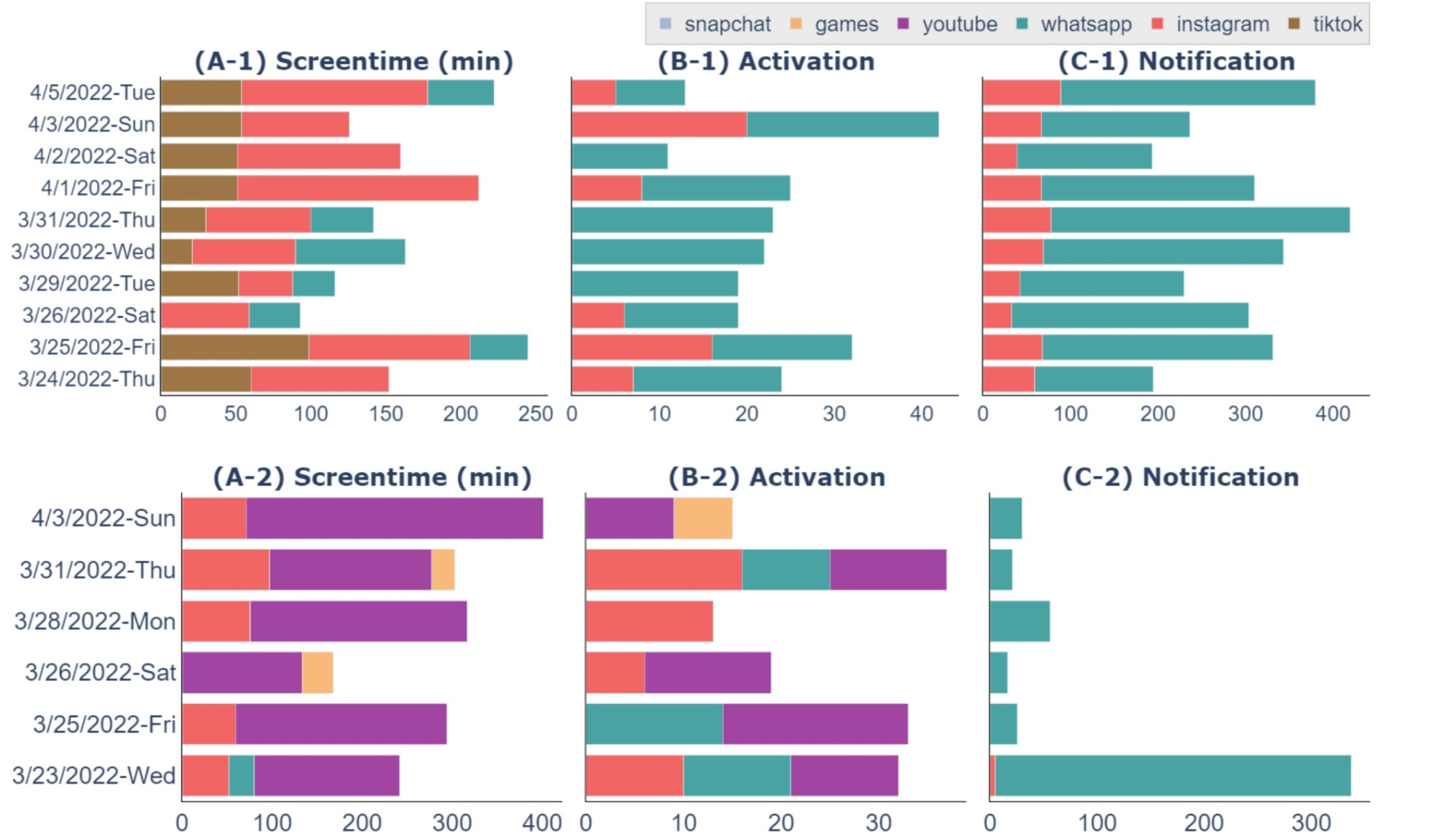
The debate on how social media use (SMU) influences adolescent well-being is mostly based on self-reports of SMU. By collecting data and screenshots donated from 374 Swiss adolescents (Meanage = 15.71; SDage = 0.82) over 2 weeks, we created “Appnomes”—app-specific usage metrics on screentime, number of activations, and number of notifications per participant per day derived, and associated them with daily hedonic and eudaimonic well-being. Longer TikTok time predicted lower eudaimonic well-being (β = − 0.08) daily but higher positive emotions (β = 0.06) the next day; longer use of WhatsApp predicted negative emotions (β = 0.06) while more screen activations for WhatsApp predicted greater feelings of connection (β = 0.08). Instagram notification was positively related to increased feeling of focused (β = 0.06) the next day. YouTube screen unlocks predicted more feeling of meaning (β = 0.07) the next day. More Snapchat screentime predicted less relaxed, less competent, and less positive emotions (with − 0.07 < β < − 0.06). Results pointed towards minimal or no effects, challenging the moral panic on the detrimental impact of SMU on teen well-being.
‘My social life completely plummeted’: gen Z is fighting back against big tech
From apps that block distractions to stripped-down phones, young people are finding ways to unplug from platforms they say profit from their attention