Bulk math from the browser’s own layout algorithms.
Doing maths in CSS
sin(), cos(), atan2() landed in CSS in 2023. You can now place elements in circles, arcs, and spirals with pure CSS, no JavaScript, no libraries. Here's how the math works.
Reusing Previous Computations | Web Browser Engineering
Compositing (see Chapter 13) makes animations smoother, but it doesn’t help with interactions that affect layout, like text editing or DOM modifications. Luckily, we can avoid redundant layout work by treating the layout tree as a kind of cache, and only recomputing the parts that change. This invalidation technique is traditionally complex and bug-prone, but we’ll use a principled approach and simple abstractions to make it manageable.
Relearn CSS layout
If you find yourself wrestling with CSS layout, it’s likely you’re making decisions for browsers they should be making themselves.
KaTeX – The fastest math typesetting library for the web
Simple API, no dependencies – yet super fast on all major browsers.

The n-Category Café
Note:These pages make extensive use of the latest XHTML and CSS Standards. They ought to look great in any standards-compliant modern browser. Unfortunately, they will probably look horrible in older browsers, like Netscape 4.x and IE 4.x. Moreover, many posts use MathML, which is, currently only supported in Mozilla. My best suggestion (and you will thank me when surfing an ever-increasing number of sites on the web which have been crafted to use the new standards) is to upgrade to the latest version of your browser. If that's not possible, consider moving to the Standards-compliant and open-source Mozilla browser.
CSS Matic: The Ultimate CSS Tools for Web Designers
CSSmatic is a non-profit ultimate CSS tools for web designers. There are four useful tools at the moment. You can use the Gradient Generator which
Qalculate! - the ultimate desktop calculator
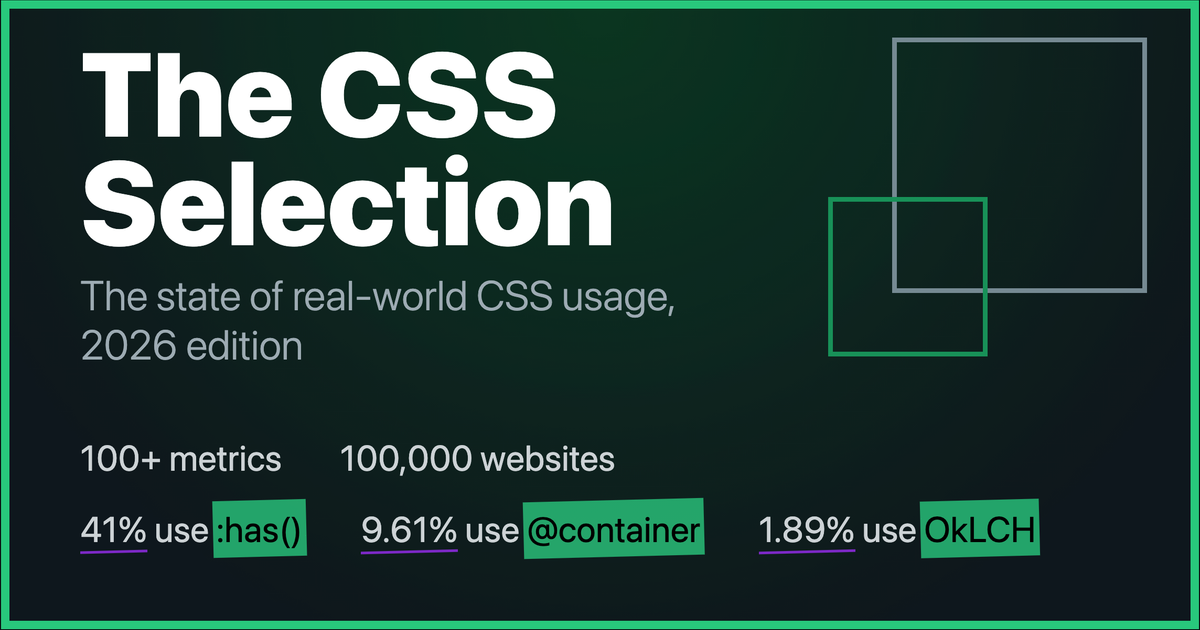
The CSS Selection - 2026 Edition - Project Wallace
The CSS Selection shows real-world CSS usage from over 100,000 websites and looks at the most important metrics.
Free Calculators & Tech Insights - The Pastry Box Project
Discover free online calculators for everyday problems and clear articles about technology. Simple tools and insights to make life easier.
Using maths to balance your heading styles - Craig Abbott
A simple system for styling heading levels using a modular scale
Improving Your CSS with Parker – CSS Wizardry
Using static analysis to learn where to improve your CSS

The Layout Maestro by Ahmad Shadeed
Build any web layout with confidence. Learn practical CSS layout through visual lessons, interactive demos, and a proven layout mindset.

Resources - Shenanigans
Simple bits of decorative CSS and HTML I put together that you can use on your own pages! Naturally, you can change their style to fit your own aesthetic.
Multiple-column layout, rows, rules, and floats
Recently implemented in Chrome are two of my top asks for CSS—the concept of rows in multiple-column layout, and gap decorations for rows and columns in grid, flexbox, and multicol. Rows (using column-wrap) provide a way to use multicol on the web without risking scrolling up and down to read if the columns become taller than the viewport. Gap decorations mean that, for multicol, you can now add a rule between these new rows. This post is a collection of the things I think would be interesting to do in future. If you think so too, and particularly if you have a great use case for any of these, let me know in the comments.