

Q. Michael Pershan’s main critique of spaced repetition in the context of Math Academy?A. It reinforces his memory of a shallow understanding.
Using spaced repetition systems to see through a piece of mathematics
By Michael Nielsen, January 2019
Spaced repetition
Spaced repetition is an evidence-based learning technique that is usually performed with flashcards. Newly introduced and more difficult flashcards are shown more frequently, while older and less difficult flashcards are shown less frequently in order to exploit the psychological spacing effect. The use of spaced repetition has been proven to increase the rate of learning.

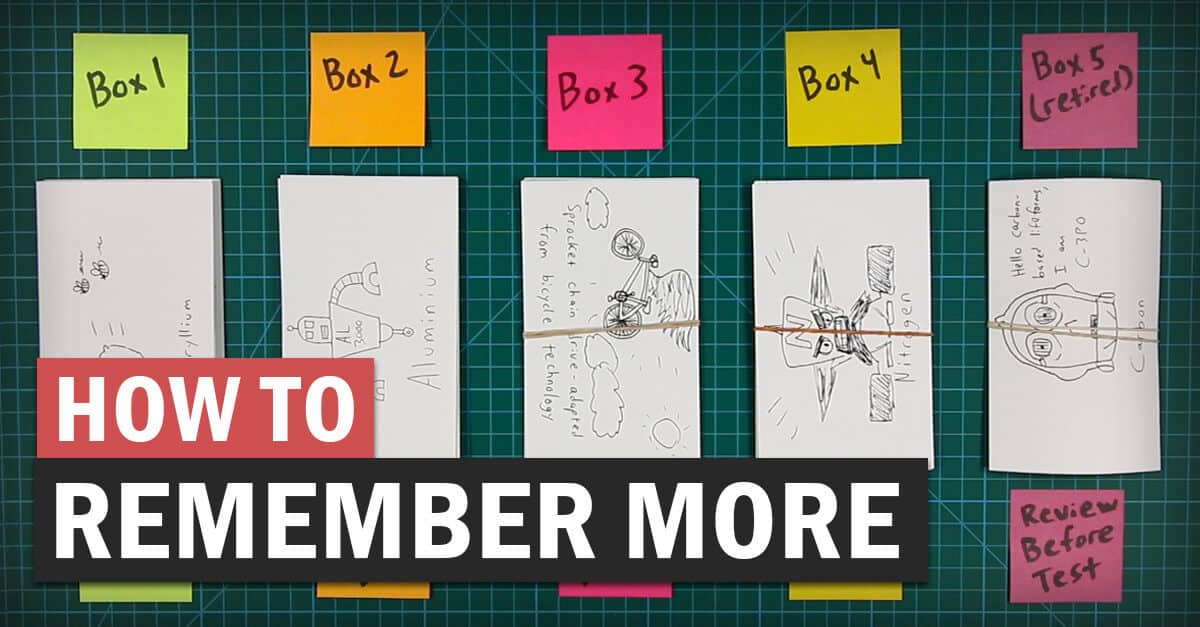
How to Remember More of What You Learn with Spaced Repetition
Using spaced repetition in conjunction with other study techniques can help you memorize information much, much more quickly. Here's how to do it.
Spaced mathematics practice improves test scores and reduces overconfidence
Abstract The practice assignments in a mathematics textbook or course can be arranged so that most of the problems relating to any particular concept are massed together in a single assignment, or these related problems can be distributed across many assignments–a format known as spaced practice. Here we report the results of two classroom experiments that assessed the effects of mathematics spacing on both test scores and students' predictions of their test scores. In each experiment, students in Year 7 (11–12 years of age) either massed their practice into a single session or divided their practice across three sessions spaced 1 week apart, followed 1 month later by a test. In both experiments, spaced practice produced higher test scores than did massed practice, and test score predictions were relatively accurate after spaced practice yet grossly overconfident after massed practice.

Dylan Wiliam on Twitter / X
The best journal article titles tell you what the study actually found, rather than being a teaser to make you read the paper. Here's a good example: "Spaced mathematics practice improves test scores and reduces overconfidence" https://t.co/iXxdkAgYPM ($)— Dylan Wiliam (@dylanwiliam) December 31, 2024

Mochi - Spaced repetition flashcards
Take notes and make flashcards using markdown, then study them using spaced repetition.
My Ongoing Review of MathAcademy.com - Updated 7/18/24
I wasn't able to find many reviews for Math Academy, so I thought I'd start keeping a log of our experiences. Background: DS1 Algebra 1: AOPS (first half of book) Geometry: first half of Jacob's (2nd ed.), ch 5-12 from Derek Owens, two chapters from Thinkwell Algebra 2: Foerster Precalc: Derek Ow...

My Journey Back to Math: A Short Review of MathAcademy
Personal journey of rediscovering math through MathAcademy and learning in public

Automated Sentence Generation for a Spaced Repetition Software
This paper presents and tests AllAI, an app that utilizes state-of-the-art NLP technology to assist second language acquisition through a novel method of sentence-based spaced repetition. Diverging from current single word or fixed sentence repetition, AllAI dynamically combines words due for repetition into sentences, enabling learning words in context while scheduling them independently. This research explores various suitable NLP paradigms and finds a few-shot prompting approach and retrieval of existing sentences from a corpus to yield the best correctness and scheduling accuracy. Subsequently, it evaluates these methods on 26 learners of Danish, finding a four-fold increase in the speed at which new words are learned, compared to conventional spaced repetition. Users of the retrieval method also reported significantly higher enjoyment, hinting at a higher user engagement.
A balanced review of Math Academy
And some thoughts on motivation and structure, for autodidacts

Mathematics in the Library of Babel — Daniel Litt
Mathematics isn't only about saying true things. It's about asking the right questions, being confused, stumbling about, getting distracted, being wrong, recognizing when you're wrong, being stuck. Mostly being stuck. It's about clinging to a giant edifice and feeling it out until you understand som

Math Academy, part 1: My eigenvector embarassment
I start a series of posts on Math Academy and its system for learning mathematics.
A Math Academy review
Background and context Some background on me just so that you have a rough idea of where this review is coming from: I did Olympiads as a kid and have been involved in fairly math-heavy fields ever since, through university at least, depending on your definition of math-heavy. I’ve also been completely self-taught when it comes to the non-elementary-school math I know. So my plan on using my Math Academy subscription was to mostly brush up on things. I also did only the university-level courses.