

designing for social cohesion
Community by Design
Social media empower distributed content creation by algorithmically harnessing "the social fabric" (explicit and implicit signals of association) to serve this content. While this overcomes the bottlenecks and biases of traditional gatekeepers, many believe it has unsustainably eroded the very social fabric it depends on by maximizing engagement for advertising revenue. This paper participates in open and ongoing considerations to translate social and political values and conventions, specifically social cohesion, into platform design. We propose an alternative platform model that includes the social fabric an explicit output as well as input. Citizens are members of communities defined by explicit affiliation or clusters of shared attitudes. Both have internal divisions, as citizens are members of intersecting communities, which are themselves internally diverse. Each is understood to value content that bridge (viz. achieve consensus across) and balance (viz. represent fairly) this internal diversity, consistent with the principles of the Hutchins Commission (1947). Content is labeled with social provenance, indicating for which community or citizen it is bridging or balancing. Subscription payments allow citizens and communities to increase the algorithmic weight on the content they value in the content serving algorithm. Advertisers may, with consent of citizen or community counterparties, target them in exchange for payment or increase in that party's algorithmic weight. Underserved and emerging communities and citizens are optimally subsidized/supported to develop into paying participants. Content creators and communities that curate content are rewarded for their contributions with algorithmic weight and/or revenue. We discuss applications to productivity (e.g. LinkedIn), political (e.g. X), and cultural (e.g. TikTok) platforms.

Consensus Democracy | The Paper Pilot
The Paper Pilot's digital garden of thoughts on philosophy, politics, and sociology
Democracy as a Scaled Collective Intelligence Process: Points of Vulnerability and Augmentation
As part of the Digital Library's transition to Open Access, new features for researchers are available in the Premium Edition. Click here to learn more.

AI and the knowledge commons
Democracy and the Epistemic Commons
The Consilience Project is a publication of the Civilization Research Institute (CRI)

Open By Design: Tools for Participation - An Evening with Internet Archive Canada · Luma
Internet Archive Canada for Open by Design - Tools for Participation. Join us as we explore how we can build a more open and participatory digital future, and…

Democracy x AI Cohort | Mozilla Foundation
The Democracy x AI cohort is founded on the hypothesis that, if built differently, AI could strengthen democracy rather than erode it.

Governing Together: Toward Infrastructure for Community-Run Social Media
Decentralizing the governance of social computing systems to communities promises to empower them to make independent decisions, with nuance and in accordance with their values. Yet, communities do not govern in isolation. Many problems communities face are common, or move across their boundaries. We therefore propose designing for "inter-community governance:" mechanisms that support relationships and interactions between communities to coordinate on governance issues. Drawing from workshops with 24 individuals on decentralized, community-run social media, we present six challenges in designing for inter-community governance surfaced through ideas proposed in workshops. Together, these ideas come together as an ecosystem of resources, infrastructures, and tools that highlight three key principles for designing for inter-community governance: modularity, forkability, and polycentricity. We end with a discussion of how the ideas proposed in workshops might be implemented in future work aiming to support community governance in social computing systems broadly.
Citizen Participation (@oliverescobar.bsky.social)
Professor of Public Policy and Democratic Innovation | University of Edinburgh | Working on #democracy #participation #deliberation #commons #governance #power #research | RT≠ endorse | Own views | Profile: https://www.sps.ed.ac.uk/staff/oliver-escobar

Citizen Participation (@oliverescobar.bsky.social)
Professor of Public Policy and Democratic Innovation | University of Edinburgh | Working on #democracy #participation #deliberation #commons #governance #power #research | RT≠ endorse | Own views | Profile: https://www.sps.ed.ac.uk/staff/oliver-escobar
Liquid Democracy: True Democracy for the 21st Century
Liquid Democracy, a subset of Delegative Democracy, is a powerful voting model for collective decision making in large communities. Liquid…
Democracy Policy Network
Together, we can build the foundation for a deeper democracy.
Opensocial.community proposal
Hey folks! This is an opinionated proposal I put together for the community WG. Still a few open questions/uncertainties that I list at the ned. Check it out here: opensocial communities proposal - Google Docs Feel free to comment here or we can chat more in the next WG meeting.

Governable Spaces: Democratic Design for Online Life – Writings and rehearsals by Nathan Schneider
Read the free, open access editionBuy: Amazon, Bookshop, Narrow Gauge Book Co-op, UC Press
How will democracy work in the 21st century?

Exploring and understanding how democracy is and must evolve to support self governance and open societies into the future

How a permanent Citizens' Assembly in Paris passed a bill into law

Another Democratic Future | Substack
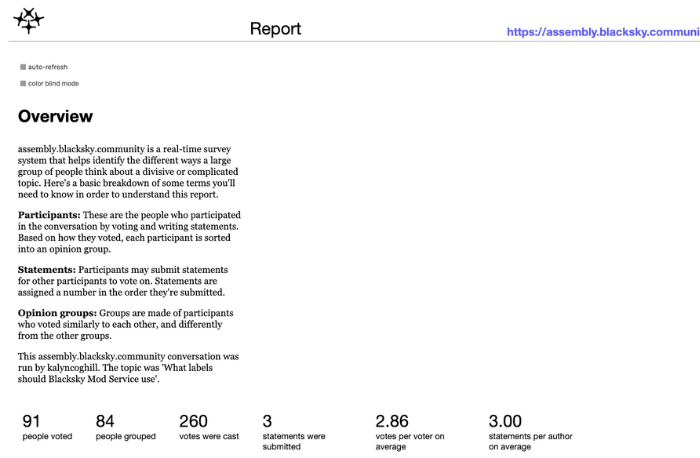
What Happens When You Have a Choice? : A Breakdown of The People's Assembly and Blacksky's Vision for Democratic Tooling

Home - LogiVote
Plurality

One year on: The momentum behind Jigsaw’s Sensemaking AI