


There are 160 apps on my phone. What they're actually doing, I don't know. But I decided to find out. This is an English translation, read the original here. I have a feeling these apps are …
SnoopSnitch - Apps on Google Play
Show missing security patches. Find mobile abuse (IMSI catchers & stealth SMS).

Revealed: how Russia uses mobile ‘super-app’ Max to spy on its citizens
Research shows tens of millions of people are being forced to use platform that amounts to ‘backdoor’ on their device

Perspective | It’s the middle of the night. Do you know who your iPhone is talking to?
We ran a privacy experiment to see how many hidden trackers are running from the apps on our iPhone. The tally is astounding.

SaTS’26
Mobile super apps have evolved into complex ecosystems that integrate diverse services through third-party miniapps, plugins, and APIs. These super apps, offering a plethora of services often in the form of third-party integrated, self-contained packages and capabilities, have greatly extended the versatility of the platforms, offering unprecedented convenience but also introducing significant security and privacy challenges. In the past decade, super apps have evolved into a comprehensive OS-alike ecosystem, with millions of miniapps hosted by built-in stores akin to Google Play and the Apple App Store. Nevertheless, the surging popularity of these apps, such as WeChat, Alipay, TikTok, Line, Zalo, and Grab, has resulted in an immense volume of user data being generated, stored, and transmitted via these platforms. Emerging Operating Systems have also provided such light-weight integration, such as QuickApps as advocated by Huawei, Xiaomi, and Oppo. With their integration of diverse services within a single platform or application, these super apps pose significant security and privacy challenges. Recently, the rise of agentic AI frameworks and AI-enabled application development has further transformed the ecosystem of super apps. Agentic frameworks enabling automatic multi-modal interaction, as well as AI-augmented app development, has significantly reformed the landscape of software development and user interactions. However, these advancements have also expanded the attack surface, introducing novel risks such as data leakage, malicious integrations, privilege escalation, and adversarial manipulation. Our desire of SaTS workshop is to bring together researchers and practitioners from academia, industry, and government to share the latest research efforts and advances, exploring emerging threats, defense, and research directions at the intersection of AI-empowered mobile super apps, miniapp ecosystems, and security analysis.
App-pocalypse Now
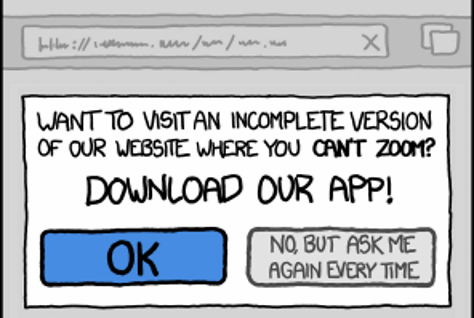
I’m getting pretty sick of being nagged to install your damn apps. XKCD helpfully translates: Yeah, there are smart app banners, which are marginally less annoying, but it’s amazing how quickly we went from “Cool! Phone apps that finally don’t suck!” to this sad, eye rolling, oh-
234 Android Applications Are Currently Using Ultrasonic Beacons to Track Users
A team of researchers from the Brunswick Technical University in Germany has discovered an alarming number of Android applications that employ ultrasonic tracking beacons to track users and their nearby environment.

Your Apps Know Where You Were Last Night, and They’re Not Keeping It Secret (Published 2018)
Dozens of companies use smartphone locations to help advertisers and even hedge funds. They say it’s anonymous, but the data shows how personal it is.

Series: Apps as Views, Not Vaults | Guido X Jansen
Your data lives in a bookshelf you own; apps are just the views that read from it. A seven-part series on what the AT Protocol flips, what it doesn't, and why the boring architecture really does impact you.

Series: Apps as Views, Not Vaults | Guido X Jansen
Your data lives in a bookshelf you own; apps are just the views that read from it. A seven-part series on what the AT Protocol flips, what it doesn't, and why the boring architecture really does impact you.

Apple Confirms Governments Using Push Notifications to Surveil Users
Unidentified governments are surveilling smartphone users by tracking push notifications that move through Google's and Apple's servers, a US senator warned on Wednesday (via Reuters). In a letter to the Department of Justice, Senator Ron Wyden said foreign officials were demanding the data from the tech giants to track smartphones.

Tens of Thousands of Malicious Apps Use Facebook's APIs - Slashdot
Slashdot reader lod123 quotes ThreatPost: At least 25,936 malicious apps are currently using one of Facebook's APIs, such as a login API or messaging API. These allow apps to access a range of information from Facebook profiles, like name, location and email address. Trustlook discovered the malicio...

Is Your Phone Infected With Pegasus? - Slashdot
Fossbytes has an article detailing how you can check to see if your mobile device is infected with the "Pegasus" spyware. What's Pegasus you ask? It's phone-penetrating spy software developed by NSO Group and sold to governments to target journalists and activists around the world. The CEO of NSO Gr...

ATProto explained for a slightly "technical" audience - Foxes
AppView: Retrieves stuff from a relay and does any app-specific preparation Relay: Collects data from Personal Data Servers (PDSes) App: Phone apps, web ap…
New: a new tool called DecryptAds unmasks the shadowy world of ad companies that track your phone's location. It is incredibly difficult to investigate this world, but DecryptAds pulls together public data in a wholly unique way to make digging through this possible 404media.co/this-tool-unmasks-the-shadowy…

This Tool Unmasks the Shadowy World of Ads that Track Your Location
www.404media.co