

At FediForum 2026, ActivityPub co-author Evan Prodromou explained why the protocol succeeded by staying deliberately ordinary and why the W3C's Q3 2026 revision needs to keep it that way.
Decentralization Trade Offs in AT Protocol and ActivityPub DWeb Camp 2026
Christine Lemmer Webber is lead author and co-editor of the W3C ActivityPub specification. Daniel Holmgren is Head of Protocol at Bluesky, working on the AT Protocol specification at the IETF. Join us for a discussion on decentralization trade-offs and other design decisions in the two protocols, and what that means for different architectures, structures, and even future points of convergence. Moderated by Boris Mann
ActivityPub, AT Protocol, and more!
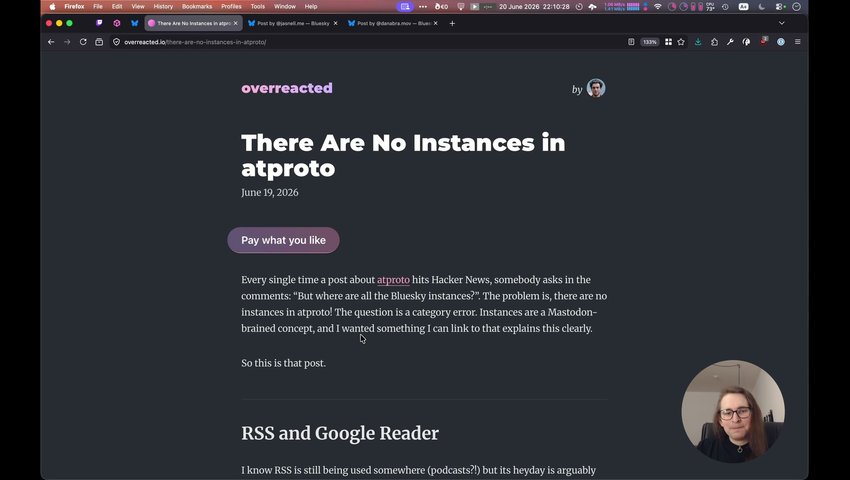
Talking about this article and how ActivityPub and AT Protocol are maybe not as different as people might think. We covered some slides to an unrecorded talk of mine, which explores a lot of things...
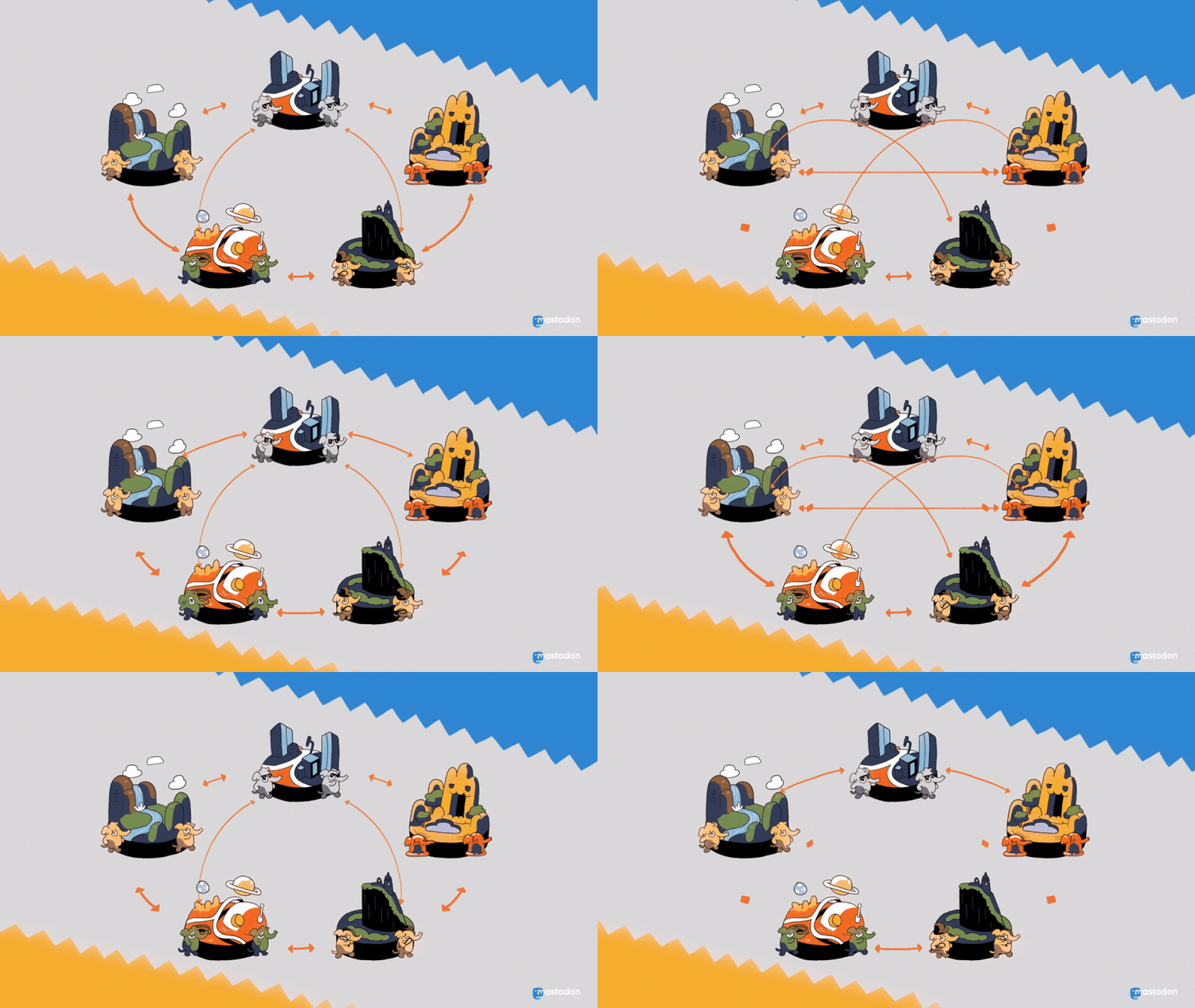
Why ActivityPub is the future
We often tout things like “Mastodon is based on open web protocols” as one of its advantages. I want to elaborate why exactly that’s a good thing.
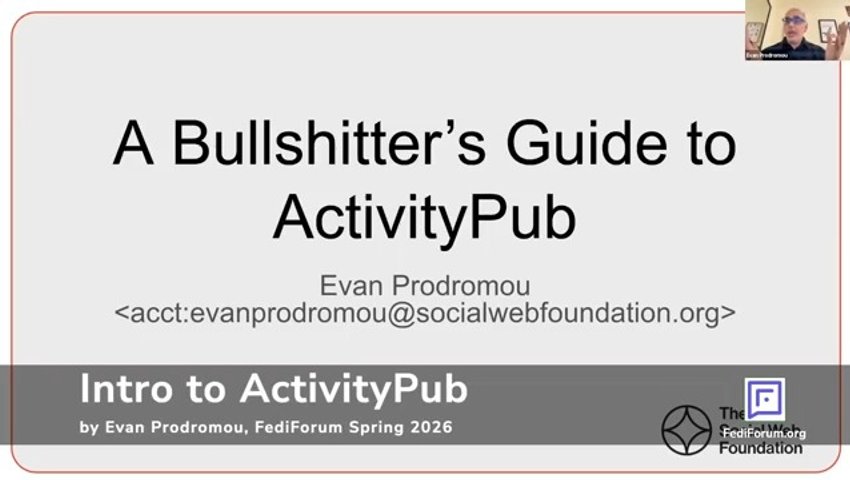
FediForum Talk: How To Bullshit Your Way Through a Conversation about ActivityPub
By Evan Prodromou, Social Web Foundation and editor of the ActivityPub standard. One of the best bluffers in the field of distributed social networks gives you just enough knowledge about ActivityP...
The Long Tail of Work Left Until ActivityPub Has E2EE - Dhole Moments
Separate from my proposal for key transparency for the Fediverse (which I’ve certainly blogged about a lot), the W3C has been working on building out end-to-end encryption (E2EE) for Activity…

ActivityPub, AT Protocol, and more!
Statement on discourse about ActivityPub and AT Protocol
Foreword This statement was originally published on the swicg/general repository after I had been granted approval to merge. Since then one community member has raised that it did not follow the Community Group's processes, and consequently the document has been taken down from the original location. When publishing,

ActivityPub
The ActivityPub protocol is a decentralized social networking protocol based upon the [ActivityStreams] 2.0 data format. It provides a client to server API for creating, updating and deleting content, as well as a federated server to server API for delivering notifications and content.
ActivityPub
The ActivityPub protocol is a decentralized social networking protocol based upon the [ActivityStreams] 2.0 data format. It provides a client to server API for creating, updating and deleting content, as well as a federated server to server API for delivering notifications and content.
ActivityPub
ActivityPub is a protocol and open standard for decentralized social networking. It provides a client-to-server (C2S) API for creating and modifying content, as well as a federated server-to-server (S2S) protocol for delivering notifications and content to other servers. ActivityPub is the defining standard of the Fediverse, a decentralised social network of various social interaction models, and content types, which consists of independently managed instances of software such as Mastodon, Pixelfed and PeerTube, among others.

Developer Documentation for ActivityPub & Fediverse | SocialDocs
The comprehensive developer resource for building with ActivityPub, Mastodon, and the Fediverse. Guides, specs, API reference, and tools.
ActivityPub Client API: A Way Forward | Steve Bate
The ActivityPub Client-to-Server (C2S) protocol was envisioned as a cornerstone of the decentralized social web, along with the Server-to-Server (S2S) protocol. Standardized by the W3C in 2018, C2S defines how user-facing applications, such as mobile apps or web clients, and bots should interact with social servers using Activity Streams 2.0 and JSON-LD. In theory, it ... Read more

I'm certainly not against saying what I think AT Protocol has wrong. github.com/swicg/activitypub-api/issues/…
The Long Tail of Work Left Until ActivityPub Has E2EE Separate from my proposal for publickey.directory (which I've certainly blogged about a lot), the W3C has been…...

The Long Tail of Work Left Until ActivityPub Has E2EE
soatok.blogIt's always fascinating to me that proponents of Activity Pub are always like, "Just use AP, it's better." Isn't the point of decentralization to have no single point of failure? Why doesn't that mean multiple protocols? Everyone who argues that point honestly just sounds salty to me.


