There is a beautiful and romanticized image of the doe. The doe is graceful, elegant, and delicate. She is shy and unattainable, disappearing softly at the slightest sound. Her eyes have become a cliche for the vulnerable, docile feminine, and a glimpse of her, staring back at you for a profound moment before she flies, is precious and moving.I am not this doe.In fact, in a way I hate this doe. No doe is really this doe. Let me tell you a few things about cervids, the whitetail doe in particular. Cervids are olfactory animals. That means they learn things about other deer with their sense of smell. What that means is that the smelliest things about deer are pretty crucial to the way deer live. As with many animals, urine plays a large part in communication – males will urinate in pools and wallow in them to advertise; they will also urinate on their feet to leave their scent with their hoofprints. Females advertise their eligibility to mate by urinating, also.It means that does will ingest the excrement of their young in order to prevent fawns from having a scent that would give away their position to predators.Does aren’t always gentle or vulnerable.In winter, does that are healthier and more able to sense danger will actively prevent other does and fawns from having access to food. Even if a high-ranking doe no longer needs to eat, she will fend off others from the food area and not allow them access, even if they are starving.Nor do deer always flee in the face of danger – several accounts chronicle deer attacking dogs and humans when threatened, in some cases quite brutally. Not many animals hold up closely to their romanticized stereotypes when their survival is put into question, but the desperate deer is the exact opposite of its gentle popular image, its adorable hoofs formidable and unexpected weapons.Besides that, deer do kill, sometimes to eat. A number of articles bring to light the fact that deer do eat carrion, and there is record of deer killing and eating grounded birds.For me, though, there’s more that negates the image of the wholly graceful doe than just wildlife facts. Because the grace of deer, the elegance, is not what makes me deer. As far as the romantic stereotype goes, I do usually feel more inclined to flight, and can be standoffish as a mode of self-preservation. I feel vulnerable in the way that I recognize deer are very, very “killable” – living in Vermont, I saw a great deal of dead deer and the mortality of the whitetail in a hunting community that supports a healthy coyote population was impossible to ignore. I do not feel graceful; usually I feel colossally awkward, and something about deer speaks of that awkwardness to me. Being spooked about nothing, the awkward indignation of being disturbed, the skittering flight are all deer. These things are aspects of the romantic stereotype, but I do not perceive them in a romantic way. I do not think being deer makes me mysterious, desirable, or delicate. Since I’ve become able to consciously analyze my animality, I have found it extremely important to define myself by the more negative or humble aspects of an animal as well as the positive and proud ones. I have difficulty understanding people who speak of their animality primarily in terms of the powerful, beautiful, majestic, or strong. Yes, there are things about deer that I think are lovely and ideal and that I relate to very much. I love the flick of their ears, the clarity of their gaze, the small cloven hoof poised not quite touching the ground, the flag of the tail, the sudden and fleeting bounding away. These are things that I can feel. But I can also feel the awkward stretch of the neck for browse, the indignation of being encroached upon, the need to hide, to flee, to fear. I can feel the undignified sound of the grunt and wheeze, the frozen discomfort of surprise and being caught in headlights, so to speak, and the hurried skitter away. Even the olfactory things that we consider unpleasant or gross in our culture make some sense to me – conveniently, as a human, I do not need to use urine to communicate sexual availability, but I rarely feel the need to rid myself of sexual smells when I notice them. I can’t deny the beauty and seriousness of feeling deer, or of following a deer path through the woods. I can’t ignore the bark and smell, the moss and magic, but I also can’t ignore that these paths are liberally punctuated with droppings. And this, for me, is an adequate metaphor for my experience of being doe: I can acknowledge the beautiful and wonderful, but must take into account the awkward and uncomfortable as well. I would not be deer if I could not accept both the loveliness and the unpleasantness of the doe.
Heterospecific social behavior in primates: insights into the evolutionary roots of pet-keeping
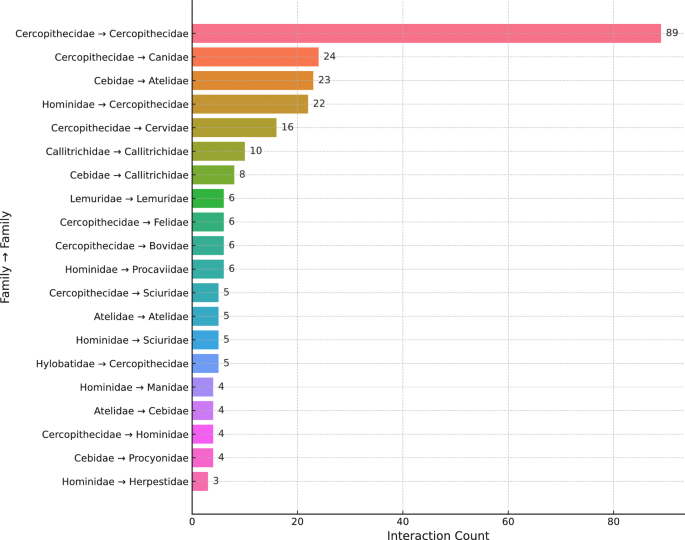
Primate interspecific interactions with both other primates and non-primate species range from predator–prey dynamics to affiliative behaviors such as grooming, play, and carrying. While many primates participate in interspecific associations or commensal relationships, to our knowledge interspecific social interactions have never been systematically synthesized. Here, we present the first comprehensive review of such interactions, compiling 427 cases from the literature, media sources, and a global survey of primatologists. These involved 88 primate species and 127 non-primate species (including mammals, birds, reptiles, amphibians, malacostracans, and insects) across wild (n = 311) and captive (n = 111) contexts. The most frequent interactions occurred within or between primate families (e.g., Cercopithecidae–Cercopithecidae, Cebidae–Atelidae), though affiliative behaviors were also directed toward distantly related taxa such as dogs and birds. Play (n = 139) and grooming (n = 136) were most common. Juveniles and infants predominantly engaged in play, while adult females were more likely to groom. Adult males were less affiliative overall. Contrary to expectations, affiliative behaviors were not more often directed toward immature than adult heterospecifics. Primates were the initiators in most interactions. These findings offer new insights into the diversity and contexts of heterospecific sociality in primates and suggest that some behavioral tendencies relevant to later forms of human–animal companionship – such as caregiving, tolerance, and exploratory play – may be more widespread among primates than previously recognized.
Vote 1 for Wildlife
Subscribe to Wildlife Victoria. Stay up to date with our latest news.
VULVA | Notion
— Female reproductive system Organs of the human female reproductive system.
.webp?table=block&id=3f353b7a-6777-809b-a59d-c818e3bb68c4&width=2000&userId=&cache=v2&imgBuildSrc=pageMetadataCover)
Why aren’t coyotes, dingoes and wolves treated like our dogs? | Aeon Essays
Coyotes, dingoes and wolves are all dogs, as intelligent and loyal as our familiars. Our treatment of them is unconscionable

House Mice
The house mouse (Mus musculus) is considered one of the most troublesome and economically important rodents in the United States. House mice thrive under a variety of conditions. They are found in and around homes and farms as well as in open fields and agricultural lands. House mice consume and contaminate food meant for humans, livestock, or other animals. They cause damage to structures and property, and they transmit diseases such as salmonellosis and swine dysentery.

Do Drunk Mice Sire Weird-Looking Offspring? – Quentin André
A recent piece in The Atlantic argues fathers-to-be should abstain from alcohol when trying to conceive. The science that underpins this recommendation has some issues.

Beaver walking upright on hind legs, carrying wet mud to build its lodge.
Male-like ornamentation in female hummingbirds results from social harassment rather than sexual selection
Female white-necked jacobin hummingbirds are polymorphic—some express ornamented plumage like adult males. Falk et al. find that all juvenile females have male-like plumage, which some maintain as adults. Rather than being favored by sexual selection, male-like plumage benefits females by reducing social harassment from this and other species.

Male-like ornamentation in female hummingbirds results from social harassment rather than sexual selection
Female white-necked jacobin hummingbirds are polymorphic—some express ornamented plumage like adult males. Falk et al. find that all juvenile females have male-like plumage, which some maintain as adults. Rather than being favored by sexual selection, male-like plumage benefits females by reducing social harassment from this and other species.
The Beaver’s Food Foraging / Tree-Cutting Behavior - AnimAnswers.com
Beavers are one of the largest rodents in the world. These fantastic creatures have thick fur, webbed feet, and flattened tails that are useful when they forage. They are also known for their notable dam-building abilities and unique skills in making their homes. Their sharp teeth help them to cut different sizes of trees. Let’s ... Read more

Pheromone
A pheromone is a chemical that is secreted or excreted by an organism, which triggers a social response in members of the same species. There are alarm pheromones, food trail pheromones, sex pheromones, and many others that affect behavior or physiology. Pheromones are used by many organisms, from basic unicellular prokaryotes to complex multicellular eukaryotes. Their use among insects has been particularly well documented. In addition, some vertebrates, plants and ciliates communicate by using pheromones. The ecological functions and evolution of pheromones are a major topic of research in the field of chemical ecology.
Sheldrick Wildlife Trust: Haven for Elephants & Rhinos
Pioneers in the rescue and hand-raising of orphaned baby elephants and rhinos, through to their reintegration to the wild when grown. Saving wild lives today and securing habitats for the future.

Social Insects : Ecology and Behavioural Biology
1 online resource; Here is a guide to the ecology of social insects. It is intended for general ecologists and entomologists as well as for undergraduates and those about to start research on social insects; even the experienced investigator may find the comparison between different groups of social insects illuminating. Most technical terms are translated into common language as far as can be done without loss of accuracy but scientific names are unavoidable. Readers will become familiar with the name even though they cannot visualize the animal and could reflect that only a very few of the total species have been studied so far! References too are essential and with these it should be possible to travel more deeply into the vast research literature, still increasing monthly. When I have cited an author in another author's paper, this implies that I have not read the original and the second author must take responsi bility for accuracy! Many hands and heads have helped to make this book. I thank all my colleagues past and present for their enduring though critical support, and I thank with special pleasure: E.]. M. Evesham who fashioned the diagrams;]. Free, D.J. Stradling and]. P.E.C. Darlington who supplied photographs; D.Y. Brian and R.A. Weller who were meticulous on the linguistic side; and G. Frith and R.M. Jones who collated the references. List of plates 1. Fungus combs of Acromyrmex octospinosus and Macrotermes michaelseni. 13 2. Mouthparts of larval Myrmica; 1 Introduction -- 2 Food -- 2.1 Termites as decomposers -- 2.2 Wasps and ants as predators -- 2.3 Sugars as fuel save prey -- 2.4 Seed eaters -- 2.5 Leaf eaters -- 2.6 Pollen eaters -- 3 Foraging by individuals -- 3.1 Foraging strategy -- 3.2 Worker variability -- 4 Foraging in groups -- 4.1 Communication about food -- 4.2 Group slave-raiding -- 4.3 Tunnels and tracks -- 4.4 Nomadic foraging -- 5 Cavity nests and soil mounds -- 5.1 Cavities and burrows -- 5.2 Soil mounds -- 6 Nests of fibre, silk and wax -- 6.1 Mounds of vegetation and tree nests -- 6.2 Combs of cells -- 7 Microclimate -- 7.1 Environmental regulation -- 7.2 Metabolic regulation -- 8 Defence -- 8.1 Painful and paralysing injections -- 8.2 Toxic smears and repellants -- 9 Food processing -- 9.1 Mastication, extraction and regurgitation -- 9.2 Yolk food supplements -- 9.3 Head food glands -- 10 Early population growth -- 10.1 Food distribution -- 10.2 Colony foundation -- 10.3 The growth spurt -- 11 Maturation -- 11.1 Simple models of reproduction -- 11.2 Social control over caste -- 11.3 Males in social Hymenoptera -- 11.4 Maturation in general -- 12 Reproduction -- 12.1 Caste morphogenesis -- 12.2 Copulation and dispersal -- 12.3 Production -- 12.4 Summary -- 13 Evolution of insect societies -- 13.1 Theories of individual selection -- 13.2 Models of these theories -- 13.3 Group selection -- 13.4 Conclusions -- 14 Colonies -- 14.1 The colony barrier -- 14.2 Queen number and species ecology -- 14.3 Queen interaction and queen relatedness -- 15 Comparative ecology of congeneric species -- 15.1 Ant and termite races -- 15.2 Desert ants and termites -- 15.3 Ants and termites in grassland -- 15.4 Forest ants and termites -- 15.5 Wasps and bumblebees -- 15.6 Advanced bees -- 16 Communities -- 16.1 Temperate zone communities in grass and woodland -- 16.2 Desert communities -- 16.3 Tropical rain forest -- 16.4 Conclusions -- 17 Two themes -- 17.1 Plant mutualism -- 17.2 Social organization -- References -- Author index