


Highlight and capture web pages in your favorite browser. Save anything and everything with just one click.
Hyper-Frame - an iframe that can frame any website
Try the live console. Embed, navigate, automate, and capture pages through a remote browser-backed iframe.
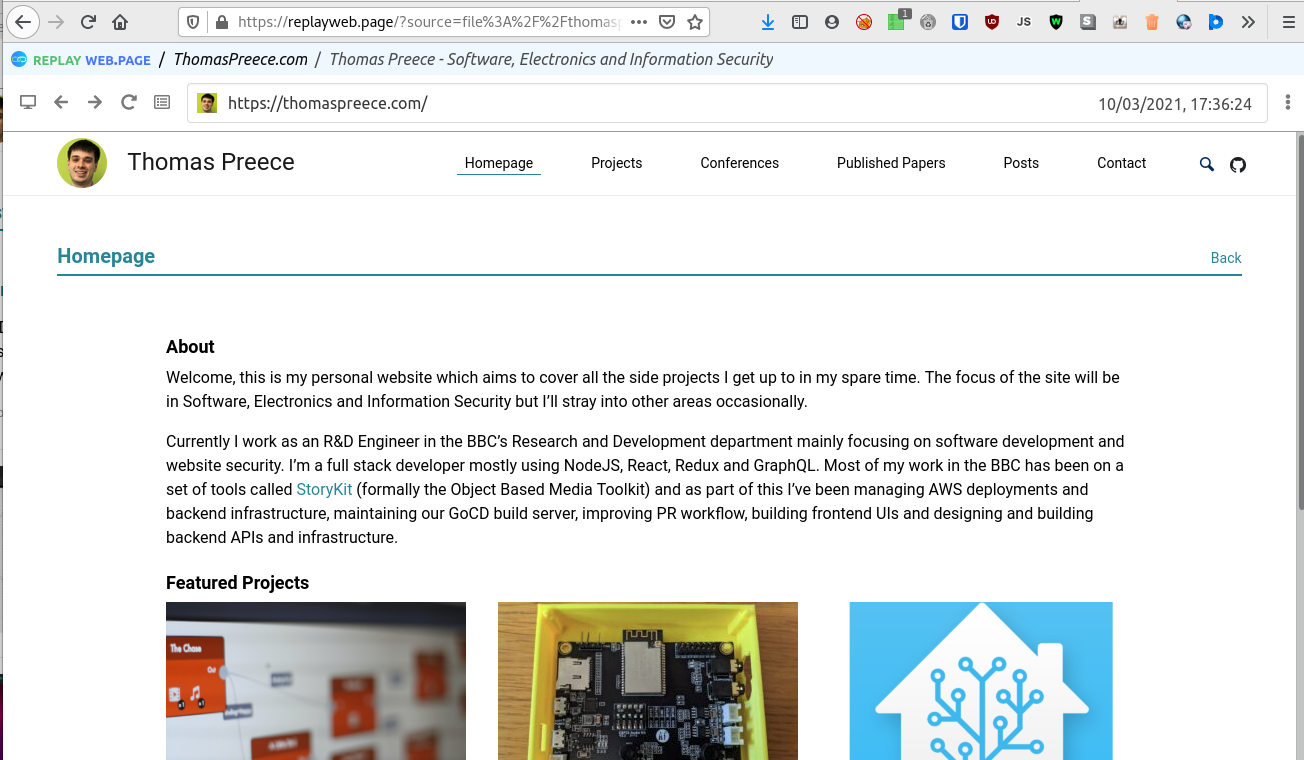
Web Archiving: Playback Tools - Thomas Preece
Web Archiving: Playback Tools - Below I've listed some of the tools I found to playback web archives. The two most popular tools that I found were OpenWayback and PyWb. Of the tests I
gildas-lormeau/SingleFile
Web Extension for saving a faithful copy of a complete web page in a single HTML file
/screenshot - Capture screenshot
The /screenshot endpoint renders the webpage by processing its HTML and JavaScript, then captures a screenshot of the fully rendered page.

Skyreader - Chrome Web Store
Save the page you're reading to Skyreader, or subscribe to its feeds.

Capturing Website
Record camera and screen directly in your browser in a local, privacy-first way.

Margin - Chrome Web Store
Annotate and highlight any webpage, with your notes saved to the decentralized AT Protocol.

Margin - Chrome Web Store
Annotate and highlight any webpage, with your notes saved to the decentralized AT Protocol.

Margin - Chrome Web Store
Annotate and highlight any webpage, with your notes saved to the decentralized AT Protocol.
Mustard
A browser extension that lets you annotate any webpage with notes and share them with your Bluesky and/or GitHub followers.

Standard Reader - Chrome Web Store
Save articles and follow publications on the standard.site network.

Solutions for Link Rot on the Modern Web
Web links are fundamental to the web, enabling navigation between pages and citations in research articles. However, web links suffer from "link rot", a phenomenon in which links are likely to become inaccessible over time. This can occur if a link’s site disappears, making it impossible to resolve the hostname or establish a server connection, or the linked page has been deleted, resulting in an HTTP 404 "Not Found" error. Today, a common solution to tackle link rot is to rely on web archives, which capture snapshots of web pages for future reference. However, the modern web has evolved significantly since web archives were first introduced, leading to several limitations in their effectiveness. First, the scale of the web has grown tremendously, making it infeasible to crawl every page whenever it changes. As a result, many broken links either have no archived copies, or the archived copies have stale content. Second, modern web pages rely heavily on increasingly complex and diverse JavaScript. This shift has made it more challenging for preserving fidelity in archived copies, significantly increasing both the computational cost of operating browser-based crawlers and engineering effort required to maintain accurate replay systems. This thesis presents a set of solutions to cope with link rot on the modern web. My work aims to mitigate the various limitations of web archives. First, for broken links without any archived copy, or if the archived copy includes stale content or unavailable functionalities, I built Fable. Fable revives the dead link with the new URL to the same page whenever available. Compared to prior approaches, Fable revives 4.6K broken links—a 50% increase—with much higher accuracy. Second, for pages that require dynamic crawling, I show how web archives can achieve a better tradeoff between efficiency and fidelity. By carefully choosing 8.9% of pages to crawl dynamically and strategically reusing resources from those crawls, an archive can serve 99% of the remaining statically crawled pages without any fidelity loss. Third, for fidelity violations in archived copies that are caused by incorrect edits to crawled scripts, I built FidEx. FidEx reliably detects when an archived page differs from its original version and pinpoints the root cause. After fixing the most common errors pinpointed by FidEx, I reduced the fraction of pages for which FidEx reports a violation of fidelity from 15% to 9%.
Solutions for Link Rot on the Modern Web
Web links are fundamental to the web, enabling navigation between pages and citations in research articles. However, web links suffer from "link rot", a phenomenon in which links are likely to become inaccessible over time. This can occur if a link’s site disappears, making it impossible to resolve the hostname or establish a server connection, or the linked page has been deleted, resulting in an HTTP 404 "Not Found" error. Today, a common solution to tackle link rot is to rely on web archives, which capture snapshots of web pages for future reference. However, the modern web has evolved significantly since web archives were first introduced, leading to several limitations in their effectiveness. First, the scale of the web has grown tremendously, making it infeasible to crawl every page whenever it changes. As a result, many broken links either have no archived copies, or the archived copies have stale content. Second, modern web pages rely heavily on increasingly complex and diverse JavaScript. This shift has made it more challenging for preserving fidelity in archived copies, significantly increasing both the computational cost of operating browser-based crawlers and engineering effort required to maintain accurate replay systems. This thesis presents a set of solutions to cope with link rot on the modern web. My work aims to mitigate the various limitations of web archives. First, for broken links without any archived copy, or if the archived copy includes stale content or unavailable functionalities, I built Fable. Fable revives the dead link with the new URL to the same page whenever available. Compared to prior approaches, Fable revives 4.6K broken links—a 50% increase—with much higher accuracy. Second, for pages that require dynamic crawling, I show how web archives can achieve a better tradeoff between efficiency and fidelity. By carefully choosing 8.9% of pages to crawl dynamically and strategically reusing resources from those crawls, an archive can serve 99% of the remaining statically crawled pages without any fidelity loss. Third, for fidelity violations in archived copies that are caused by incorrect edits to crawled scripts, I built FidEx. FidEx reliably detects when an archived page differs from its original version and pinpoints the root cause. After fixing the most common errors pinpointed by FidEx, I reduced the fraction of pages for which FidEx reports a violation of fidelity from 15% to 9%.
chrome.clipboard | Platform Apps APIs | Chrome for Developers
The chrome.clipboard API is provided to allow users to access data of the clipboard. This is a temporary solution for chromeos platform apps until open-web alternative is available. It will be deprecated once open-web solution is available, which could be in 2017 Q4.
idk why i haven't really tried @semble.so bookmarklets on web and ios until now. so much fun! already saved and discovered a bunch of cool stuff in just a ~day of using them. major friction for capture removed.
