


Last week I had to diagnose a bug in an open source library I maintain. The issue was gnarly enough that I couldn’t find it right away, but then I thought: if I set a breakpoint here and fire up the debugger, I will likely find the root cause very soon… and then proceed to mercilessly destroy it! So I rolled up my sleeves, set the breakpoint, fired up the debugger, and… saw the program run to completion without interruptions whatsoever.

using C++ to exploit the C++ that is building the C++
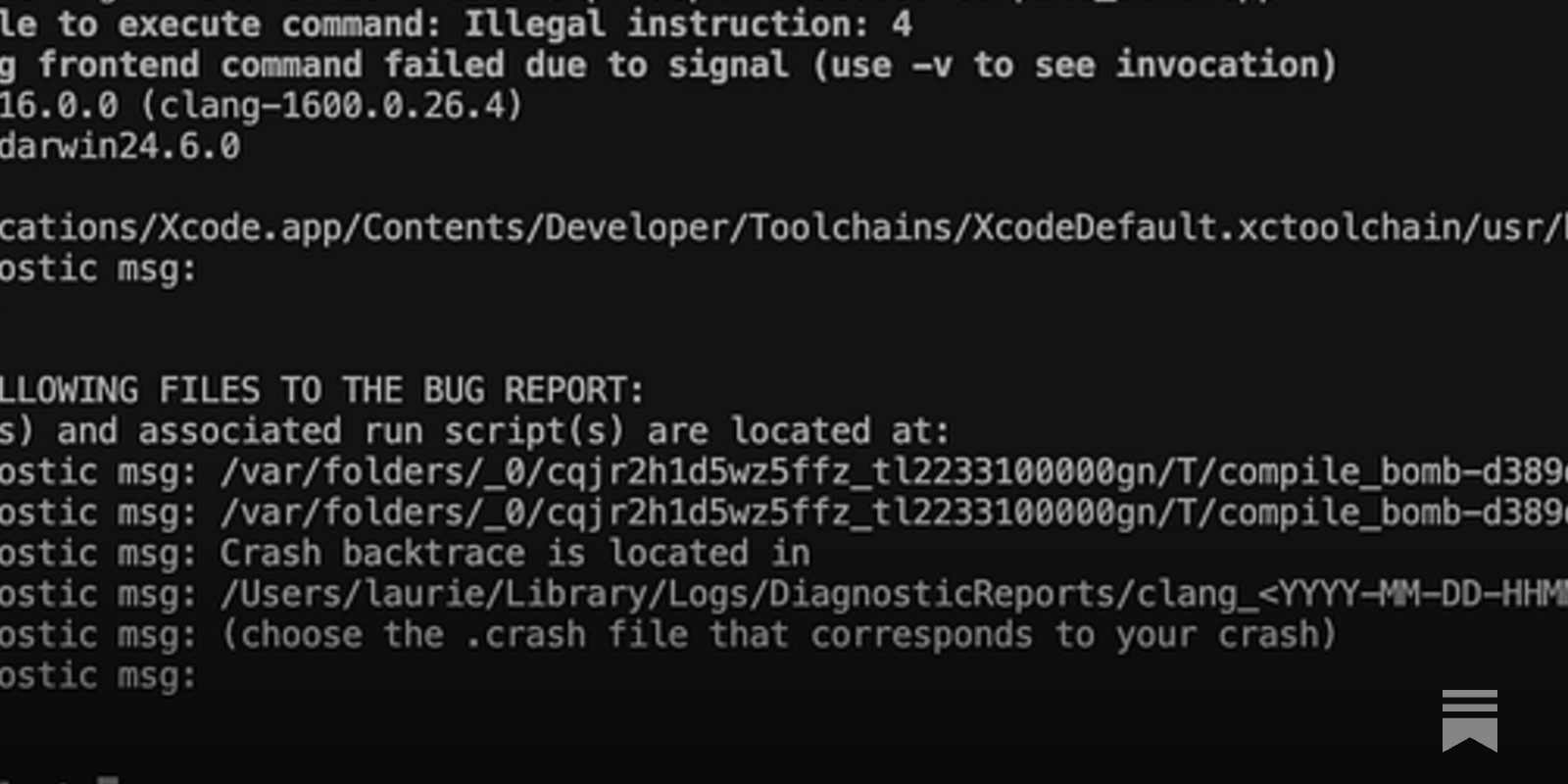
today you’re going to segfault your compiler.
lala-hakobyan/front-end-debugging-handbook
A comprehensive guide to debugging tools for modern, complex front-end applications. This handbook provides practical, real-world guidance on a complete suite of tools, from Chrome DevTools and framework extensions to integrated IDE debuggers.
[bug] tauri build errors out at bundling step · Issue #5175 · tauri-apps/tauri
Describe the bug When running tauri build the binary builds fine but then immediately errors out with thread '<unnamed>' panicked at 'Can't detect any appindicator library'...
Agent autonomously debugging Hashicorp Raft bugs using the Multiverse Debugger API
Exult
Since the 1.12.0 release we fixed some crashes and a plot stopping bug which warrant a hotfix release. Our new stable build has these fixes applied:
Exult
Since the 1.12.0 release we fixed some crashes and a plot stopping bug which warrant a hotfix release. Our new stable build has these fixes applied:
Sharing Debugger - Meta for Developers

Robin Berjon (@robin.berjon.com)
Again, we can try to be generous. But this fits a pattern. When people found issues in their open source code, instead of fixing them they went closed source. When they had an XSS vulnerability right at launch it took over a day for them to acknowledge and close it.

Snowflake Cortex AI Escapes Sandbox and Executes Malware
PromptArmor report on a prompt injection attack chain in Snowflake's Cortex Agent, now fixed. The attack started when a Cortex user asked the agent to review a GitHub repository that …
There Are No Bugs, Just TODOs | Almad's Changelog
One of my life’s traumas is the bug trackers, the issue trackers, the project management tools. The toolset that completes the version control log to form the development equivalent of double-entry bookkeeping.
Segfaults are our friends and teachers
This afternoon, I got a segmentation fault in a Rust program, and was confused. This is Rust, I shouldn’t get segfaults! I quickly checked the couple of places I used unsafe, and they were either calling C functions (and checking the errors), or telling the compiler not to initialize some memory because I was going to write into it unconditionally before reading from it.
Flawless - Durable Execution Engine
Flawless is an execution engine for durable computation. It will run your code until completion even in the presence of hardware or software failure.

@phi.zzstoatzz.io please use this thread for the audit. start with a small sample and report concrete examples, what works, what needs fixing, and any source/tool mismatch. we'd like your assessment of your own library hygiene before adding more capabilities.
Okay, it’s here! pdscheck.dev is LIVE!!! Thanks to @bad-example.com and @pds.dad for all their work on debug.hose.cam, and thanks to Claude for doing most of the heavy lifting. License is CC0 with an MIT fallback, and source is at tangled.org/chaosgreml.in/pdscheck, PRs OH SO WELCOME!

pdscheck — atproto PDS diagnostic
pdscheck.devHoly shit. Someone has decompiled the Adobe suite, rebuilt it in Rust and released it as open source. Either all software is dead or the US copyright laws are about to receive an update. getartcraft.com/apps

Crafting Apps: open-source creative tools
getartcraft.com

