

tl;dr: Our understanding of value dictates the marketing system we build.
Search, Discovery, Pills, and Portals
Solving the distribution crisis in marketing

There Are Actually Just Three Ways To Grow
Most brands obsess over distribution when the real growth comes from moves marketers can’t make alone

Understanding Abundance, part 1: It’s Caused by Consumers
Hello! If you’re coming here for the first time, thanks for checking out my writing on Medium. I don’t publish much here anymore — I’ve…

The Four Big Risks | Silicon Valley Product Group
In the first edition of my book, INSPIRED, I discussed how successful products are valuable, usable and feasible, where I defined “valuable” as both valuable to customers and valuable to your business. While it’s easy to remember these three attributes, over the years I’ve come to believe that it was obscuring some pretty serious risks and...

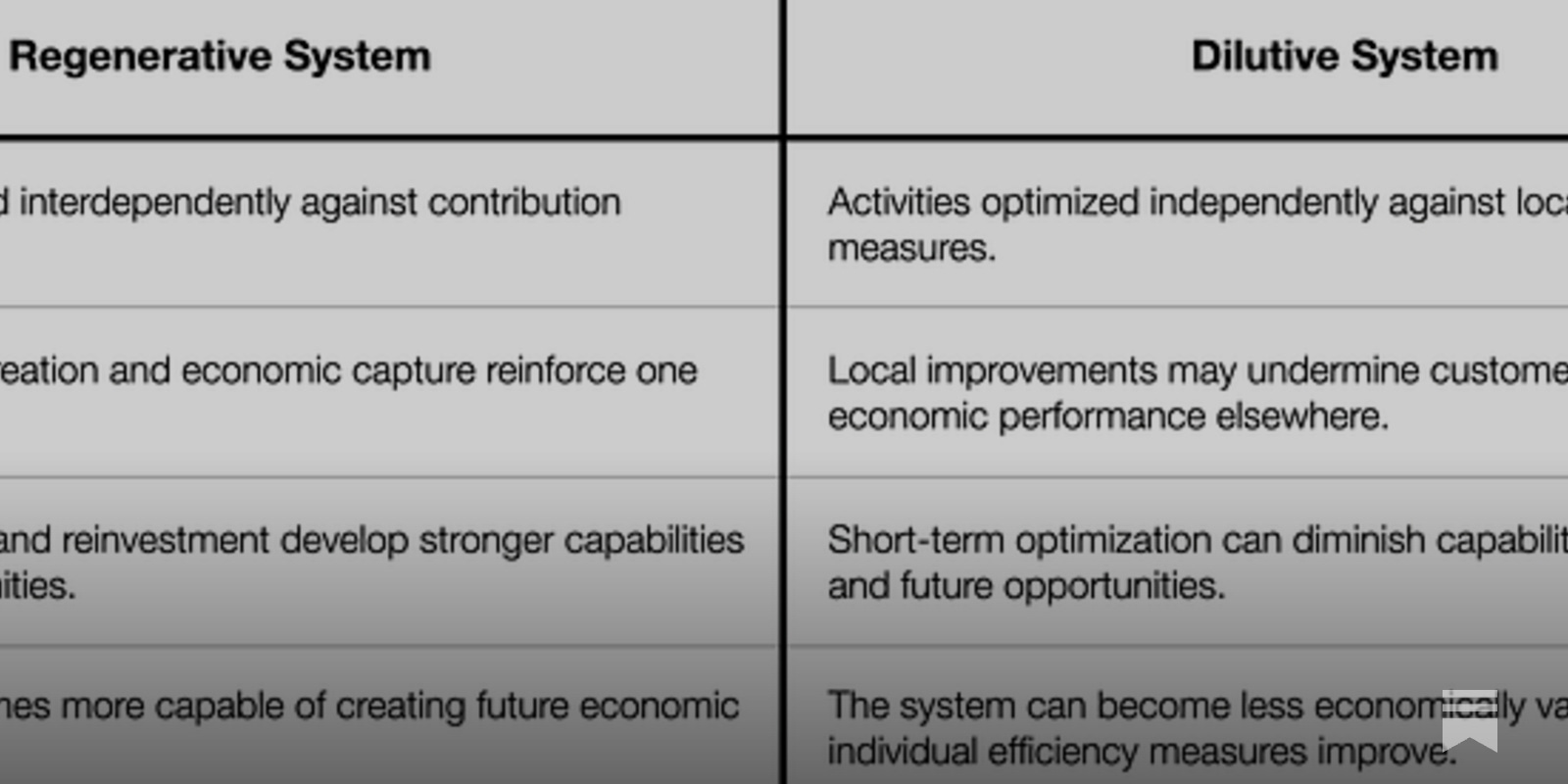
Regenerative Economics - Principles
Our hope is that the Regenerative Economics materials act like a wildflower, taking root in even the smallest of cracks and spreading seeds to change the way economics is understood by young people around the world. The guiding principles: Facilitate change from the ground up: We recognise the

Marketing Is an Argument - A Manifesto
A manifesto on human dignity in marketing. Against the Great Human Flattening.
kill the metrics in your head
Get in, loser, we’re doing an old-fashioned conversation-by-blog-post. Dan Sinker wrote recently about the Who Cares Era: The writer didn’t care. The supplement’s editors didn’t care. The biz people on both sides of the sale of the supplement didn’t care. The production people didn’t care. And, the fact that it took two days for anyone to discover this epic fuckup in print means that, ultimately, the reader didn’t care either. It’s so emblematic of the moment we’re in, the Who Cares Era, where completely disposable things are shoddily produced for people to mostly ignore. Then Les Orchard wrote in response that Only the Metrics Care: The user isn’t the customer. And they’re not the product either. The real product is behavioral optimization—metrics on a dashboard. The paying customer is somewhere else entirely, and the “content” is just a means to nudge behavior and juice KPIs. … The point isn’t to communicate. It’s to simulate relevance in order to optimize growth. It’s all goal-tracking, A/B tests, fake doors, and dark patterns. Both of those posts are great and you should read them, but reading them is not a prerequisite to reading this one. I just wanted to place this post in context of the conversation I’m dropping into.
Denizen
How might we promote and sustain human prosperity and well being in an economy of permanence? John Fullerton takes his cues from stable, healthy living systems to formulate eight principles for a regenerative economy.

AIDA model | Marketing | Research Starters | EBSCO Research
<p>The AIDA model is a marketing framework that outlines the stages consumers typically go through when making a purchasing decision: Attention, Interest, Desire, and Action. Developed in the late 19th century by American marketer Elias St. Elmo Lewis and later refined by Edward Strong in the 1920s, this model aims to guide marketers in capturing potential buyers' attention and leading them toward a purchase. </p> <p>In the Attention stage, marketers employ engaging strategies to attract consumers, often using eye-catching visuals or intriguing information. Next, the Interest stage focuses on maintaining that attention through memorable content or relatable messaging. The Desire stage demonstrates how a product or service fulfills the consumer's needs, often using persuasive techniques like testimonials or demonstrations. Finally, the Action stage prompts the consumer to make a purchase, providing clear instructions on how to proceed.</p> <p>While the AIDA model remains relevant, marketers today may adapt it to incorporate new elements, such as Retention or Satisfaction, reflecting the evolving digital landscape and consumer behavior. Overall, the AIDA model serves as a foundational tool for understanding consumer engagement and facilitating effective marketing strategies.</p>

Pricing — In a Moon
See how your kudos pool distributes among creators you appreciate.

Feature / Product / Business: A Framework for Sustainable ATProto Projects | ATmosphereConf VODs
The ATProto community built a ton of great features and products over the past year! For our next trick, let's mature them into products and businesses. In this talk, you'll get a practical framework for understanding whether what you're building should be a feature, product, or business, plus concrete funding models at each layer to keep your work going and growing. (More in this thread: https://bsky.app/profile/mosh.bsky.social/post/3mckiat2ne22q)
On Taste, Effort & Curiosity - again
When AI collapses how long it takes to ship, what’s left is judgment, experimentation, and knowing what not to build.
How To Think In Funnels (And Achieve The Best Possible Outcomes)
Elias Elmo Lewis created a formula that changed marketing forever. But his method applies beyond marketing. Here's how to think in funnels:
Exploring the Frontier of Feeds - The Open Garden
Reorienting distribution and monetization in the attention economy.
Exploring the Frontier of Feeds - The Open Garden
Reorienting distribution and monetization in the attention economy.