

We are a non-profit organization dedicated to improving Wikipedia and other open platforms. We do so by providing monthly stipends to full-time contributors and translators. We leverage AI (Large Language Models) to automate most of the work.
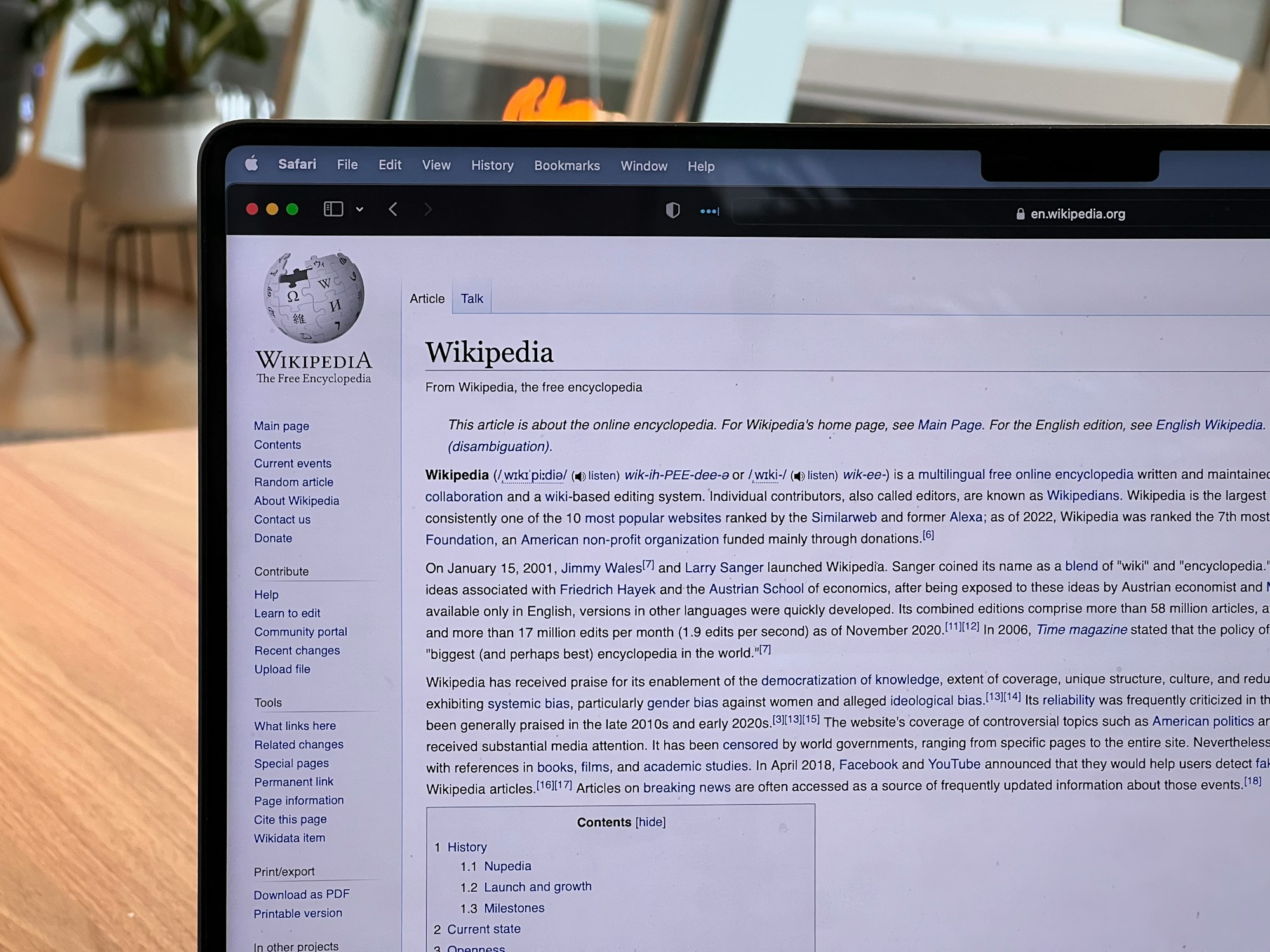
Wikipedia Says AI Is Causing a Dangerous Decline in Human Visitors
“With fewer visits to Wikipedia, fewer volunteers may grow and enrich the content, and fewer individual donors may support this work.”
AI Contribution Policies
Ready-to-use AI contribution policies for open source projects.
The Lenfest AI Collaborative has additional funding. That's great for open source in news.
The Lenfest AI Collaborative lets newsrooms explore a new technology together - but more importantly, it gives them the muscle to open source their work and collaborate.

Category:Articles translated by an OKA editor
The following 200 pages are in this category, out of approximately 5,177 total. This list may not reflect recent changes.
Wikidata Launches Free Vector Database as Open Alternative to Closed AI Systems
Wikidata has launched something big.
AI and the Collapse of the www
This paper studies market design for generative AI intermediation. AI answer systems can improve user experience while diverting visits that finance publisher content and generate source-level quality signals. I show that an AI platform that underinternalizes future content reproduction retains too little referral traffic and can make costly open-web information subcritical, even with truthful content, accurate answers, and rational users. The mechanism can be self-reinforcing: less source-level measurement weakens conventional search, inducing further AI reliance. Sustainable repair requires replacing displaced revenue and deleted measurement through visitor-replacement royalties, audited provenance, human-information audits, and keystone-topic compensation.

Curated retrieval versus open web search in public AI information...
Public institutions increasingly use large language models (LLMs) to answer citizens' questions, often pairing a curated knowledge base with live web search, yet whether the sources behind these...

AI creates asymmetric pressure on Open Source
How Open Source communities can adapt to AI-generated contributions without overwhelming Open Source maintainers

DBpedia Abstracts: A Large-Scale, Open, Multilingual NLP Training Corpus
The ever increasing importance of machine learning in Natural Language Processing is accompanied by an equally increasing need in large-scale training and evaluation corpora. Due to its size, its openness and relative quality, the Wikipedia has already been a source of such data, but on a limited scale. This paper introduces the DBpedia Abstract Corpus, a large-scale, open corpus of annotated Wikipedia texts in six languages, featuring over 11 million texts and over 97 million entity links. The properties of the Wikipedia texts are being described, as well as the corpus creation process, its format and interesting use-cases, like Named Entity Linking training and evaluation.
Going beyond open data – increasing transparency and trust in language models with OLMoTrace | Ai2
Ai2, a non-profit research institute founded by Paul Allen, is committed to breakthrough AI to solve the world’s biggest problems.
Wikipedia Is Battling for the Soul of the Internet
The internet’s largest stockpile of free knowledge is under threat from MAGA, A.I. and foreign autocrats. A bibliophile ex-ambassador is here to help.

OpenAI launches new initiative to help find and patch open source bugs | TechCrunch
OpenAI is using AI to help the open source community better protect itself.

Google's OKF - The New Way to Structure Your Knowledge for Agents
Content Independence Day, one year on- building the business model for the agentic Internet
One year after declaring Content Independence Day, a dynamic market for monetized content has officially emerged. In this report, we examine how the rise of autonomous AI agents is upending traditional search referrals and detail the new infrastructure required to support a sustainable web economy.

I'd like to see some coordination in the open source community to respond to this. The outcome could shape significant funding and strategic moves. Off the top of my head, there's a few things that I'd like to see in a new European open source strategy. 🧵

Maximilian Henning
The @ec.europa.eu will soon present “a combination of funding and policy measures” to support European open source projects in becoming commercially viable alternatives to proprietary US tech. Read my article at @euractiv.com: euractiv.com/news/commission-wants-to-comm…
Sure. AI companies have ALWAYS been training their models on Wikipedia content, which under the free and open access model is available to anyone — including AI companies. Agreements like these require AI companies to limit and offset the strain they place on Wikimedia infrastructure.

Club Announcement Spurs 🤦♂️
Hoping that @molly.wiki can help explain.

