


The manifesto for our brand new rich text editor with version control capabilities, v2. In this post, we describe the basic principles, design decisions and our vision for v2, alongside reflecting on the current state and potential future of knowledge production in society.
v2 Editor
v2 is a local-first writing tool that treats your documents as evolving artifacts, preserving every version in open formats that last.
Universal Version Control
Building tools to help people explore alternatives, keep track of history, and collaborate better, across all kinds of media.

The Lore Version Control System - Lore Developer Documentation
A reference document explaining the rationale, goals, and theoretical design of Lore. This is not a peer-reviewed paper; it is a public-facing standalone description of the system, intended to make the why of Lore - the problems it was built to solve and the design choices that follow from those problems - as legible as a reader can make it without reading the source code.
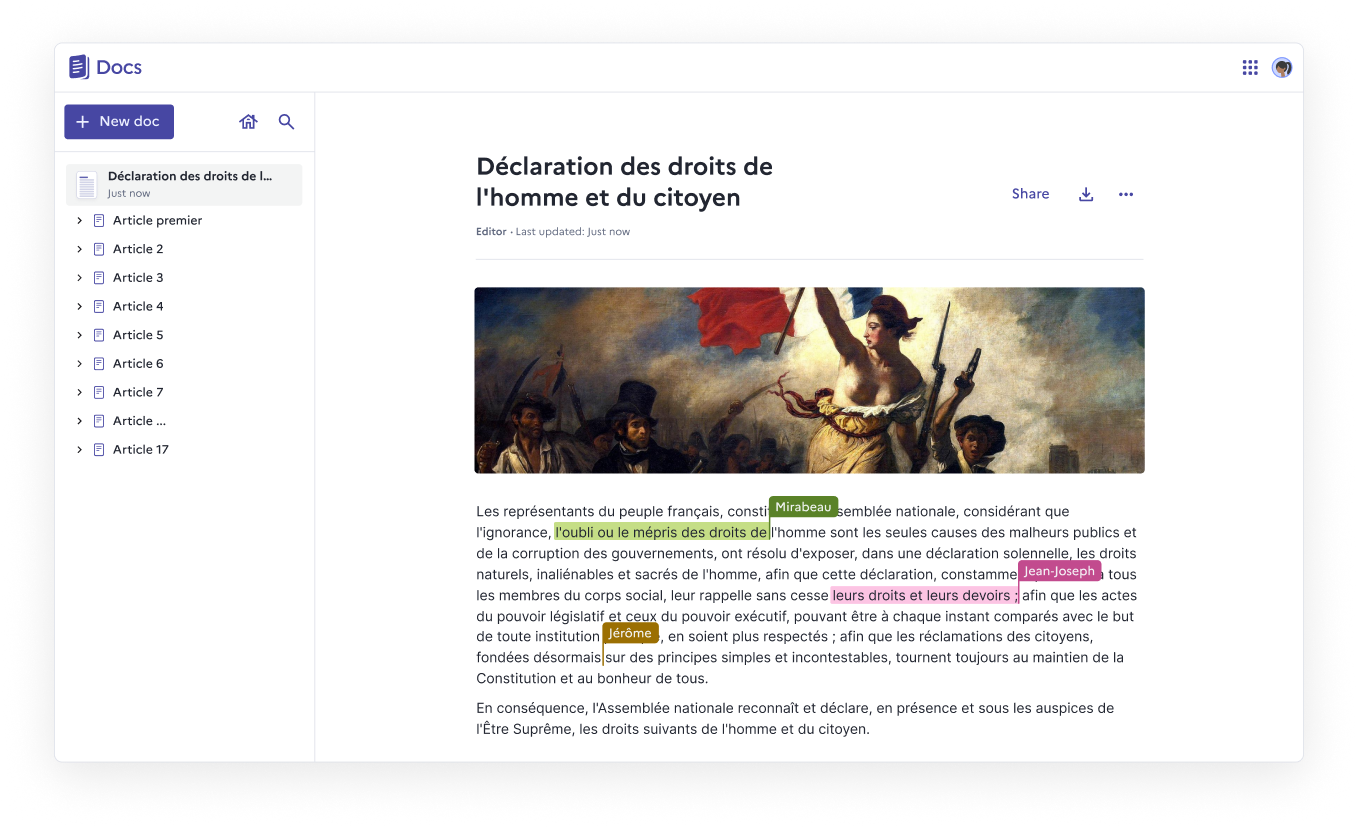
Docs — Turn your team's content into knowledge
Docs is the open-source document editor that turns your team's content into knowledge: real-time collaboration, structured knowledge, and full data ownership. Self-host it anywhere, or try a public instance in seconds.
Learn about Lore: next-generation open source version control
Maintained by Epic Games, Lore is designed for unprecedented scalability of both data and teams. It’s optimized for projects that combine code with large binary assets.
01 · Universal version control
We believe that simple, powerful, universal version control tools could help all kinds of creators produce better work.
Steps Towards an Infrastructure for Scholarly Synthesis
Sharing, reusing, and synthesizing knowledge is central to the research process, both individually, and with others. These core functions are not supported by our formal scholarly publishing infrastructure: instead of the smooth functioning of functional infrastructure, researchers resort to laborious "hacks" and workarounds to "mine" publications for what they need, and struggle to efficiently share the resulting information with others. Information scientists have proposed an alternative infrastructure based on the more appropriately granular model of a discourse graph of claims, and evidence, along with key rhetorical relationships between them. However, despite significant technical progress on standards and platforms, the predominant infrastructure remains steadfastly document-based. Drawing from infrastructure studies, we locate the current infrastructural bottlenecks in the lack of local systems that integrate discourse-centric models to augment synthesis work, from which an infrastructure for synthesis can be grown. Through 3 years of research through design and field deployment in a distributed community of hypertext notebook users, we elaborate a design vision of what can and should be built in order to grow a discourse-centric synthesis infrastructure: a thriving "installed base" of researchers authoring local, shareable discourse graphs to improve synthesis work, enhance primary research and research training, and augment collaborative research. We discuss how this design vision -- and our empirical work -- contributes steps towards a new infrastructure for synthesis, and increases HCI's capacity to advance collective intelligence and solve infrastructure-level problems.

Synchronized editing: the future of collaborative writing
A growing suite of tools allows teams of researchers to work collectively to edit scientific documents.

Steps Towards an Infrastructure for Scholarly Synthesis
Sharing, reusing, and synthesizing knowledge is central to the research process, both individually, and with others. These core functions are not supported by our formal scholarly publishing infrastructure: instead of the smooth functioning of functional infrastructure, researchers resort to laborious ”hacks” and workarounds to ”mine” publications for what they need, and struggle to efficiently share the resulting information with others. Information scientists have proposed an alternative infrastructure based on the more appropriately granular model of a discourse graph of claims, and evidence, along with key rhetorical relationships between them. However, despite significant technical progress on standards and platforms, the predominant infrastructure remains steadfastly document-based. Drawing from infrastructure studies, we locate the current infrastructural bottlenecks in the lack of local systems that integrate discourse-centric models to augment synthesis work, from which an infrastructure for synthesis can be grown. Through 3 years of research through design and field deployment in a distributed community of hypertext notebook users, we elaborate a design vision of what can and should be built in order to grow a discourse-centric synthesis infrastructure: a thriving “installed base” of researchers authoring local, shareable discourse graphs to improve synthesis work, enhance primary research and research training, and augment collaborative research. We discuss how this design vision — and our empirical work — contributes steps towards a new infrastructure for synthesis, and increases HCI’s capacity to advance collective intelligence and solve infrastructure-level problems.
Collaborative Editor Demo App
Introducing Aris: The publishing platform for the Post-PDF Era - Aris
We're building the future of academic publishing: tools that make it easy to create, share, and preserve knowledge in formats designed for the web, not the printing press.
DITA Open Toolkit
The open-source publishing engine for content authored in the Darwin Information Typing Architecture
Announcing Changesets v3 | Changesets
A tool to manage versioning and changelogs with a focus on monorepos
okay, introducing standard.horse! an editor for simple @standard.site publications if you've hand-rolled your standard.site blog, this provides a simple markdown editor and publication management interface

standard.horse
standard.horseokay, introducing standard.horse! an editor for simple @standard.site publications if you've hand-rolled your standard.site blog, this provides a simple markdown editor and publication management interface
standard.horse
standard.horse