


A new way for writers on Substack to recommend each other and discover more great work
How to build community around your publication
Tips for building your community on Substack, courtesy of Bailey Richardson, who helped shape the communities around Instagram, IDEO, and Pop-Up Magazine.

substandard-recs
We'll ask permission to read your likes from the last 30 days and match you with long-form writing published on Standard.site. Your recommendations page will be public.
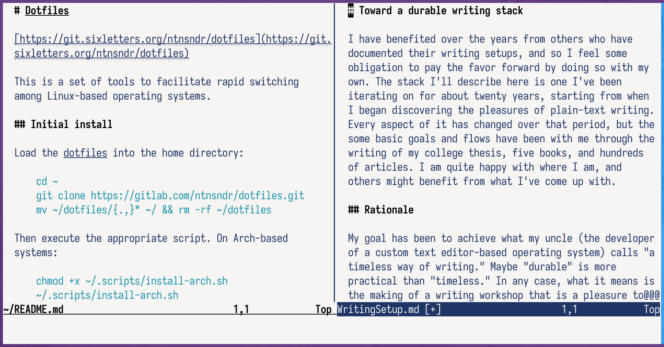
Toward a durable writing stack – Writings and rehearsals by Nathan Schneider
I have benefited over the years from others who have documented their writing setups, and so I feel some obligation to pay the favor forward by doing so with my own. The stack I’ll describe here is one I’ve been iterating on for about twenty years, starting from when I began discovering the pleasures of plain-text writing. Every aspect of it has changed over that period, but the some basic goals and flows have been with me through the writing of my college thesis, five books, and hundreds of articles. I am quite happy with where I am, and others might benefit from what I’ve come up with.

Connecting with your readers on Semble [Patterns of Sensemaking #2] - Cosmik Labs
On how the references you make help your writing find its natural audience
BridgEU: new project to study how recommendation systems can reduce polarization | SynoSys
A new collaborative project with Philipp Lorenz-Spreen, Eurosky, and SPRIND explores whether social media recommendation algorithms can strengthen public discourse instead of reinforcing divisions.
Substack writers, you need a website!
Substack is convenient, but treat it as a distribution tool for your content. Your content should live on an independently owned website, which has a domain name you control and own. This way, you …

On Writing #3
Periodically I like to gather various observations about writing, and share my perspective.

Letting Users Choose Recommender Algorithms: An Experimental Study
Recommender systems are not one-size-fits-all; different algorithms and data sources have different strengths, making them a better or worse fit for different users and use cases. As one way of taking advantage of the relative merits of different algorithms, we gave users the ability to change the algorithm providing their movie recommendations and studied how they make use of this power. We conducted our study with the launch of a new version of the MovieLens movie recommender that supports multiple recommender algorithms and allows users to choose the algorithm they want to provide their recommendations. We examine log data from user interactions with this new feature to understand whether and how users switch among recommender algorithms, and select a final algorithm to use. We also look at the properties of the algorithms as they were experienced by users and examine their relationships to user behavior.
Paper Skygest: Personalized Academic Recommendations on Bluesky
We build, deploy, and evaluate Paper Skygest, a custom personalized social feed for scientific content posted by a user's network on Bluesky and the AT Protocol. We leverage a new capability on emerging decentralized social media platforms: the ability for anyone to build and deploy feeds for other users, to use just as they would a native platform-built feed. To our knowledge, Paper Skygest is the first and largest such continuously deployed personalized social media feed by academics, with over 50,000 weekly uses by over 1,000 daily active users, all organically acquired. First, we quantitatively and qualitatively evaluate Paper Skygest usage, showing that it has sustained usage and satisfies users; we further show adoption of Paper Skygest increases a user's interactions with posts about research, and how interaction rates change as a function of post order. Second, we share our full code and describe our system architecture, to support other academics in building and deploying such feeds sustainably. Third, we overview the potential of custom feeds such as Paper Skygest for studying algorithm designs, building for user agency, and running recommender system experiments with organic users without partnering with a centralized platform.

The Price of Advice: Experimental Evidence on the Effects of AI Recommenders
<p><span>The integration of large language models (LLMs) into recommender systems (RS) has given rise to a new generation of Conversational RS (CRS). This study

nonstandard-recs
We'll ask permission to read your likes from the last 30 days and match you with long-form writing published on Standard.site. Your recommendations page will be public.
I wrote a custom Bluesky feed! It's a classifier trained my past likes. As a bonus, I got to learn more about recommender systems ("RecSys"). adamwiggins.com/posts/a-bluesky-feed-for-one/

A Bluesky feed for one · Adam Wiggins
adamwiggins.com
