Different disciplines have studied employee voice as a key component of workplaces. However, they have not tended to look at voice as a journey en route to enhanced (or diminished) employee voice with a start, diversion, delay and combining twists and turns during processes leading to outcomes. In this article, we build on existing theory and phenomena to develop the concept of ‘employee voice pathways’. We use this concept to provide a framework for analysing the processes underpinning employee voice as a potential desirable form of employee voice as well as outlining areas for a future research agenda.
Building Effective Voice Agents — Toki Sherbakov + Anoop Kotha, OpenAI
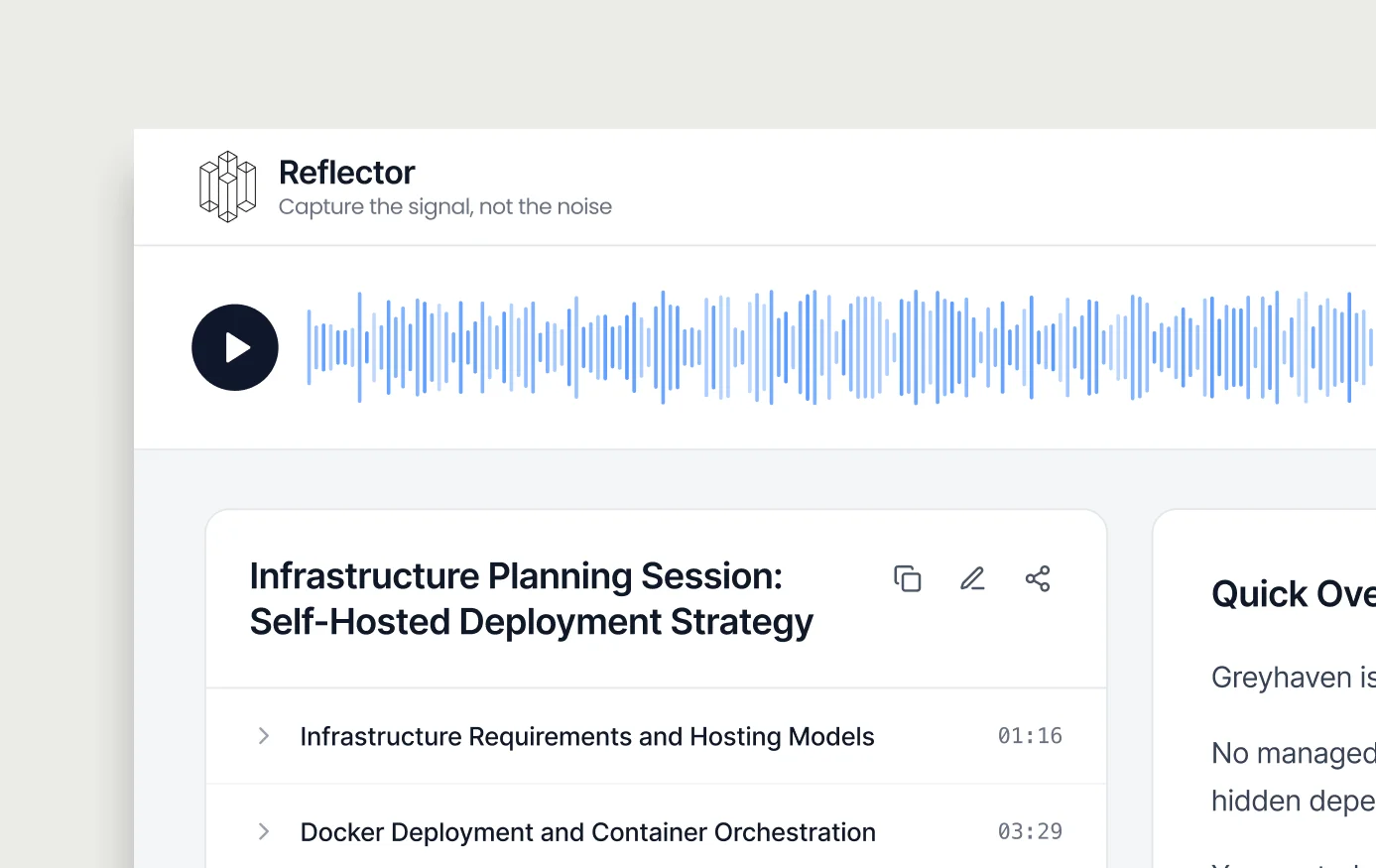
Reflector: Infrastructure for Meetings, by Greyhaven
Most organizations run on meetings. Strategy gets debated there. Decisions get made there. Context lives there. And yet...
Luozhu on Twitter / X
I taught a speech model to understand context in conversation. This is what happenedIt adjusts voice and tone to express urgency, comfort, understanding from the dialogue. Just like a real human being520M model. Runs locally on consumer devicesHow this is achieved 🧵 pic.twitter.com/oMgSh2TKbO— Luozhu (@LuozhuZhang) February 27, 2026

Appropriating Technology | Public Sphere Project — Liberating Voices Pattern Language
Dematerialization, Participatory Design, Techno-Criticism, Intermediate Technologies, Users' IT Quality Network, Wholesome Design for Wicked Problems, Labor Visions, Community Inquiry, Tactical Media
Eliciting Advice Instead of Feedback Improves Developmental Input
Most organizations encourage employees to provide feedback to one another to support learning, personal growth, and career advancement. However, employee feedback often fails to improve performance because it lacks concrete, specific guidance. We provide a temporal explanation for why workplace input processes routinely fail to produce valuable and concrete developmental insights: they are insufficiently focused on the future. In this paper, we theorize and demonstrate that encouraging input providers to think about the future leads them to produce more concrete developmental input. Across a large scale, preregistered field experiment (n = 27,432 comments) and two laboratory studies (n = 806), people provide more concrete and actionable developmental input when they are prompted to provide future-looking “advice” rather than “feedback,” a common method of soliciting input in organizations. The effect of soliciting advice on input concreteness was mediated by providers’ future focus. Moreover, in a follow-up study, such concrete input was assessed by independent raters as more useful. These findings highlight the role of temporal orientation in driving the content of developmental input. In doing so, our data suggest that individuals and organizations have the potential to promote higher-quality developmental input by attending to the temporal orientation that their input systems encourage. This paper was accepted by Isabel Fernandez-Mateo, organizations. Funding: Funding for the laboratory experiments was provided by Harvard Business School. Supplemental Material: The supplementary appendix and data files are available at https://doi.org/10.1287/mnsc.2022.03207 .


Voice AI & Voice Agents | An Illustrated Primer
A comprehensive guide to voice AI in 2026
The Published Voice: Whose Voice Are We Really Reading? - The Scholarly Kitchen
What happens then to “author voice,” which has always been an important consideration to authors and reviewers alike, if AI is helping researchers with their writing?

Will AI shape the way we speak? The emerging sociolinguistic influence of synthetic voices
The growing prevalence of conversational voice interfaces, powered by developments in both speech and language technologies, raises important questions about their influence on human communication. While written communication can signal identity through lexical and stylistic choices, voice-based interactions inherently amplify socioindexical elements - such as accent, intonation, and speech style - which more prominently convey social identity and group affiliation. There is evidence that even passive media such as television is likely to influence the audience's linguistic patterns. Unlike passive media, conversational AI is interactive, creating a more immersive and reciprocal dynamic that holds a greater potential to impact how individuals speak in everyday interactions. Such heightened influence can be expected to arise from phenomena such as acoustic-prosodic entrainment and linguistic accommodation, which occur naturally during interaction and enable users to adapt their speech patterns in response to the system. While this phenomenon is still emerging, its potential societal impact could provide organisations, movements, and brands with a subtle yet powerful avenue for shaping and controlling public perception and social identity. We argue that the socioindexical influence of AI-generated speech warrants attention and should become a focus of interdisciplinary research, leveraging new and existing methodologies and technologies to better understand its implications.

Will AI shape the way we speak? The emerging sociolinguistic influence of synthetic voices
The growing prevalence of conversational voice interfaces, powered by developments in both speech and language technologies, raises important questions about their influence on human communication. While written communication can signal identity through lexical and stylistic choices, voice-based interactions inherently amplify socioindexical elements - such as accent, intonation, and speech style - which more prominently convey social identity and group affiliation. There is evidence that even passive media such as television is likely to influence the audience's linguistic patterns. Unlike passive media, conversational AI is interactive, creating a more immersive and reciprocal dynamic that holds a greater potential to impact how individuals speak in everyday interactions. Such heightened influence can be expected to arise from phenomena such as acoustic-prosodic entrainment and linguistic accommodation, which occur naturally during interaction and enable users to adapt their speech patterns in response to the system. While this phenomenon is still emerging, its potential societal impact could provide organisations, movements, and brands with a subtle yet powerful avenue for shaping and controlling public perception and social identity. We argue that the socioindexical influence of AI-generated speech warrants attention and should become a focus of interdisciplinary research, leveraging new and existing methodologies and technologies to better understand its implications.
Why ChatGPT Keeps Interrupting You — Dr. Tom Shapland, LiveKit
Effective voice: Beyond exit and affect in online communities - Seth Frey, Nathan Schneider, 2023
Online communities provide ample opportunities for user self-expression but generally lack the means for average users to exercise direct control over community...

Yap — Post with your voice
The social network that listens. Record a thought, drop it in the feed, and let your voice do the talking. Decentralized. Unfiltered. Loud.
Yap — Post with your voice
The social network that listens. Record a thought, drop it in the feed, and let your voice do the talking. Decentralized. Unfiltered. Loud.
Exit, Voice, and Platform Loyalty
A recent article by Renée DiResta is interesting for a number of different reasons.