


ABSTRACT This study investigates the mechanisms by which gig platforms degrade labour conditions over time, building on the concept of platform decay, or ‘enshittification’, initially developed in the context of social media platforms. In this article, we draw on 30 interviews with long‐term gig workers in the ride‐hail and grocery delivery sectors, offering insights into how these companies shift from offering attractive working conditions to exploiting labour as these services develop market power via network effects. We identify three mechanisms through which gig companies claw back value from workers over time: burden shifting (transferring operational costs to workers), feature addition and alteration (increasing the demands on workers), and market manipulation (reducing worker bargaining power). We then explore how workers respond to platform decay, finding that workers adopt three responses: effort recalibration , multi‐homing and navigating the changing conditions through what we term toxic resilience . This study contributes to the gig work literature by developing a framework to explain how working conditions in the gig economy improve or degrade over time. In doing so, this article provides a framework for organizing the growing constellation of labour research on gig workers.

High score, low pay: why the gig economy loves gamification
The long read: Using ratings, competitions and bonuses to incentivise workers isn’t new – but as I found when I became a Lyft driver, the gig economy is taking it to another level

Design From the Margins
In an age of virtual connectivity and increased reliance on the internet for daily functions, including by marginalized groups, can companies and technologists reframe their features or standards to support the most marginalized users’ needs? Can the modes of resilience within digital spaces from some of the most marginalized groups be listened to, learned from, and centered when creating technology? Design from the Margins (DFM), a design process that centers the most impacted and marginalized users from ideation to production, pushes the notion that not only is this something that can and must be done, but also that it is highly beneficial for all users and companies. For this to happen, consumer interest conversations need to be framed outside the “biggest use case” scenarios and United States and European Union-centrisms and refocused on the cases often left in the margins: the decentered cases. This report outlines how the DFM method can be used to build our most well-known and relied-upon technologies for decentered cases (often deemed “edge cases” which is atypical or less common use case for a product) from the beginning of the design process, rather than retrofitting them post-deployment to cater to communities with what are perceived to be extra needs.

Automation is coming for the gig economy
A safety net for people who have fallen out of the formal labour market is being dismantled

The platformization of cultural production: Theorizing the contingent cultural commodity
This article explores how the political economy of the cultural industries changes through platformization: the penetration of economic and infrastructural extensions of online platforms into the web, affecting the production, distribution, and circulation of cultural content. It pursues this investigation in critical dialogue with current research in business studies, political economy, and software studies. Focusing on the production of news and games, the analysis shows that in economic terms platformization entails the replacement of two-sided market structures with complex multisided platform configurations, dominated by big platform corporations. Cultural content producers have to continuously grapple with seemingly serendipitous changes in platform governance, ranging from content curation to pricing strategies. Simultaneously, these producers are enticed by new platform services and infrastructural changes. In the process, cultural commodities become fundamentally “contingent,” that is increasingly modular in design and continuously reworked and repackaged, informed by datafied user feedback.

The Truth About Social Media as an "Advertising Industry," Bluesky's Gamble, and "Reclaiming Conversation" - Nightflight
Preparing for the Creator Economy Apocalypse (with Chris Gethard)
Design choices: Mechanism design and platform capitalism
Mechanism design is a form of optimization developed in economic theory. It casts economists as institutional engineers, choosing an outcome and then arranging a set of market rules and conditions to achieve it. The toolkit from mechanism design is widely used in economics, policymaking, and now in building and managing online environments. Mechanism design has become one of the most pervasive yet inconspicuous influences on the digital mediation of social life. Its optimizing schemes structure online advertising markets and other multi-sided platform businesses. Whatever normative rationales mechanism design might draw on in its economic origins, as its influence has grown and its applications have become more computational, we suggest those justifications for using mechanism design to orchestrate and optimize human interaction are losing traction. In this article, we ask what ideological work mechanism design is doing in economics, computer science, and its applications to the governance of digital platforms. Observing mechanism design in action in algorithmic environments, we argue it has become a tool for producing information domination, distributing social costs in ways that benefit designers, and controlling and coordinating participants in multi-sided platforms.
Digitalisation and the Remaking of the Ideal Worker
The ideal worker concept, typified by an unencumbered male, continues to influence workplace norms, despite a more gender-mixed workforce. This article examines whether this concept is being disrupted or reproduced as digitalisation becomes increasingly embedded in the workplace. Based on qualitative research in two professional services firms, the analysis shows how the ideal worker themes of work prioritisation and presenteeism have been maintained but adapted. Significantly, the study reveals how the novel dimension of connectedness is reshaping the ideal worker norm as enhanced digitalisation becomes interwoven in social relations. This has modified informal expectations about how, when and where work is performed, altering work organisation. This reconfiguration may in principle broaden scope for conformity with the ideal worker model, but in practice the heightened intrusion of work demands on personal time and into domestic space potentially works against gender equality.
Money as Message | Andreessen Horowitz
Network effects — where a product or service becomes more valuable to its users as more people use it — are one of the key ways software businesses maintain a better product and more defensible market position. This is especially true of messaging apps like WeChat — which, as I’ve argued before, is not just...

More work for your labor-value - The Wobbly World of Miftah's Words
...and more exploitation for your location.
Berlin Biennale | All Problems Can Be Illuminated; Not All Problems Can Be Solved
We can all tell this story: The rails of human advancement stretching from the Enlightenment to a Bitcoin start-up; innovation measured by increased reach, increased uniformity, increased predictability and size and quickness. The telegraph to the landline to the mobile phone to the Bluetooth wearable; the abacus to Pascal’s mechanical calculator to the room-sized computer to the palm-sized device a million times more powerful than equipment a thousand times its size from only ten years ago; the stone tablet to the book to the internet offering everything, no excuses. We are all connected. We’re at the bright tip of a comet hurtling forward. We can place ourselves, with mild satisfaction. Thank god it’s not then. What kind of person uses a BlackBerry? (Old people!)

Berlin Biennale | All Problems Can Be Illuminated; Not All Problems Can Be Solved
We can all tell this story: The rails of human advancement stretching from the Enlightenment to a Bitcoin start-up; innovation measured by increased reach, increased uniformity, increased predictability and size and quickness. The telegraph to the landline to the mobile phone to the Bluetooth wearable; the abacus to Pascal’s mechanical calculator to the room-sized computer to the palm-sized device a million times more powerful than equipment a thousand times its size from only ten years ago; the stone tablet to the book to the internet offering everything, no excuses. We are all connected. We’re at the bright tip of a comet hurtling forward. We can place ourselves, with mild satisfaction. Thank god it’s not then. What kind of person uses a BlackBerry? (Old people!)
What Managers Need to Know About Social Tools
To identify the value that social tools can bring to companies, the authors split employees at a large financial services firm into two groups, only one of which used an internal social platform, and observed them for six months. Those who had used the tool became 31% more likely to find coworkers with relevant expertise and 88% more likely to discover who had useful connections. Internal social tools can help employees make faster decisions, develop more innovative ideas for products and services, and become more engaged in their work and their companies. But companies that try to “go social” often fall into four traps: They (1) assume that Millennials will embrace social tools at work; (2) struggle to foster personal interaction that builds trust and promotes knowledge sharing; (3) fail to recognize how learning occurs on social tools; and (4) focus on the wrong data. The authors offer advice on how to avoid these traps.

In-Store Spending Dynamics: How Budgets Invert Relative-Spending Patterns
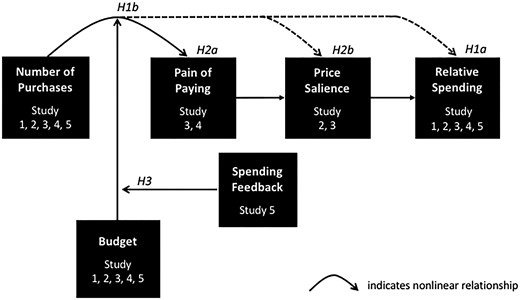
Abstract The authors conduct four controlled lab experiments and one field study in a brick-and-mortar grocery store to demonstrate that relative spending—the price of the purchased item relative to the mean price of the product category—evolves nonlinearly and distinctly for budget and nonbudget shoppers. While the relative spending of budget shoppers evolves in a concave manner, the relative spending of nonbudget shoppers evolves inversely in a convex manner. Thus, budget (nonbudget) shoppers spend relatively more (less) in the middle than at the beginning and toward the end of their shopping trip. Mediation analyses confirm that the pain of paying experienced while shopping drives price salience, which then drives relative spending. Moreover, manipulating shoppers’ pain of paying, by altering the opportunity costs associated with their spending or drawing shoppers’ attention to their spending via real-time spending feedback, is shown to influence these spending patterns. The research offers theoretical contributions to the in-store decision-making, budgeting, and pain-of-paying literature and has important implications for marketing and promotion strategies in retail and mobile technology environments, as it suggests when a shopper may be more sensitive to price-related factors.
hey builders and devs in the open social web! just curious about what's the state of burnout and bus factors within both the fediverse + atmosphere ecosystems, so feel free to chime in the forums or replies: discourse.atmosphere.community/t/the-state-of-burnout-and-bu…

The state of burnout and bus factors in the open social web
discourse.atmosphere.community