Abstract The practice assignments in a mathematics textbook or course can be arranged so that most of the problems relating to any particular concept are massed together in a single assignment, or these related problems can be distributed across many assignments–a format known as spaced practice. Here we report the results of two classroom experiments that assessed the effects of mathematics spacing on both test scores and students' predictions of their test scores. In each experiment, students in Year 7 (11–12 years of age) either massed their practice into a single session or divided their practice across three sessions spaced 1 week apart, followed 1 month later by a test. In both experiments, spaced practice produced higher test scores than did massed practice, and test score predictions were relatively accurate after spaced practice yet grossly overconfident after massed practice.
Dylan Wiliam on Twitter / X
The best journal article titles tell you what the study actually found, rather than being a teaser to make you read the paper. Here's a good example: "Spaced mathematics practice improves test scores and reduces overconfidence" https://t.co/iXxdkAgYPM ($)— Dylan Wiliam (@dylanwiliam) December 31, 2024
Math Academy
Q. Michael Pershan’s main critique of spaced repetition in the context of Math Academy?A. It reinforces his memory of a shallow understanding.
Spaced repetition
Spaced repetition is an evidence-based learning technique that is usually performed with flashcards. Newly introduced and more difficult flashcards are shown more frequently, while older and less difficult flashcards are shown less frequently in order to exploit the psychological spacing effect. The use of spaced repetition has been proven to increase the rate of learning.

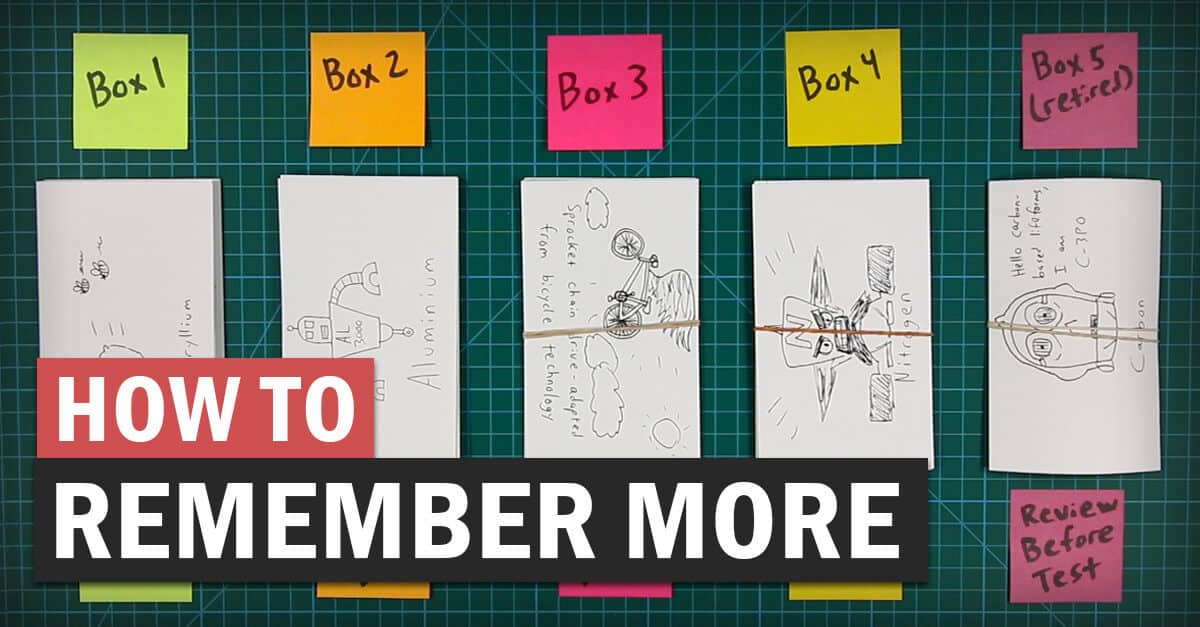
How to Remember More of What You Learn with Spaced Repetition
Using spaced repetition in conjunction with other study techniques can help you memorize information much, much more quickly. Here's how to do it.
Using spaced repetition systems to see through a piece of mathematics
By Michael Nielsen, January 2019
Kids who use ChatGPT as a study assistant do worse on tests
Researchers compare math progress of almost 1,000 high school students

Mochi - Spaced repetition flashcards
Take notes and make flashcards using markdown, then study them using spaced repetition.
Sleep: Educational Impact and Habit Formation
In a field experiment among US university students, incentives for sleep increase both sleep and academic performance. Our primary intervention pairs bedtime reminders with morning feedback and immediate rewards for sleeping at least 7 hours on weeknights. The intervention raises the share of weeknights with 7+ hours of sleep by 26% and average sleep by 19 minutes during a 4-week treatment period, with posttreatment effects of 8 minutes. Immediate incentives outperform both delayed incentives and reminders/feedback alone during treatment but have no distinguishable impacts posttreatment. The primary intervention improves average semester course performance by 0.075–0.089 grade points, a 0.10–0.11 standard deviation increase. Our results demonstrate that incentives targeting sleep can be a cost-effective approach to improve educational outcomes.
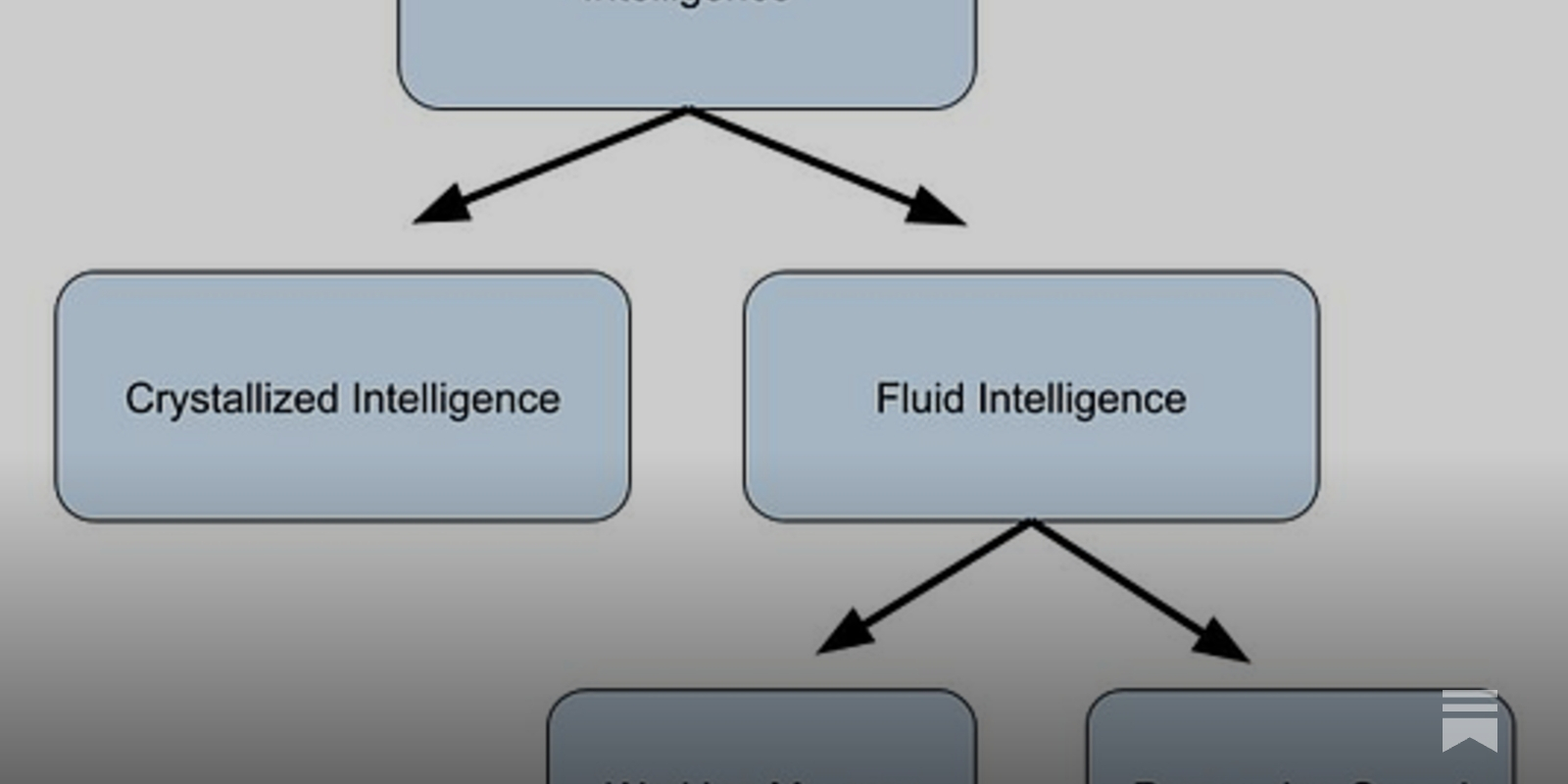
Why Some Students Learn Faster
A hypothesis about teaching and learning
Why Some Students Learn Faster
A hypothesis about teaching and learning
Experimental Evidence on the Learning Impact of Generative AI
We study whether access to off-the-shelf generative AI changes how much students learn in a timed assignment. In a proctored, in-person randomized experiment, undergraduates study an unfamiliar topic and write an essay with or without AI, then complete unaided assessments immediately and one week later. AI access raises test scores, and a smaller gain persists a week later. Gains remain for students who use AI as a tutor ("augmentation") and fade for students who have AI write for them ("automation"). We document two mechanisms: students shift time from writing toward reading and searching for information, and report greater learning enjoyment.

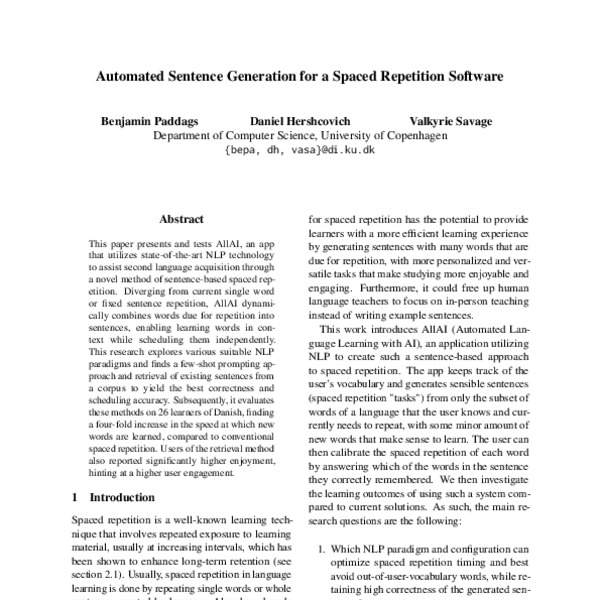
Automated Sentence Generation for a Spaced Repetition Software
This paper presents and tests AllAI, an app that utilizes state-of-the-art NLP technology to assist second language acquisition through a novel method of sentence-based spaced repetition. Diverging from current single word or fixed sentence repetition, AllAI dynamically combines words due for repetition into sentences, enabling learning words in context while scheduling them independently. This research explores various suitable NLP paradigms and finds a few-shot prompting approach and retrieval of existing sentences from a corpus to yield the best correctness and scheduling accuracy. Subsequently, it evaluates these methods on 26 learners of Danish, finding a four-fold increase in the speed at which new words are learned, compared to conventional spaced repetition. Users of the retrieval method also reported significantly higher enjoyment, hinting at a higher user engagement.
SpaceDucking — Practice software testing
Duck-themed practice apps full of deliberate bugs, plus a members-only bug database.
Math Academy
The Math Academy curriculum and pedagogy leverage cutting-edge cognitive learning theory. Why? Because it’s been studied extensively, backed up and proven to work. We aren’t providing edu-tainment. This isn’t enrichment. We teach math as if we were training a professional athlete or musician, or anyone looking to acquire a skill to the highest degree possible. This is real work for a student who is serious about learning math. We expect every student using our system to actually master the material, and do it efficiently and effectively.
Study explores how AI use affects performance on math and reasoning tasks - Berkeley News
A UC Berkeley researcher co-authored a study that raises profound questions about how we interact with artificial intelligence in education — and daily life.