


The last two decades have seen a shift in public services organizations from hierarchies to networks. Network forms are seen as particularly suited to handling ‘wicked problems'. We make an assessmen...
Entering the Age of Networks - Of Souls & Silos
Institutions are out, networks are in. What are the consequences, the perils and the promise? Originally published in The Orange County Register, March 5, 2015 Everyone’s interested in human networks these days. How to make them work, how to structure…

An s-frame agenda for behavioral public policy research
We have previously argued thatbehavioral scientists have been testing and advocating individualistic (i-frame) solutions to policy problems that have systemic (s-frame) causes and require systemic solutions. Here, we consider the implications of adopting an s-frame approach for research. We argue that an s-frame approach will involve addressing different types of questions, which will, in turn, require a different toolbox of research methods.
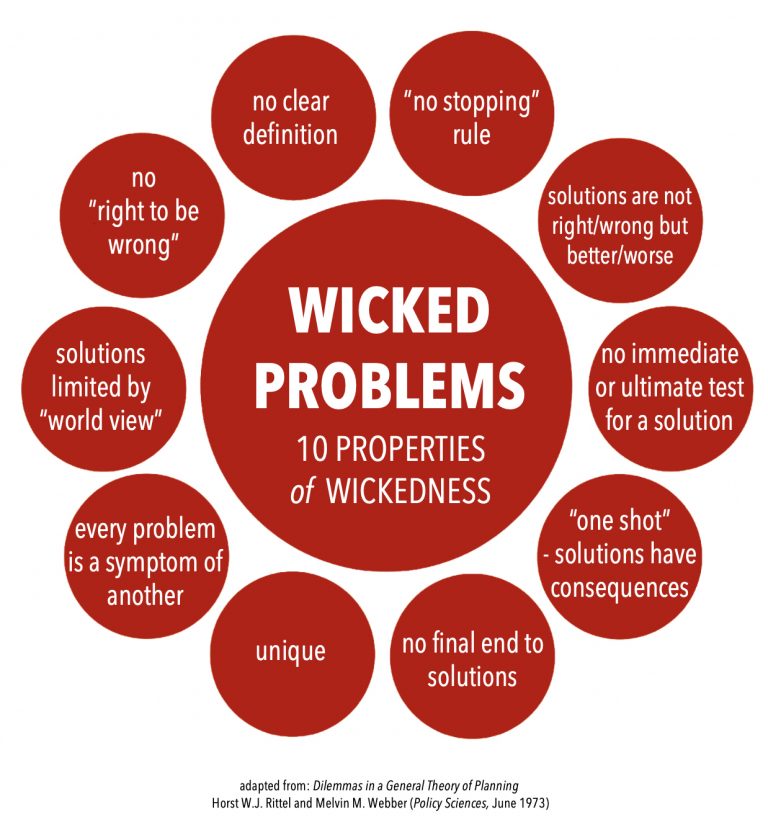
Dilemmas in a general theory of planning
The search for scientific bases for confronting problems of social policy is bound to fail, becuase of the nature of these problems. They are “wicked” problems, whereas science has developed to deal with “tame” problems. Policy problems cannot be definitively described. Moreover, in a pluralistic society there is nothing like the undisputable public good; there is no objective definition of equity; policies that respond to social problems cannot be meaningfully correct or false; and it makes no sense to talk about “optimal solutions” to social problems unless severe qualifications are imposed first. Even worse, there are no “solutions” in the sense of definitive and objective answers.

Wicked problem
In planning and policy, a wicked problem is a problem that is difficult or impossible to solve because of incomplete, contradictory, and changing requirements that are often difficult to recognize. It refers to an idea or problem that cannot be fixed, where there is no single solution to the problem; "wicked" does not indicate evil, but rather resistance to resolution. Another definition is "a problem whose social complexity means that it has no determinable stopping point". Because of complex interdependencies, the effort to solve one aspect of a wicked problem may reveal or create other problems. Due to their complexity, wicked problems are often characterized by organized irresponsibility.
Decentralized advocacy | Patrick Singletary | Offprint
How serious are we about AT Protocol / DID ?

The Internet Transition
The Internet is allowing us to build a richer, more complex society but the way in which we Internet today is failing to support the governance systems that a more complex world requires. I take a look at why these issues are related, try to develop an intuition for a way forward, and point at the emerging field that is coming together to build that future.

Independent Media has an Infrastructural Problem
We need to roll out infrastructures that foster public values and the common good over the market imperatives, writes Agustin Ferrari Braun.

Obeying Nobody: Public Service and the Ordinary Evil of Administration - Roy L. Heidelberg, 2026
This essay explores administrative evil by reconsidering it through Weber’s ideal-type of bureaucracy and Arendt’s concerns over the bureaucratization of social...

The Organization of Government in Metropolitan Areas: A Theoretical Inquiry
Allusions to the “problem of metropolitan government” are often made in characterizing the difficulties supposed to arise because a metropolitan region is a legal non-entity. From this point of view, the people of a metropolitan region have no general instrumentality of government available to deal directly with the range of problems which they share in common. Rather there is a multiplicity of federal and state governmental agencies, counties, cities, and special districts that govern within a metropolitan region.This view assumes that the multiplicity of political units in a metropolitan area is essentially a pathological phenomenon. The diagnosis asserts that there are too many governments and not enough government. The symptoms are described as “duplication of functions” and “overlapping jurisdictions.” Autonomous units of government, acting in their own behalf, are considered incapable of resolving the diverse problems of the wider metropolitan community. The political topography of the metropolis is called a “crazy-quilt pattern” and its organization is said to be an “organized chaos.” The prescription is reorganization into larger units—to provide “a general metropolitan framework” for gathering up the various functions of government. A political system with a single dominant center for making decisions is viewed as the ideal model for the organization of metropolitan government. “Gargantua” is one name for it.

We need network societies, not network states — The Collective Intelligence Project
Balaji Srinivasan's The Network State posits a choice between reaction and stasis. A brighter future does not await through network states, but through network societies.
Scaling sustainable social networks in the public interest | Heinrich Böll Stiftung | Brussels office - European Union
This policy paper identifies five key challenges for scaling a public-interest social web: infrastructure, governance, funding, attractiveness, and public mandate. It outlines a roadmap for overcoming these challenges and building the Open Social Web Alliance into a relevant force within months — starting in Germany.
A Government Guide to Open Protocols
Public sector teams must go beyond the in-house or off-the-shelf dichotomy to take advantage of open protocols, which offer a unique way to manage both software costs and geopolitical exposure

the "atproto as public infrastructure" argument is gaining real traction — sebastian at re:publica today making that case to a european policy crowd. bsky.app/profile/sebastian.eurosky.soc…
'Safety as Public Infrastructure? The Future of Moderation in the Open Social Web' Talk by Saskia Welch, Aditya Singh and Sebastian Vogelsang More info: ctalx.c-base.org/fediday-2026/talk/MGDNUN/ Click your tickets here: berlinfedi.day ⁂ […] berlin.social/@berlinfediday/11724669250279…


