


The last two decades have seen a shift in public services organizations from hierarchies to networks. Network forms are seen as particularly suited to handling ‘wicked problems'. We make an assessmen...
Why Equitable Networks? - Interaction Institute for Social Change
Readers of this blog know how much promise we at IISC see in networks to bring about greater depth and breadth of change in our country and communities. At the same time, we do not see networks as a panacea. In fact, there are good reasons to be vigilant about “net work” to ensure that... Read More
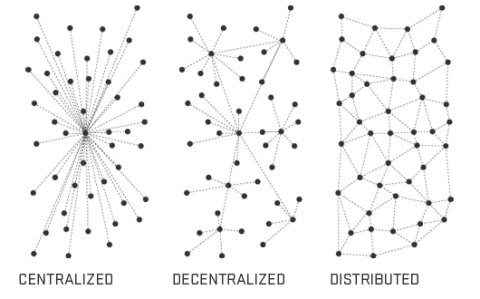
Entering the Age of Networks - Of Souls & Silos
Institutions are out, networks are in. What are the consequences, the perils and the promise? Originally published in The Orange County Register, March 5, 2015 Everyone’s interested in human networks these days. How to make them work, how to structure…

An s-frame agenda for behavioral public policy research
We have previously argued thatbehavioral scientists have been testing and advocating individualistic (i-frame) solutions to policy problems that have systemic (s-frame) causes and require systemic solutions. Here, we consider the implications of adopting an s-frame approach for research. We argue that an s-frame approach will involve addressing different types of questions, which will, in turn, require a different toolbox of research methods.

Dilemmas in a general theory of planning
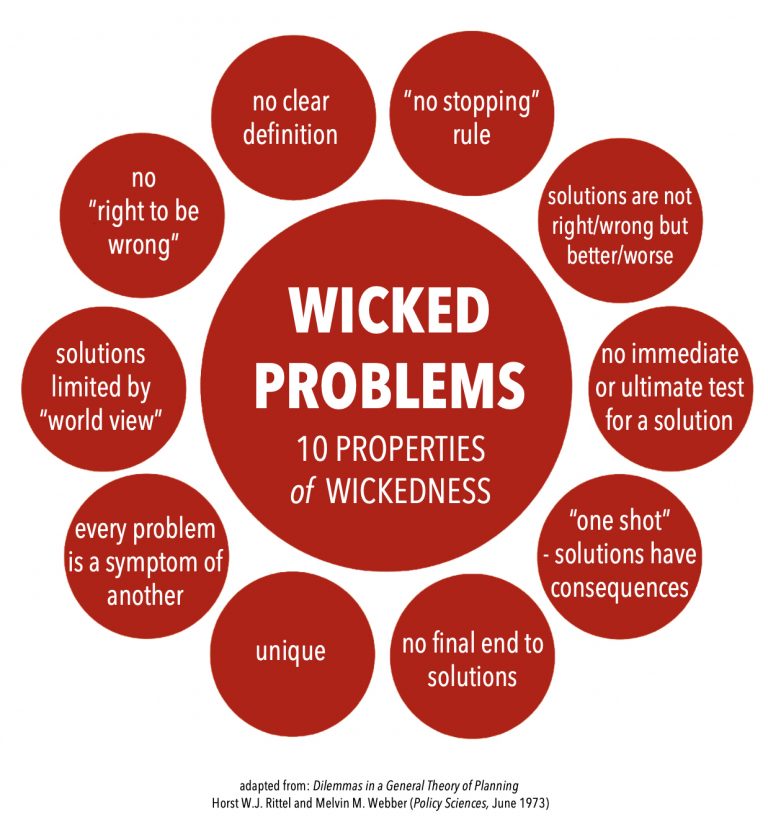
The search for scientific bases for confronting problems of social policy is bound to fail, becuase of the nature of these problems. They are “wicked” problems, whereas science has developed to deal with “tame” problems. Policy problems cannot be definitively described. Moreover, in a pluralistic society there is nothing like the undisputable public good; there is no objective definition of equity; policies that respond to social problems cannot be meaningfully correct or false; and it makes no sense to talk about “optimal solutions” to social problems unless severe qualifications are imposed first. Even worse, there are no “solutions” in the sense of definitive and objective answers.

Wicked problem
In planning and policy, a wicked problem is a problem that is difficult or impossible to solve because of incomplete, contradictory, and changing requirements that are often difficult to recognize. It refers to an idea or problem that cannot be fixed, where there is no single solution to the problem; "wicked" does not indicate evil, but rather resistance to resolution. Another definition is "a problem whose social complexity means that it has no determinable stopping point". Because of complex interdependencies, the effort to solve one aspect of a wicked problem may reveal or create other problems. Due to their complexity, wicked problems are often characterized by organized irresponsibility.
Decentralized advocacy | Patrick Singletary | Offprint
How serious are we about AT Protocol / DID ?

The Hidden Cost of Privatization
Why some goods and services should stay in the public domain

Stewardship of Ourselves
Working behind the scenes in the news media sector, it has become increasingly clear to me that tech and the internet as they operate today are causing structural damage to our collective institutions that runs deeper than seems to be understood. But these changes can be hard to characterise. If you take advertising revenue from high-quality contexts and use it to subsidise conspiracy theories, it's pretty obvious that nothing good will happen — but we barely have an understanding of the data economy sufficient to put a critique of this transfer on solid footing. If you move editorial decisions about what information people get to see first from tens of thousands of career editors working with methods that are highly diversified in biases, culture, skill, or politics the world around to a tiny number of algorithms that are everywhere uniform, what effect can you expect? Reputational and market-driven accountability will be removed, which is evidently bad, but the massive simplification of this ecosystem seems very likely to have deep-running consequences of its own — but how do you begin proving that? A new paper in PNAS leads the way forward.
How Networks Can Change Systems - Interaction Institute for Social Change
At this point a couple of networks with which I am working have reached or are reaching the three year mark in their formalized existence. By many accounts, this is a milestone and inflection point worth noting, as these initiatives have built significant connectivity (depth and breadth) and alignment (shared sense of common identity and direction)... Read More

The Internet Transition
The Internet is allowing us to build a richer, more complex society but the way in which we Internet today is failing to support the governance systems that a more complex world requires. I take a look at why these issues are related, try to develop an intuition for a way forward, and point at the emerging field that is coming together to build that future.

The Internet Transition
The Internet is allowing us to build a richer, more complex society but the way in which we Internet today is failing to support the governance systems that a more complex world requires. I take a look at why these issues are related, try to develop an intuition for a way forward, and point at the emerging field that is coming together to build that future.
Draft Framework for Policy Engagement – Why, When, and How
Over the past few years we’ve become more engaged in public policy issues driven by proposed legislative and regulatory actions that threaten core tenants of the open web. These threats are g…
Independent Media has an Infrastructural Problem
We need to roll out infrastructures that foster public values and the common good over the market imperatives, writes Agustin Ferrari Braun.

Public First network | Tech Influence Watch
Committees, donors, and election spending across the Public First PAC network.

