Abstract Skeletal muscle fiber is largely classified into two types: type 1 (slow‐twitch) and type 2 (fast‐twitch) fibers. Meat quality and composition of fiber types are thought to be closely related. Previous research showed that overexpression of constitutively active peroxisome proliferator‐activated receptor ( PPAR )δ, a nuclear receptor present in skeletal muscle, increased type 1 fibers in mice. In this study, we found that hexane extracts of Yamabushitake mushroom ( Hericium erinaceus ) showed PPAR δ agonistic activity in vitro . Eight‐week‐old C57 BL /6J mice were fed a diet supplemented with 5% (w/w) freeze‐dried Yamabushitake mushroom for 24 hr. After the treatment period, the extensor digitorum longus ( EDL ) muscles were excised. The Yamabushitake‐supplemented diet up‐regulated the PPAR δ target genes Pdk4 and Ucp3 in mouse skeletal muscles in vivo . Furthermore, feeding the Yamabushitake‐supplemented diet to mice for 8 weeks resulted in a significant increase in muscle endurance. These results indicate that Yamabushitake mushroom contains PPAR δ agonistic ligands and that dietary intake of Yamabushitake mushroom could activate PPAR δ in skeletal muscle of mice. Unexpectedly, we observed no significant alterations in composition of muscle fiber types between the mice fed control and Yamabushitake‐supplemented diets.
Yamabushitake Mushroom ( <i>Hericium erinaceus</i> ) Improved Lipid Metabolism in Mice Fed a High-Fat Diet
Interactions between gut microbiota and skeletal muscle
The gut microbiota is now recognized as a major contributor to the host’s nutrition, metabolism, immunity, and neurological functions. Imbalanced microbiota (ie, dysbiosis) is linked to undernutrition-induced stunting, inflammatory and metabolic diseases, and cancers. Skeletal muscle also takes part in the interorgan crosstalk regulating substrate metabolism, immunity, and health. Here, we review the reciprocal influence of gut microbiota and skeletal muscle in relation to juvenile growth, performance, aging, and chronic diseases. Several routes involving the vascular system and organs such as the liver and adipose tissue connect the gut microbiota and skeletal muscle, with effects on fitness and health. Therapeutic perspectives arise from the health benefits observed with changes in gut microbiota and muscle activity, further encouraging multimodal therapeutic strategies.

Erinacine A-enriched Hericium erinaceus mycelia promotes longevity in Drosophila melanogaster and aged mice
Erinacine A-enriched Hericium erinaceus mycelia is a well-established potential therapeutic agent for neurodegenerative disorders. However, the effect of erinacine A-enriched H. erinaceus mycelia on promoting longevity remains unclear. This is the first study to investigate the effect of erinacine A-enriched H. erinaceus mycelia on lifespan-prolonging activity in Drosophila melanogaster and senescence-accelerated P8 (SAMP8) mice. Two hundred D. melanogaster and 80 SAMP8 mice of both sexes were randomly divided into four groups and were administered with either the standard, low-dose, mid-dose, or high-dose erinacine A-enriched H. erinaceus mycelia. After treatment, the lifespan was measured in D. melanogaster, and the lifespan, food intake and oxidative damage were evaluated in SAMP8 mice. Results showed that supplementation with erinacine A-enriched H. erinaceus mycelia extended the lifespan in both D. melanogaster and SAMP8 by a maximum of 32% and 23%, respectively, compared to the untreated controls. Moreover, erinacine A-enriched H. erinaceus mycelia decreased TBARS levels and induced the anti-oxidative enzyme activities of superoxide dismutase, catalase, and glutathione peroxidase. Together, these findings suggest that erinacine A-enriched H. erinaceus mycelia supplement could promote longevity, mediated partly through the induction of endogenous antioxidants enzymes.

Prebiotics Enhance Magnesium Absorption and Inulin‐based Fibers Exert Chronic Effects on Calcium Utilization in a Postmenopausal Rodent Model
Abstract: Age‐related changes in calcium metabolism play a role in the development of osteoporosis. A 4‐wk feeding study was conducted in 5‐mo‐old ovariectomized (OVX) Sprague‐Dawley rats to assess the effect of various dietary fibers on mineral metabolism and bone health parameters. There were 6 treatment groups: sham‐Control, OVX‐Control, OVX rats receiving daily estradiol (E 2 ) injections, and OVX rats receiving an AIN‐93M diet supplement with either an inulin‐based fiber (Synergy1® or Fruitafit HD®) or a novel fiber (polydextrose) at 5% wt. of diet. Calcium and magnesium metabolic balances were performed after early (3 d) and late exposure (4 wk) to dietary treatments. Rats receiving polydextrose had significantly higher net calcium absorption efficiency and retention than all control groups and a trend ( P ≤ 0.10) for higher calcium absorption when compared to inulin‐based fibers after early exposure but the advantage did not persist over long‐term exposure. The inulin‐based fibers had positive chronic effects on calcium metabolism that were related to changes in the gut, that is, production of short chain fatty acids and higher cecal wall weights. All fibers improved magnesium absorption and retention in early and late metabolic balances; effects on magnesium metabolism were more pronounced than for calcium. Practical Application: Steady growth in US middle‐aged and elderly populations has led to higher incidences of several chronic diseases including osteoporosis, a bone disease that primarily affects postmenopausal women. Recent research suggests that certain dietary fibers (prebiotics) enhance mineral absorption and may impart bone health benefits. This work examines the impact of prebiotic supplementation on mineral metabolism and bone health using a postmenopausal rat model. Study findings will aid future investigations in ascertaining the factors related to potential bone health benefits of prebiotic which will aid in developing an effective prebiotics food product/supplement that will address the bone health needs of consumers.

The Best Exercise for Aging Muscles (Published 2017)
Certain kinds of exercise may mitigate the effects of aging at the cellular level.

The Best Exercise for Aging Muscles (Published 2017)
Certain kinds of exercise may mitigate the effects of aging at the cellular level.
Effect of Long-Term Green Tea Polyphenol Supplementation on Bone Architecture, Turnover, and Mechanical Properties in Middle-Aged Ovariectomized Rats
We investigated the effects of 6-month green tea polyphenols (GTP) supplementation on bone architecture, turnover, and mechanical properties in middle-aged ovariectomized (OVX) rats. Female rats were sham-operated (n = 39, 13/group) or OVX (n = 143, 13/group). Sham-control and OVX-control rats (n = 39) receiving no GTP were assigned for sample collection at baseline, 3, or 6 months. The remaining OVX rats (n = 104) were randomized to 0.15%, 0.5%, 1%, and 1.5% (g/dL) GTP for 3 or 6 months. Blood and bone samples were collected. Relative to the OVX-control group, GTP (1% and 1.5%) lowered serum procollagen type 1 N-terminal propeptide at 3 and 6 months, C-terminal telopeptides of type I collagen at 3 months, and insulin-like growth factor-I at 6 months. GTP did not affect bone mineral content and density. At 6 months, no dose of GTP positively affected trabecular bone volume based on microCT, but a higher cortical thickness and improved biomechanical properties of the femur mid-diaphysis was observed in the 1.5% GTP-treated group. At 3 and 6 months, GTP (0.5%, 1%, and 1.5%) had lower rates of trabecular bone formation and resorption than the OVX-control group, but the inhibitory effects of GTP on periosteal and endocortical bone mineralization and formation at the tibial midshaft were only evident at 3 months. GTP at higher doses suppressed bone turnover in the trabecular and cortical bone of OVX rats and resulted in improved cortical bone structural and biomechanical properties, although it was not effective in preventing the ovariectomy-induced dramatic cancellous bone loss.

Dried Plum’s Polyphenolic Compounds and Carbohydrates Contribute to Its Osteoprotective Effects and Exhibit Prebiotic Activity in Estrogen Deficient C57BL/6 Mice
Evidence of dried plum’s benefits on bone continues to emerge. This study investigated the contribution of the fruit’s polyphenol (PP) and carbohydrate (CHO) components on a bone model of postmenopausal osteoporosis to explore their prebiotic activity. Osteopenic ovariectomized mice were fed diets supplemented with dried plum, a crude extract of dried plum’s polyphenolic compounds, or the PP or CHO fraction of the crude extract. The effects of treatments on the bone phenotype were assessed at 5 and 10 weeks as well as the prebiotic activity of the different components of dried plum. Both the CHO and PP fractions of the extract contributed to the effects on bone with the CHO suppressing bone formation and resorption, and the PP temporally down-regulating formation. The PP and CHO components also altered the gut microbiota and cecal short chain fatty acids. These findings demonstrate that the CHO as well as the PP components of dried plum have potential prebiotic activity, but they have differential roles in mediating the alterations in bone formation and resorption that protect bone in estrogen deficiency.

Drug 'reverses' ageing in animal tests
Mice had more stamina, hair and improved organ function with the drug.

Dietary Fiber and Bacterial SCFA Enhance Oral Tolerance and Protect against Food Allergy through Diverse Cellular Pathways
Tan et al. examine the beneficial roles of dietary fiber in peanut allergy using mice. The authors find that this effect involves reshaping of the gut microbiota as well as increased levels of short-chain fatty acids and activity of their receptors GPR43 and GPR109a. High-fiber feeding also increased tolerogenic CD103+ DCs activity, leading to increased Treg cell differentiation.

Specific inulin‐type fructan fibers protect against autoimmune diabetes by modulating gut immunity, barrier function, and microbiota homeostasis
Scope Dietary fibers capable of modifying gut barrier and microbiota homeostasis affect the progression of type 1 diabetes (T1D). Here, we aim to compare modulatory effects of inulin‐type fructans (ITFs), natural soluble dietary fibers with different degrees of fermentability from chicory root, on T1D development in nonobese diabetic mice. Methods and results Female nonobese diabetic mice were weaned to long‐ and short‐chain ITFs [ITF(l) and ITF(s), 5%] supplemented diet up to 24 weeks. T1D incidence, pancreatic‐gut immune responses, gut barrier function, and microbiota composition were analyzed. ITF(l) but not ITF(s) supplementation dampened the incidence of T1D. ITF(l) promoted modulatory T‐cell responses, as evidenced by increased CD25 + Foxp3 + CD4 + regulatory T cells, decreased IL17A + CD4 + Th17 cells, and modulated cytokine production profile in the pancreas, spleen, and colon. Furthermore, ITF(l) suppressed NOD like receptor protein 3 caspase‐1‐p20‐IL‐1β inflammasome in the colon. Expression of barrier reinforcing tight junction proteins occludin and claudin‐2, antimicrobial peptides β‐defensin‐1, and cathelicidin‐related antimicrobial peptide as well as short‐chain fatty acid production were enhanced by ITF(l). Next‐generation sequencing analysis revealed that ITF(l) enhanced Firmicutes/Bacteroidetes ratio to an antidiabetogenic balance and enriched modulatory Ruminococcaceae and Lactobacilli . Conclusion Our data demonstrate that ITF(l) but not ITF(s) delays the development of T1D via modulation of gut‐pancreatic immunity, barrier function, and microbiota homeostasis.

More protein in your breakfast or snacks won’t give you more muscle without more work – a biologist separates the science from the marketing
Protein powders and protein-fortified versions of all manner of foods line grocery store shelves. But just because something has added protein doesn’t necessarily make it better.

Probiotics Protect Mice from Ovariectomy-Induced Cortical Bone Loss
The gut microbiota (GM) modulates the hosts metabolism and immune system. Probiotic bacteria are defined as live microorganisms which when administered in adequate amounts confer a health benefit on the host and can alter the composition of the GM. Germ-free mice have increased bone mass associated with reduced bone resorption indicating that the GM also regulates bone mass. Ovariectomy (ovx) results in bone loss associated with altered immune status. The purpose of this study was to determine if probiotic treatment protects mice from ovx-induced bone loss. Mice were treated with either a single Lactobacillus (L) strain, L. paracasei DSM13434 (L. para) or a mixture of three strains, L. paracasei DSM13434, L. plantarum DSM 15312 and DSM 15313 (L. mix) given in the drinking water during 6 weeks, starting two weeks before ovx. Both the L. para and the L. mix treatment protected mice from ovx-induced cortical bone loss and bone resorption. Cortical bone mineral content was higher in both L. para and L. mix treated ovx mice compared to vehicle (veh) treated ovx mice. Serum levels of the resorption marker C-terminal telopeptides and the urinary fractional excretion of calcium were increased by ovx in the veh treated but not in the L. para or the L. mix treated mice. Probiotic treatment reduced the expression of the two inflammatory cytokines, TNFα and IL-1β, and increased the expression of OPG, a potent inhibitor of osteoclastogenesis, in cortical bone of ovx mice. In addition, ovx decreased the frequency of regulatory T cells in bone marrow of veh treated but not probiotic treated mice. In conclusion, treatment with L. para or the L. mix prevents ovx-induced cortical bone loss. Our findings indicate that these probiotic treatments alter the immune status in bone resulting in attenuated bone resorption in ovx mice.
Mitochondrial Signaling and Stress Responses, Key Regulators of Aging and Longevity
ABSTRACT Mitochondria are vital not only for energy production but also for regulating signaling pathways that influence aging. While mitochondrial dysfunction contributes to age‐related decline, emerging evidence shows that mild, regulated mitochondrial stress can paradoxically promote longevity. This review highlights recent advances in mitochondrial biology and aging across species. We explore the dual role of reactive oxygen species (ROS) as both damaging agents and signaling molecules that activate adaptive stress responses. Key pathways such as the mitochondrial unfolded protein response (UPR MT ) and integrated stress response (ISR) are discussed, including their tissue‐specific as well as non‐cell‐autonomous effects on aging. Additionally, we examine the impact of mitochondrial protein import/export, dynamics (fission, fusion, mitophagy, biogenesis), and quality control in aging. Finally, we address challenges in understanding context‐dependent mitochondrial responses and mitonuclear communication. Together, these insights position mitochondria as central regulators of aging and highlight their potential as therapeutic targets to enhance health span and longevity.

Meta-omics analysis of elite athletes identifies a performance-enhancing microbe that functions via lactate metabolism
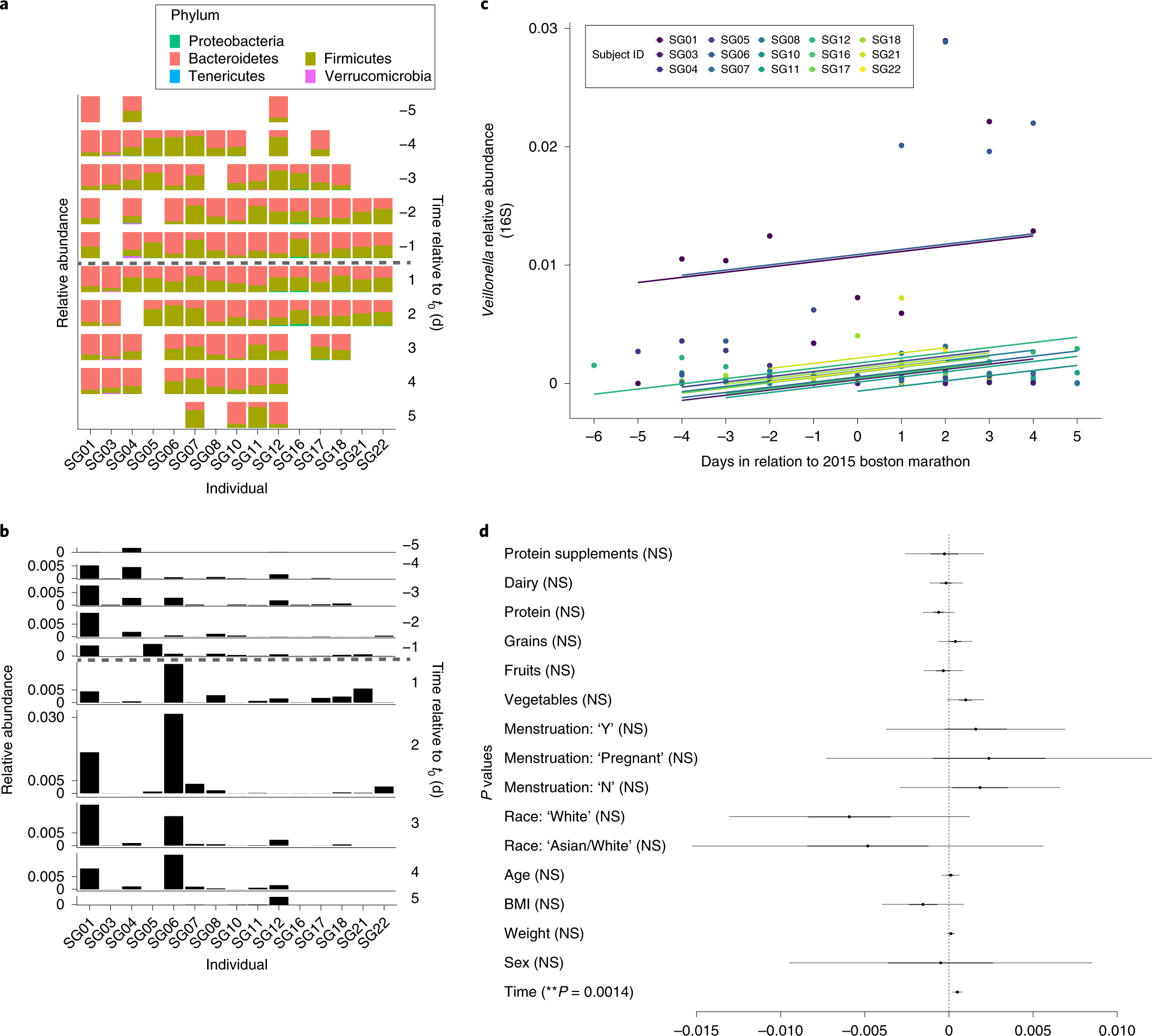
The human gut microbiome is linked to many states of human health and disease1. The metabolic repertoire of the gut microbiome is vast, but the health implications of these bacterial pathways are poorly understood. In this study, we identify a link between members of the genus Veillonella and exercise performance. We observed an increase in Veillonella relative abundance in marathon runners postmarathon and isolated a strain of Veillonella atypica from stool samples. Inoculation of this strain into mice significantly increased exhaustive treadmill run time. Veillonella utilize lactate as their sole carbon source, which prompted us to perform a shotgun metagenomic analysis in a cohort of elite athletes, finding that every gene in a major pathway metabolizing lactate to propionate is at higher relative abundance postexercise. Using 13C3-labeled lactate in mice, we demonstrate that serum lactate crosses the epithelial barrier into the lumen of the gut. We also show that intrarectal instillation of propionate is sufficient to reproduce the increased treadmill run time performance observed with V. atypica gavage. Taken together, these studies reveal that V. atypica improves run time via its metabolic conversion of exercise-induced lactate into propionate, thereby identifying a natural, microbiome-encoded enzymatic process that enhances athletic performance.
How fasting can improve overall health
Researchers found evidence that fasting affects circadian clocks in the liver and skeletal muscle, causing them to rewire their metabolism, which can ultimately lead to improved health and protection against aging-associated diseases.