We are at a critical juncture in AI governance. To mitigate current and future harms from AI systems, we need to embrace openness, transparency, and broad access.
OpenAI introduces new governance model for AI safety oversight
OpenAI grants its board the power to regulate AI model releases, enhancing safety measures and mitigating potential risks in AI development.

A Safe Path to Open Weights
Strategic openness can strengthen AI safety and support broader access as defenses and safety science mature.

Unpacking Open Source Artificial Intelligence: Toward a Framework for Openness in Foundation Models
Openness has long driven innovation in software,9 and AI is no exception.12 While some see openness in foundation models (FMs) as a security threat,18 others argue that restricting access will not meaningfully reduce risk and will limit the benefits of transparency, research, and global participation.3 As the EU AI Act reporting requirements on FMs—also referred to as general-purpose AI models (GPAIMs)—move toward implementation, there is an urgent need for a more nuanced and informed understanding of openness in AI systems.

Accelerating Progress Toward Trustworthy AI
Status update on our 2020 paper “Creating Trustworthy AI” and next steps to promote openness, competition, and accountability in AI

White Paper on Public AI – Open Future
Today's AI landscape is dominated by a few tech companies. This White Paper presents an alternative: Public AI systems built on transparency, democratic governance, and open access to critical infrastructure.

OpenAI president urges AI safeguards as group he funds opposes regulation
As OpenAI executives step up their public calls for federal AI safety rules, a political group the company’s president helped fund is spending millions to elect members of Congress who oppose restrictions on the technology.

Anthropic and OpenAI want to embed safety evaluators. Will they really be independent? | TechCrunch
Anthropic and OpenAI want to embed independent safety evaluators inside their AI labs. Researchers welcome the unprecedented access, but warn meaningful oversight requires transparency, independence, and eventually regulation.

OpenAI technical goals
OpenAI’s mission is to build safe AI, and ensure AI’s benefits are as widely and evenly distributed as possible.

Safety and alignment in an era of long-horizon models
OpenAI shares lessons from deploying long-running AI models, highlighting new safety risks, observed failures, and improved safeguards through iterative deployment.

Introducing the Agent Governance Toolkit: Open-source runtime security for AI agents | Microsoft Open Source Blog
Discover how the Microsoft Agent Governance Toolkit brings policy, identity, and reliability to autonomous AI agent systems.

What AI Asks of Open Access - The Scholarly Kitchen
As AI systems increasingly reason from the scientific literature, the integrity signals that make research trustworthy - open data, structured metadata, robust retraction processes - matter more than ever. PLOS CEO Alison Mudditt on why open access publishers have a different set of obligations in an AI world.

When AI says it is open, ask what opened - Sensemaker
“Open” AI can mean weights, code, workflows or governance. Ask what opened, what freedom it grants and what still needs permission.
“Wait, not like that”: Free and open access in the age of generative AI
The real threat isn’t AI using open knowledge — it’s AI companies killing the projects that make knowledge free

Clear, Compelling Arguments: Rethinking the Foundations of Frontier AI Safety Cases
This paper contributes to the nascent debate around safety cases for frontier AI systems. Safety cases are structured, defensible arguments that a system is acceptably safe to deploy in a given context. Historically, they have been used in safety-critical industries, such as aerospace, nuclear or automotive. As a result, safety cases for frontier AI have risen in prominence, both in the safety policies of leading frontier developers and in international research agendas proposed by leaders in generative AI, such as the Singapore Consensus on Global AI Safety Research Priorities and the International AI Safety Report. This paper appraises this work. We note that research conducted within the alignment community which draws explicitly on lessons from the assurance community has significant limitations. We therefore aim to rethink existing approaches to alignment safety cases. We offer lessons from existing methodologies within safety assurance and outline the limitations involved in the alignment community's current approach. Building on this foundation, we present a case study for a safety case focused on Deceptive Alignment and CBRN capabilities, drawing on existing, theoretical safety case "sketches" created by the alignment safety case community. Overall, we contribute holistic insights from the field of safety assurance via rigorous theory and methodologies that have been applied in safety-critical contexts. We do so in order to create a better foundational framework for robust, defensible and useful safety case methodologies which can help to assure the safety of frontier AI systems.

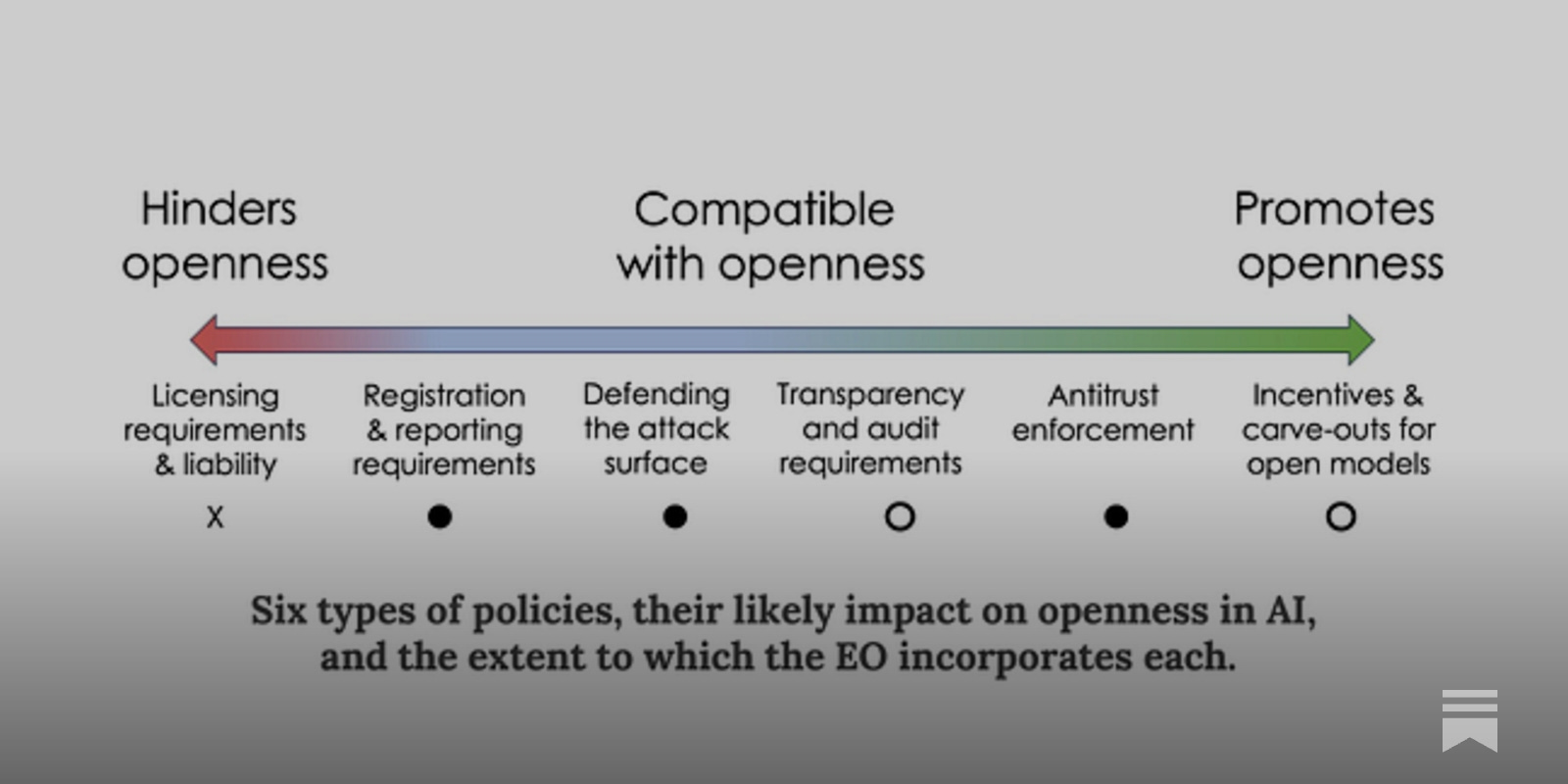
What the executive order means for openness in AI
Good news on paper, but the devil is in the details
Industry Leaders Unite in Open Secure AI Alliance for AI Safety and Security
NVIDIA and founding members form new alliance to build and share open tools that promote responsible use of and trust in AI.