

Version: 1.01 | Updated: 11/28/25
You and Your Research
Transcription of the Bell Communications Research Colloquium Seminar 7 March 1986
The Divide — Jason Hickel
The Divide: A Brief Guide to Global Inequality and its Solutions Penguin Random House UK, 2017

QBism: Quantum Theory as a Hero's Handbook
This paper represents an elaboration of the lectures delivered by one of us (CAF) during "Course 197 -- Foundations of Quantum Physics" at the International School of Physics "Enrico Fermi" in Varenna, Italy, July 2016. Much of the material for it is drawn from arXiv:1003.5209, arXiv:1401.7254, and arXiv:1405.2390. However there are substantial additions of original material in Sections 4, 7, 8 and 9, along with clarifications and expansions of the older content throughout. Topics include the meaning of subjective probability; no-cloning, teleportation, and quantum tomography from the subjectivist Bayesian perspective; the message QBism receives from Bell inequality violations (namely, that nature is creative); the import of symmetric informationally complete (SIC) quantum measurements for the technical side of QBism; quantum cosmology QBist-style; and a potential meaning for the holographic principle within QBism.

Global Inequality — Harvard University Press
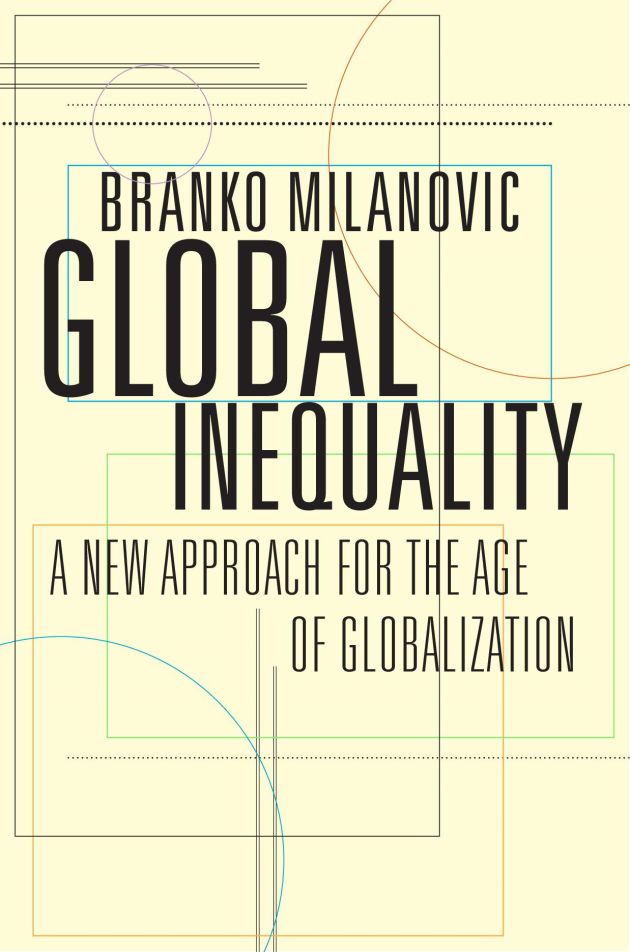
Winner of the Bruno Kreisky Prize, Karl Renner InstitutA Financial Times Best Economics Book of the Year An Economist Best Book of the Year A Livemint Best Book of the YearOne of the world’s leading economists of inequality, Branko Milanovic presents a bold new account of the dynamics that drive inequality on a global scale. Drawing on vast data sets and cutting-edge research, he explains the benign and malign forces that make inequality rise and fall within and among nations. He also reveals who has been helped the most by globalization, who has been held back, and what policies might tilt the balance toward economic justice.“The data [Milanovic] provides offer a clearer picture of great economic puzzles, and his bold theorizing chips away at tired economic orthodoxies.”—The Economist“Milanovic has written an outstanding book…Informative, wide-ranging, scholarly, imaginative and commendably brief. As you would expect from one of the world’s leading experts on this topic, Milanovic has added significantly to important recent works by Thomas Piketty, Anthony Atkinson and François Bourguignon…Ever-rising inequality looks a highly unlikely combination with any genuine democracy. It is to the credit of Milanovic’s book that it brings out these dangers so clearly, along with the important global successes of the past few decades.—Martin Wolf, Financial Times

Extreme Inequality Presages The Revolt Against It
Even the Davos elites are reading the tea leaves.


Michael Truell on Twitter / X
We believe Cursor discovered a novel solution to Problem Six of the First Proof challenge, a set of math research problems that approximate the work of Stanford, MIT, Berkeley academics. Cursor's solution yields stronger results than the official, human-written solution.…— Michael Truell (@mntruell) March 3, 2026
A Mathematical Theory of Communication
"A Mathematical Theory of Communication" is an article by mathematician Claude Shannon published in Bell System Technical Journal in 1948. It was renamed The Mathematical Theory of Communication in the 1949 book of the same name, a small but significant title change after realizing the generality of this work. It has tens of thousands of citations, being one of the most influential and cited scientific papers of all time, as it gave rise to the field of information theory, with Scientific American referring to the paper as the "Magna Carta of the Information Age", while the electrical engineer Robert G. Gallager called the paper a "blueprint for the digital era". Historian James Gleick rated the paper as the most important development of 1948, placing the transistor second in the same time period, with Gleick emphasizing that the paper by Shannon was "even more profound and more fundamental" than the transistor.

If math is more than proof, we need to better celebrate the rest of it
[This is a guest post by Grant Sanderson. This blog post was initially written in a different file format and converted using AI. — T.] A sentiment echoing throughout the mathematics communit…

annotations: Les aspects structurels des inégalités
Traduction française du billet de blog "Inequality: the structural aspects" de Branko Milanovic
4 - Kanjun Qiu - Foo Camp Lightning Talk_ AI\x27s Incentive Problem
AI’s Incentive Problem Kanjun Qiu CEO, Imbue June 27, 2026 1

📚 AI - Coding, Agents, & Automation

Digital Accessibility

The Case for Software Craftsmanship in the Era of Vibes
One Developer, Two Dozen Agents, Zero Alignment
AI assisted coding (by Ronen Tamari) — Semble

AURI for Developers | AI-Native AppSec Platform | Endor La

We Got Claude to Fine-Tune an Open Source LLM
AI* and coding (by あ) — Semble
Smart Glasses as Disability Assistive Tech (by Bee 🐝) — Semble

Digital accessibility is real and tangible