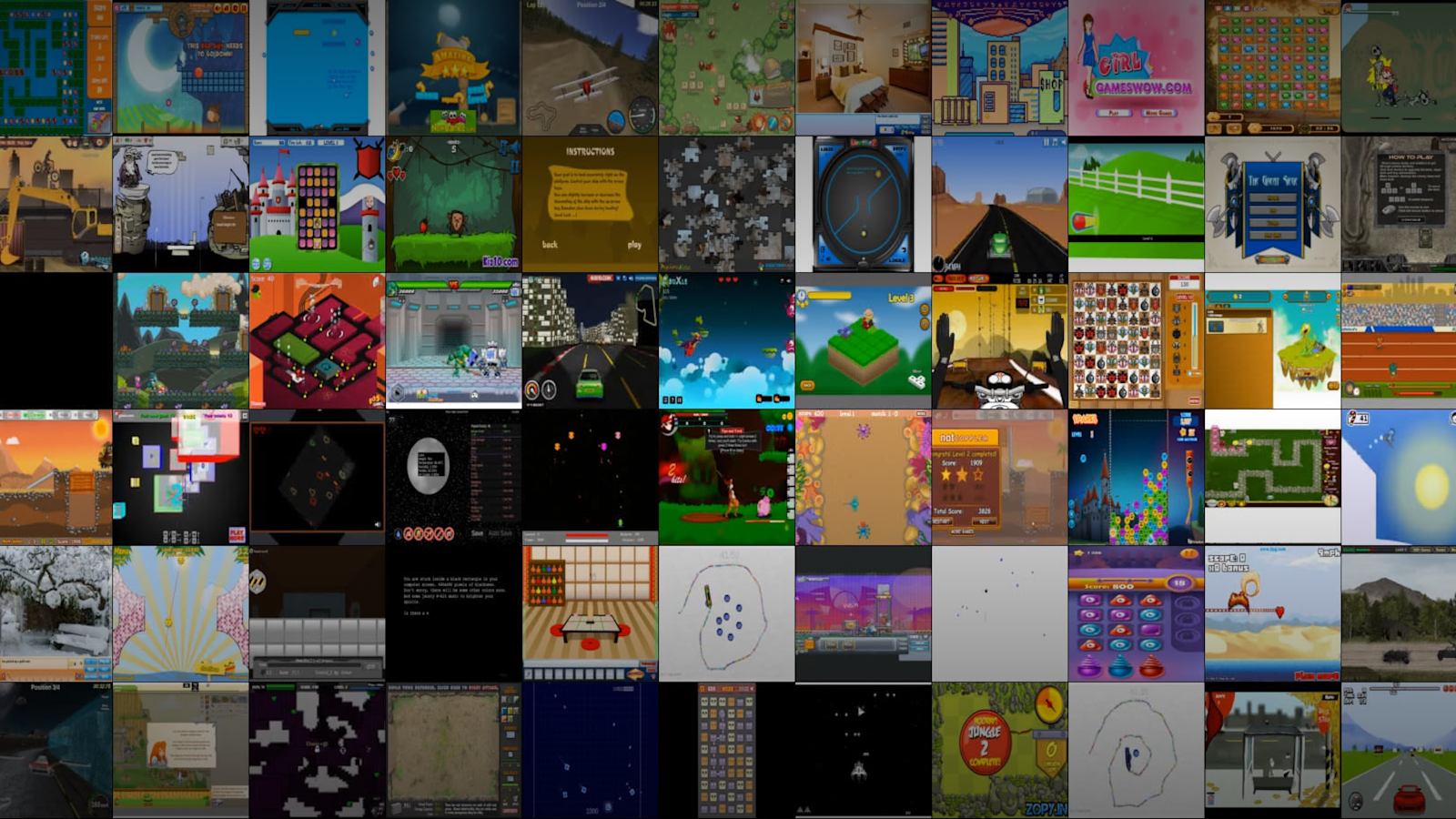
We’re releasing Universe, a software platform for measuring and training an AI’s general intelligence across the world’s supply of games, websites and other applications.
AGENTWORLD | *
An exploration of planetary intelligence, tracing how computation and cosmology—from ancient mechanisms to AI—reshape Earth and its possible futures.
DeepMind and Blizzard to release StarCraft II as an AI research environment
Today at BlizzCon 2016 in Anaheim, California, we announced our collaboration with Blizzard Entertainment to open up StarCraft II to AI and Machine Learning researchers around the world.

Kosmos: An AI Scientist for Autonomous Discovery
Today, we are announcing Kosmos, our next-generation AI Scientist. Kosmos is a major upgrade on Robin, our previous AI Scientist. You can read about it in our technical report, here. Kosmos is available to use from day one on our platform, here.

Zhijing Jin on Twitter / X
🚀 Can #AI agents actually do science?Current agents can optimize for predictive fit — but fail at recovering the underlying physical laws.We introduce Stargazer🪐: a scalable benchmark + environment for astronomical discovery🔭Agents must:• propose hypotheses•… pic.twitter.com/hGIjz4KJMT— Zhijing Jin (@ZhijingJin) May 7, 2026

The Age of Wonders and Terrors
Twenty years ago, when the idea of AI taking over the world in our lifetimes still struck most of us as the unconstrained fantasy of those who knew too much science fiction and too little science, …

Designing the hf CLI as an agent-optimized way to work with the Hub
We’re on a journey to advance and democratize artificial intelligence through open source and open science.

EurekaBench: Measuring Agentic Ability to Discover New Scientific Insights
When Isaac Newton discovered the law of gravitation, he did so through an iterative process of analyzing observed data such as planetary patterns, finding the underlying mechanisms by describing patterns in mathematical equations, and refining his theory against the Moon's orbit, revealing the startling insight that the same force governs both falling apples and orbiting planets. Would it be possible for AI agents to make similar discoveries? To measure this ability, we introduce EurekaBench, a cross-domain benchmark that tests AI agents' ability to conduct long-horizon experiments and discover mechanisms that explain observations. We evaluate these mechanisms by the scientific insights that can be derived from them. EurekaBench contains an expert-verified set of 26 long-horizon tasks across neuroscience, computer science, chemistry, astrophysics, geophysics, and plasma physics, with a total of 306 scientific insights that the discovered mechanisms are expected to support. Our evaluation framework tests three axes of scientific discovery: agents' ability to follow known scientific constraints, the predictive accuracy of the discovered mechanisms, and whether these mechanisms yield scientific insights or inform future research. Our results show that current AI agents often overly fixate on predictive accuracy optimization, surpassing human scientists, while falling substantially short in deriving scientific insights.

sigargv/Laguna-M.1-GGUF · Hugging Face
We’re on a journey to advance and democratize artificial intelligence through open source and open science.

A Collectivist, Economic Perspective on AI
Information technology is in the midst of a revolution in which omnipresent data collection and machine learning are impacting the human world as never before. The word ``intelligence'' is being...
Wuhan’s AI Development | Center for Security and Emerging Technology
Wuhan, China’s inland metropolis, is paving the way for a nationwide rollout of “embodied” artificial intelligence meant to fast-track scientific discovery, optimize production, streamline commerce, and facilitate state supervision of social activities. Grounded in real-world data, the AI grows smarter, offering a pathway to artificial “general” intelligence that will reinforce state ideology and boost economic goals. This report documents the genesis of Wuhan’s AGI initiative and its multifaceted deployment.
2026 Cosmos HAI Lab Lecture with Jack Clark, Co-founder of Anthropic
AI Isn't as Powerful as We Think | Hannah Fry
Environments Hub: A Community Hub To Scale RL To Open AGI
RL environments are the playgrounds where agents learn. Until now, they’ve been fragmented, closed, and hard to share. We are launching the Environments Hub to change that: an open, community-powered platform that gives environments a true home.Environments define the world, rules and feedback loop of state, action and reward. From games to coding tasks to dialogue, they’re the contexts where AI learns, without them, RL is just an algorithm with nothing to act on.

AI Engineer's 2025 | Unsloth Documentation
Slides to our AI Engineer's Worlds Fair 2025 Workshop.

Import AI 475: Swarm scaling; Google DeepMind watermarks biology; and the AI science economy
Who chooses what AI gets to do?

AI Analytics Platform for Your Whole Team
Agentic notebooks, conversational self-serve, and Context Studio for governed AI answers — all in a unified platform for your whole team.