OpenAI introduces a real-world evaluation framework to measure how AI can accelerate biological research in the wet lab. Using GPT-5 to optimize a molecular cloning protocol, the work explores both the promise and risks of AI-assisted experimentation.
OpenAI launches AI model GPT-Rosalind for life sciences research
OpenAI on Thursday introduced an artificial intelligence model touting increased biology knowledge and scientific research capabilities, as the startup deepens its push into the life sciences field.

OpenScience.ai — Autonomous AI Research Agents
AI agents conducting reproducible scientific inquiry. Full provenance, executable notebooks, peer validation.

Accelerating scientific discovery with ChatGPT for Academic Researchers
OpenAI is giving 100,000 academic researchers free access to ChatGPT's most advanced AI models to accelerate scientific research, collaboration, and discovery.
Accelerating life sciences research
Discover how a specialized AI model, GPT-4b micro, helped OpenAI and Retro Bio engineer more effective proteins for stem cell therapy and longevity research.

OpenAI launches new AI model for life sciences research
Researchers are drowning in data. AI could help.
Verification in the Age of AI Scientists
AI Scientists now operate at a scale that outpaces human capacity for manual review. Systems such as Sakana’s AI Scientist write entire workshop papers end-to-end. Lila Sciences runs autonomous ``AI Science Factories’’ that hypothesize, experiment, and iterate without human guidance. FutureHouse’s Kosmos and Robin generate thousands of candidate hypotheses in a single run, and Google’s Co-Scientist proposes testable experiments at a rate no laboratory can fully evaluate. Each of these systems emphasizes verified results, yet that standard ranges from near-perfect formal proof in mathematics to decade-long clinical trials in medicine, with no shared framework for judging sufficiency across domains. As outputs scale beyond what humans can manually inspect, the question of which results to trust becomes as hard as generating them. The bottleneck for AI for Science is no longer hypothesis generation, it is verification.
Using X-Labs to Unleash AI-Driven Scientific Breakthroughs | IFP
How to adapt our science funding mechanisms to the unique infrastructure needs of large-scale AI projects

Import AI 475: Swarm scaling; Google DeepMind watermarks biology; and the AI science economy
Who chooses what AI gets to do?

AutoScientists: Self-Organizing Agent Teams for Long-Running Scientific Experimentation
Scientific research proceeds through iterative cycles of hypothesis generation, experiment design, execution, and revision. AI agents can automate parts of this process, but existing approaches typically follow a single research trajectory or coordinate through a central planner with fixed objectives. As a result, they struggle to sustain parallel exploration, adapt as experimental evidence changes, or preserve knowledge of failed directions over long-running experiments. We introduce AutoScientists, a decentralized team of AI agents for long-running computational scientific experimentation. Agents interpret a shared experimental state, self-organize into teams around promising hypotheses, critique proposals before using experimental compute, and share successes and failures to reduce redundant exploration. Under matched experimental budgets, AutoScientists improves over prior AI agents across biomedical machine learning, language-model training optimization, and protein fitness prediction. On BioML-Bench, spanning biomedical imaging, protein engineering, single-cell omics, and drug discovery, AutoScientists achieves a mean leaderboard percentile of 74.4% across 24 tasks, improving over the strongest AI agent by +8.33%. On GPT training optimization, AutoScientists reaches a target validation bits-per-byte 1.9x faster than Autoresearch and continues discovering improvements from a starting champion where the single-agent approach finds none (7 vs. 0 accepted improvements). On ProteinGym fitness prediction, AutoScientists discovers a method for ACE2-Spike binding that improves over the current state-of-the-art model by +12.5% in Spearman correlation. Applied without modification across all 217 ProteinGym assays, the same method improves over the prior state of the art by +6.5% (Spearman correlation).

TERMINAL-BENCH-SCIENCE
A benchmark for evaluating AI agents on research workflows across scientific domains
Measuring the Impact of Early-2025 AI on Experienced Open-Source...
Despite widespread adoption, the impact of AI tools on software development in the wild remains understudied. We conduct a randomized controlled trial (RCT) to understand how AI tools at the...
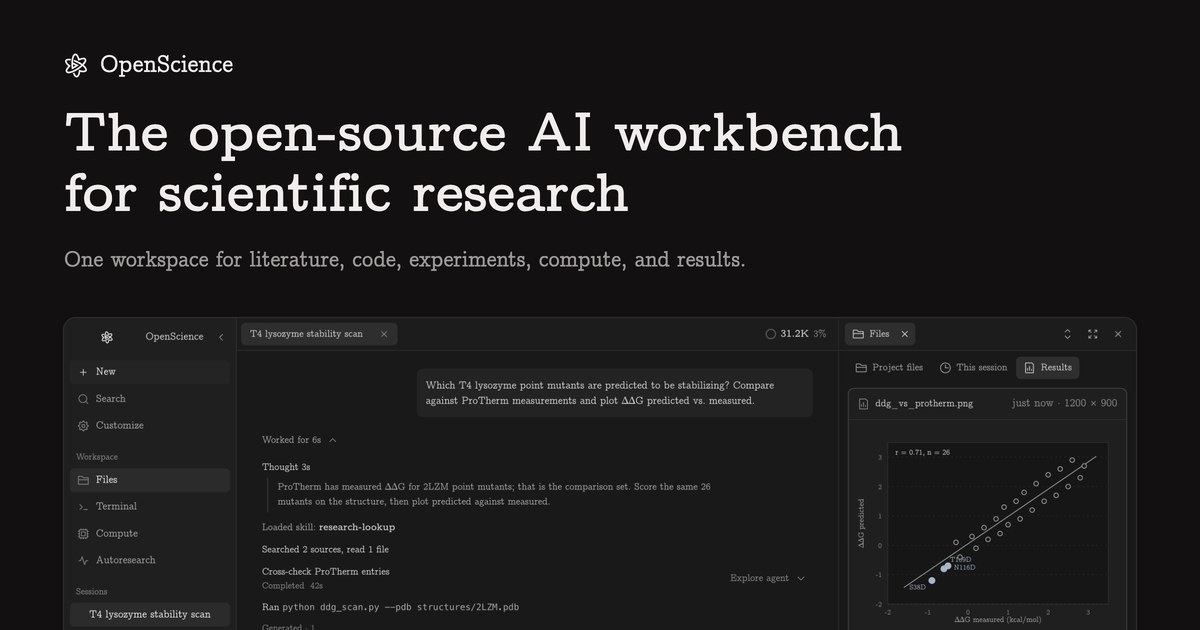
OpenScience | Open-source AI co-scientist for research
OpenScience is the open-source AI co-scientist. Free models included or connect any model from any provider, including Claude, GPT, Gemini and more.
ScientistTwo: Pioneering the Human Knowledge Frontier with Autonomous AI
Scientific discovery is defined by the ability to identify the boundaries of existing knowledge and venture into unexplored territory. The ultimate vision for AI in science is problem-driven autonomous research: given a fundamental challenge by a human expert, the AI independently navigates the scientific landscape, uncovers theoretical and empirical bottlenecks, and systematically expands the frontier of knowledge. In this paper, we introduce ScientistTwo, a fully autonomous multi-agent framework designed to realize this vision. Specifically, ScientistTwo takes an initial problem as input, establishes state-of-the-art baselines, formulates novel hypotheses, and coordinates specialized agents to orchestrate an end-to-end discovery cycle without human intervention. Moreover, the framework rigorously conducts experiments using diverse datasets and metrics, refines methodologies through automated ablation studies, and validates research findings via a closed-loop simulated peer-review rebuttal engine. To evaluate ScientistTwo's capabilities against the highest standards of human scientific achievement, we benchmark it across papers accepted at top-tier conferences such as ICLR, ICML, and NeurIPS. As a result, ScientistTwo autonomously generates expert-level, publishable papers and fully verified, executable codebases. Its solutions consistently outperform human state-of-the-art models, and achieve higher average review ratings than human-authored papers under automated AI review agents. These results show that ScientistTwo is not merely an assistive tool but an autonomous scientific pioneer capable of pushing the frontiers of human discovery. Project website: https://scientist-two.github.io/
Training AI Scientists to Replicate Research
The replicability of papers is a cornerstone of scientific knowledge, ensuring the reliability of existing results and providing a base for further experiments. The act of replication typically illuminates details that were previously underspecified, and thus requires similar hypothesis-driven exploration to open-ended research. In this work, we develop Replica, a scalable task space for paper replication. To provide reward signal, we introduce an auto-generated rubric-based judge that has low noise and agrees with human assessment of replication quality. We post-train Faraday, a 27B-parameter "AI Scientist" agent that leverages coding agents as tools, surpassing the performance of Claude Opus 4.8 and GPT-5.5 on held-out replication tasks. Qualitative analysis of individual rollouts reveals that Faraday adopts a more scientifically-principled approach. We believe that our results provide a stepping stone towards AI agents capable of long-horizon scientific innovation without requiring complex harnesses.
No. 027: AGMAI advisory group, Millennium Problems for biology, autonomous research pipelines - The Hallway Track
The Hallway Track No. 027 - How AI is affecting the practice of science
Which ‘AI scientist’ suits your lab? A guide for the perplexed
General-purpose AI tools for science, such as Claude Science, promise to accelerate research. But which is right for you?