We’ve discovered that evolution strategies (ES), an optimization technique that’s been known for decades, rivals the performance of standard reinforcement learning (RL) techniques on modern RL benchmarks (e.g. Atari/MuJoCo), while overcoming many of RL’s inconveniences.
Memory Efficient RL | Unsloth Documentation
We're excited to introduce more efficient reinforcement learning (RL) in Unsloth with multiple algorithmic advancements:

Mastering Real-Time Strategy Games with Deep Reinforcement Learning: Mere Mortal Edition
The capabilities of game-playing AIs have grown rapidly over the last few years. This trend has culminated in the defeat of top human players in the complex real-time strategy (RTS) games of DoTA 2…

Training AI Agents with RL | Unsloth Documentation
Learn how to train AI agents for real-world tasks using Reinforcement Learning (RL).
ReBeL: A general game-playing AI bot that excels at poker and more
Combining reinforcement learning with search (RL+Search) has been tremendously successful for perfect-information games. But prior RL+Search algorithms break down in

#Exploration: A Study of Count-Based Exploration for Deep...
Count-based exploration algorithms are known to perform near-optimally when used in conjunction with tabular reinforcement learning (RL) methods for solving small discrete Markov decision...

SwarmEvolve: Latent Agent Swarms for Evolutionary Discovery and Optimization
LLM-guided evolutionary search uses AI agents to improve programs for mathematical and computational problems by iteratively refining solutions and combining high-scoring methods. However, the...
OpenAI leaked Q* so let’s dive into Q-Learning and how it relates to RLHF. Q-learning is a foundational concept in the field of artificial intelligence, particularly in the area of reinforcement learning. It's a model-free reinforcement learning algorithm that aims to learn t
OpenAI leaked Q* so let’s dive into Q-Learning and how it relates to RLHF.Q-learning is a foundational concept in the field of artificial intelligence, particularly in the area of reinforcement learning. It's a model-free reinforcement learning algorithm that aims to learn the… https://t.co/Ea5O4gpp7k pic.twitter.com/DgHvxnbqBW— Brian Roemmele (@BrianRoemmele) November 23, 2023

Reward is not the optimization target — LessWrong
TurnTrout discusses a common misconception in reinforcement learning: that reward is the optimization target of trained agents. He argues reward is b…

LukeW | The Evolution of AI Products
At this point, the use of artificial intelligence and machine learning models in software has a long history. But the past three years really accelerated the ev...
Position: Don't Just "Fix it in Post": A Science of AI Must Study Training Dynamics
What would it mean to have a scientific understanding of AI? Models are not static objects: they are snapshots of time-evolving processes shaped by data, objectives, architectures, and optimization dynamics. Yet much of AI research treats models as fixed artifacts, analyzing behaviors after training rather than asking why they emerge. This position paper argues that a science of AI must move beyond post-hoc fixes and study the training dynamics that produce model behavior. Such a science should support progressively stronger forms of understanding: predicting outcomes from early training signals, intervening when trajectories go wrong, and ultimately designing training procedures that more reliably produce desired properties. Scaling laws have made prediction routine for loss; the challenge is extending this success to capabilities, biases, robustness, and safety-relevant behaviors. We articulate requirements for such theories grounded in the history and philosophy of science, examine progress in mechanistic interpretability, fairness, memorization, and simplicity bias, and identify concrete open problems.
Quickly Training Game-Playing Agents with Machine Learning
Posted by Leopold Haller and Hernan Moraldo, Software Engineers, Google Research In the last two decades, dramatic advances in compute and connecti...

Reinforcement Learning from Human Feedback
The authoritative guide for Reinforcement learning from human feedback, alignment, and post-training LLMs. Aligning AI models to human preferences helps them become safer, smarter, easier to use, and tuned to the exact style the creator desires. Reinforcement Learning From Human Feedback (RHLF) is the process for using human responses to a model’s output to shape its alignment, and therefore its behavior. In Reinforcement Learning from Human Feedback, author Nathan Lambert blends diverse perspectives from fields like philosophy and economics with the core mathematics and computer science of RLHF to provide a practical guide you can use to apply RLHF to your models. In Reinforcement Learning from Human Feedback you’ll discover: How today’s most advanced AI models are taught from human feedback How large-scale preference data is collected and how to improve your data pipelines A comprehensive overview with derivations and implementations for the core policy-gradient methods used to train AI models with reinforcement learning (RL) Direct Preference Optimization (DPO), direct alignment algorithms, and simpler methods for preference finetuning How RLHF methods led to the current reinforcement learning from verifiable rewards (RLVR) renaissance Tricks used in industry to round out models, from product, character or personality training, AI feedback, and more How to approach evaluation and how evaluation has changed over the years Standard recipes for post-training combining more methods like instruction tuning with RLHF Behind-the-scenes stories from building open models like Llama-Instruct, Zephyr, Olmo, and Tülu After ChatGPT used RLHF to become production-ready, this foundational technique exploded in popularity. In Reinforcement Learning from Human Feedback, AI expert Nathan Lambert gives a true industry insider's perspective on modern RLHF training pipelines, and their trade-offs. Using hands-on experiments and mini-implementations, Nathan clearly and concisely introduces the alignment techniques that can transform a generic base model into a human-friendly tool.
Scalable decision-making for games of imperfect information
Real-world decision-making generally involves hidden information, that is, information that is unknown to one agent but possessed by another. Unfortunately, the presence of large amounts of hidden information renders established reinforcement learning and search approaches ineffective. Even with multimillion-dollar industrial research efforts1, top-human-level play at Stratego—a board wargame with hidden information on a massive scale—has remained beyond the reach of artificial intelligence (AI). Here we introduce Ataraxos, an AI for Stratego based on general techniques that we developed for both self-play reinforcement learning and test-time search under hidden information. Ataraxos defeated the most decorated human Stratego player of all time by a large margin—achieving, to our knowledge, the first superhuman result in the game’s history—while consuming orders of magnitude less compute and data than previous efforts. Using the same techniques, we built a superhuman AI for Barrage Stratego and state-of-the-art AIs for Hanabi and dou dizhu, all with low cost and high sample efficiency. The success of this approach across adversarial, cooperative and team games establishes a design pattern for reinforcement learning and search that is effective under large amounts of hidden information, a longstanding desideratum of the field of strategic decision-making.

Why Tool AIs Want to Be Agent AIs
AIs limited to pure computation (Tool AIs) supporting humans, will be less intelligent, efficient, and economically valuable than more autonomous reinforcement-learning AIs (Agent AIs) who act on their own and meta-learn, because all problems are reinforcement-learning problems.

Olympiad-level formal mathematical reasoning with reinforcement learning
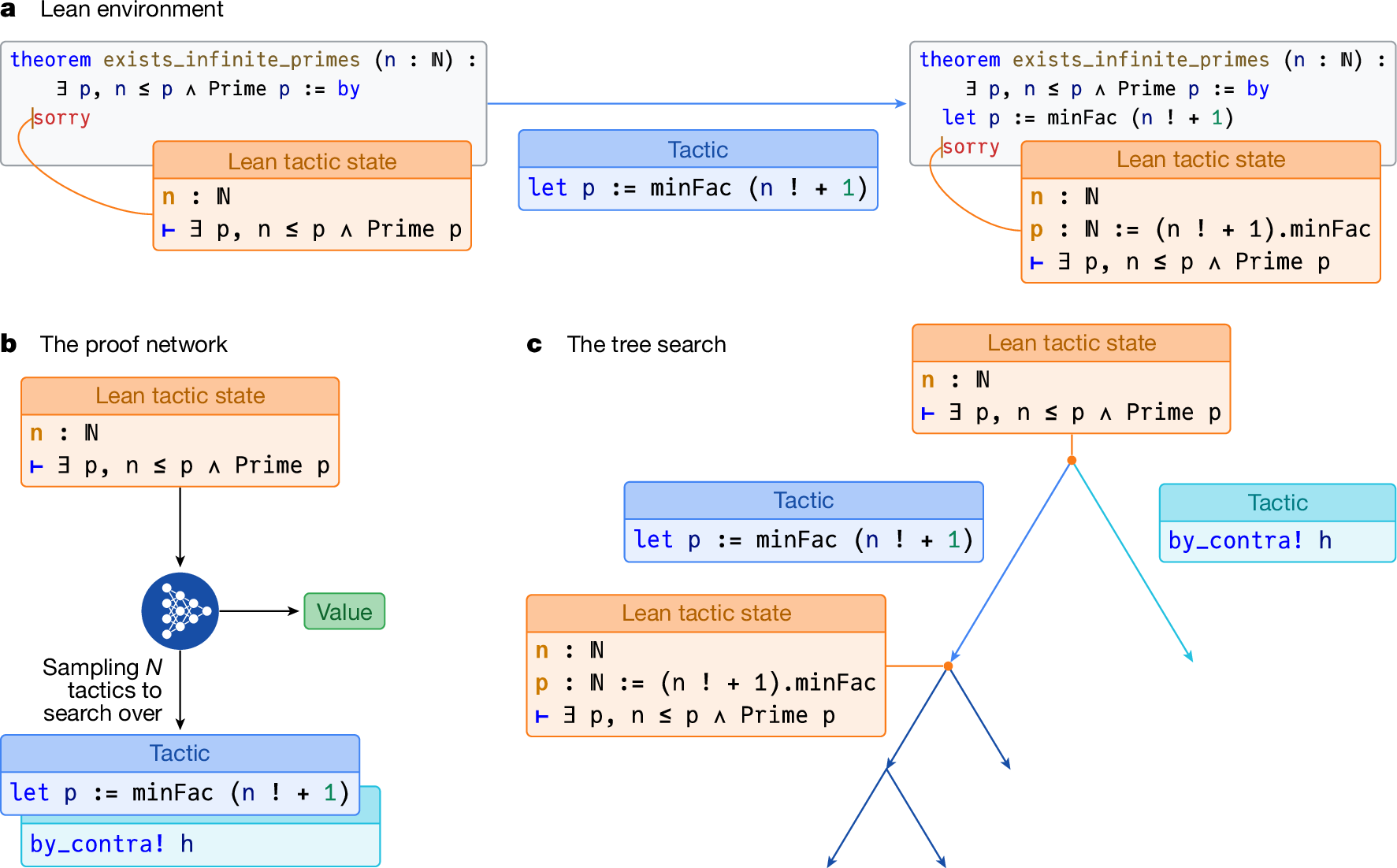
A long-standing goal of artificial intelligence (AI) is to build systems capable of complex reasoning in vast domains, a task epitomized by mathematics with its boundless concepts and demand for rigorous proof. Recent AI systems, often reliant on human data, typically lack the formal verification necessary to guarantee correctness. By contrast, formal languages such as Lean1 offer an interactive environment that grounds reasoning, and reinforcement learning (RL) provides a mechanism for learning in such environments. Here we present AlphaProof, an AlphaZero-inspired2 agent that learns to find formal proofs through RL by training on millions of auto-formalized problems. For the most difficult problems, it uses test-time RL, a method of generating and learning from millions of related problem variants at inference time to enable deep, problem-specific adaptation. AlphaProof substantially improves state-of-the-art results on historical mathematics competition problems. At the 2024 International Mathematical Olympiad competition, our AI system, with AlphaProof as its core reasoning engine, solved three out of the five non-geometry problems, including the competition’s most difficult problem. Combined with AlphaGeometry 23, this performance, achieved with multi-day computation, resulted in reaching a score equivalent to that of a silver medallist, marking the first time an AI system achieved any medal-level performance, to our knowledge. Our work demonstrates that learning at scale from grounded experience produces agents with complex mathematical reasoning strategies, paving the way for a reliable AI tool in complex mathematical problem solving.