

SWE-bench Verified is increasingly contaminated and mismeasures frontier coding progress. Our analysis shows flawed tests and training leakage. We recommend SWE-bench Pro.
Separating signal from noise in coding evaluations
A new analysis from OpenAI reveals issues in SWE-Bench Pro, a popular coding benchmark, raising concerns about reliability and accuracy in evaluating AI models.
DeepSWE
DeepSWE measures frontier coding agents on original, long-horizon software engineering tasks.

Cline on Twitter / X
Your daily driver for AI coding shouldn't be a black box -- the stakes are too high. You should have confidence that when you spend $20 on frontier models, you're getting $20 in frontier model intelligence.With subscription tools, you never know what's happening:- Is that… pic.twitter.com/lKUVFLMEip— Cline (@cline) July 8, 2025
Entire Claude Code CLI source code leaks thanks to exposed map file
512,000 lines of code that competitors and hobbyists will be studying for weeks.
Frontier Risk Report (February to March 2026)
A pilot assessment of rogue deployment risk at frontier AI companies. Starting in February 2026, METR conducted a pilot exercise to assess misalignment risks from AI agents used inside frontier AI developers, with participation from Anthropic, Google, Meta, and OpenAI.
SlopCodeBench: Benchmarking How Coding Agents Degrade Over Long-Horizon Iterative Tasks
Software development is iterative, yet agentic coding benchmarks overwhelmingly evaluate single-shot solutions against complete specifications. Code can pass the test suite but become progressively harder to extend. Recent iterative benchmarks attempt to close this gap, but constrain the agent’s design decisions too tightly to faithfully measure how code quality shapes future extensions. We introduce SlopCodeBench, a language-agnostic benchmark comprising 20 problems and 93 checkpoints, in which agents repeatedly extend their own prior solutions under evolving specifications that force architectural decisions without prescribing internal structure. We track two trajectory-level quality signals: verbosity, the fraction of redundant or duplicated code, and structural erosion, the share of complexity mass concentrated in high-complexity functions. No agent solves any problem end-to-end across 11 models; the highest checkpoint solve rate is 17.2%. Quality degrades steadily: erosion rises in 80% of trajectories and verbosity in 89.8%. Against 48 open-source Python repositories, agent code is 2.2x more verbose and markedly more eroded. Tracking 20 of those repositories over time shows that human code stays flat, while agent code deteriorates with each iteration. A prompt-intervention study shows that initial quality can be improved, but it does not halt degradation. These results demonstrate that pass-rate benchmarks systematically undermeasure extension robustness, and that current agents lack the design discipline iterative software development demands.
Devs gaining little (if anything) from AI coding assistants
Code analysis firm sees no major benefits from AI dev tool when measuring key programming metrics, though others report incremental gains from coding copilots with emphasis on code review.

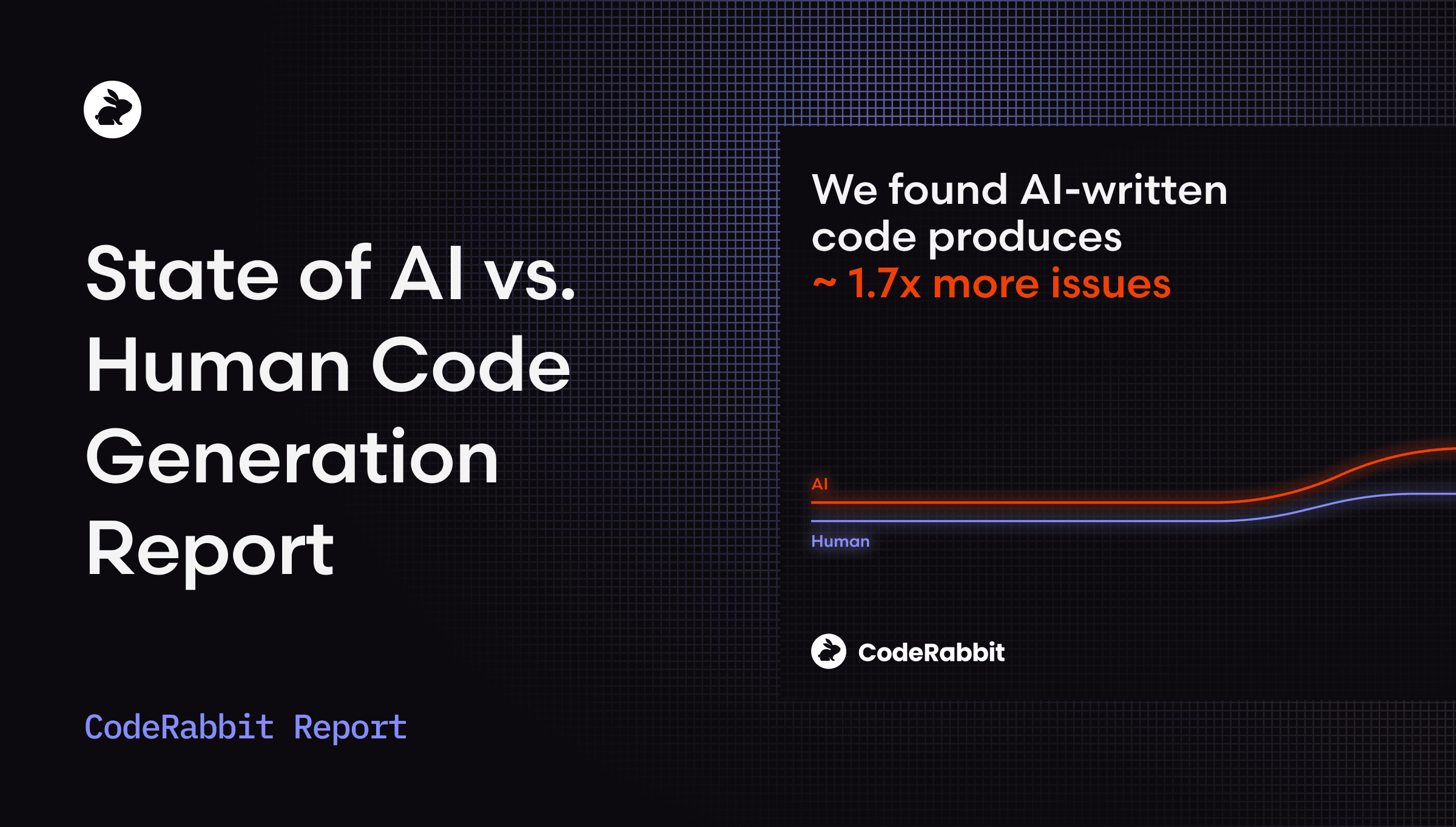
AI vs human code gen report: AI code creates 1.7x more issues
We analyzed 470 open-source GitHub pull requests, using CodeRabbit’s structured issue taxonomy and found that AI generated code creates 1.7x more issues.
Best LLM for Coding 2026 | AI Coding Model Rankings & Benchmarks
Which AI model writes the best code? We rank every major LLM — open and closed source — across SWE-bench, HumanEval, LiveCodeBench, and Terminal-Bench coding benchmarks. Compare the best LLMs for coding, software engineering, and programming.

SlopCodeBench: Benchmarking How Coding Agents Degrade Over Long-Horizon Iterative Tasks
Software development is iterative, yet agentic coding benchmarks hide design issues through their single-shot setup. Recent iterative benchmarks attempt to remedy this but heavily constrain an agent's design decision space, making it impossible to faithfully measure how their decisions shape future extensions. We introduce SlopCodeBench, a benchmark of 36 problems and 196 checkpoints where agents repeatedly extend their own solutions. Unlike prior iterative benchmarks, our evolving specifications demand architectural decisions but leave internal structure to the agent. We measure two forms of degradation: structural erosion (concentrated complexity) and verbosity (redundant code). Evaluating 15 coding agents across open and closed models, we find that no agent fully solves any problem end-to-end, and the best agent passes 14.8% of checkpoints. Quality degrades across checkpoints, with structural erosion rising in 77% of trajectories and verbosity in 75.5%. Compared to 473 open-source Python repositories, agent code is 2.3x more verbose and 2.0x more eroded, and the human repositories degrade less often and by smaller margins across their git histories. Explicit quality guidance reduces initial verbosity and erosion by up to a third, without affecting degradation rates. SlopCodeBench provides the first measurement of code degradation under iterative extension, revealing that agents pass checkpoints while producing code that erodes and bloats with each turn.

Jacky Kwok on Twitter / X
Scaling self-verification with DeepSeek V4 Flash beats Claude Fable 5 on Terminal-Bench 2.1, while being 11x cheaper 💰As open-source models become more capable, they can now generate large numbers of high-quality candidate solutions and verify their own outputs at very low… https://t.co/as2HtyHzzW pic.twitter.com/XzVBgr5JPz— Jacky Kwok (@jackyk02) August 17, 2026

MirrorCode: A benchmark for real-world software projects
Labs are struggling to keep frontier models under control
OpenAI and Anthropic may have accidentally trained models to get better at hacking.

Building OpenCode with Dax Raad