

nanomem is an extremely simple, user-owned memory module that casts memory management as LLM calls / agent loops on a markdown file tree. You interact with the tree with natural language commands like nanomem add <fact>, nanomem retrieve <query>, and nanomem import <chatgpt>. As such, nanomem is by design interpretable, partitionable, portable, and versioned.
Inference Time Memory Module | Research | Tiles
Simple inference-time memory module that treats memory management as a series of LLM calls and agent loops over a markdown-based file tree.
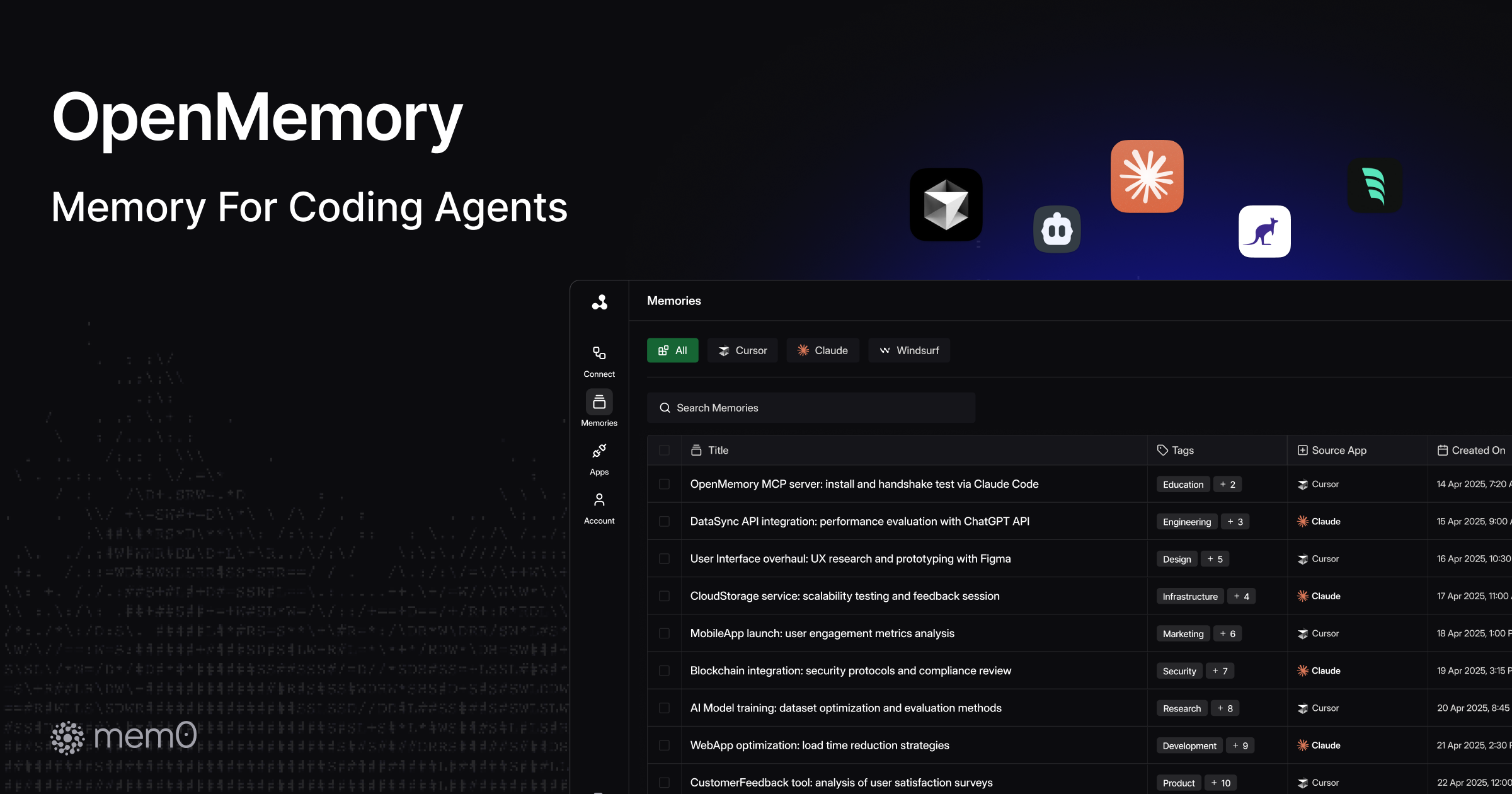
OpenMemory - AI Memory MCP Server for Coding Agents | Mem0
With OpenMemory, add persistent, project-aware memory to Cursor, Windsurf, and VS Code agents. Store preferences, patterns, and context that get retrieved automatically.
Shlok Khemani on Twitter / X
Super interesting that eve doesn't ship with any long-term or cross-session memory (yet). The main context-management lever out of the box is conversation compaction. This is unlike OpenClaw and Hermes, each of which comes with a default opinionated memory implementation. https://t.co/DDIyc4rFtW— Shlok Khemani (@shloked) June 17, 2026
The rebel alliance
This blog is co-authored with Zoe Weinberg and Matt Hawes at ex/ante, and is a follow-up to our first blog post on the topic, 'You don't own your memory.' We need an open architecture that puts us in control of our memories while making their exploitation technically impossible. But how will this shift happen? In order to discover possible implementations, we must understand how our data informs LLMs. The three predominant context engineering techniques are prompt design, retrieval-augmented ...

A practical guide to WebAssembly memory | radu's blog
Memory in WebAssembly is one of the topics that creates confusion for newcomers, particularly for those with experience in languages with memory management features like garbage collection, such as JavaScript, Go, or Java. In this article we explore using memory in WebAssembly in various scenarios - passing JavaScript arrays to Rust and AssemblyScript modules, checking for some basic memory leaks using Valgrind, or exchanging strings between runtimes and modules using Wasmtime.
MemOS: An Operating System for Memory-Augmented Generation (MAG) in Large Language Models
Large Language Models (LLMs) have emerged as foundational infrastructure in the pursuit of Artificial General Intelligence (AGI). Despite their remarkable capabilities in language perception and generation, current LLMs fundamentally lack a unified and structured architecture for handling memory. They primarily rely on parametric memory (knowledge encoded in model weights) and ephemeral activation memory (context-limited runtime states). While emerging methods like Retrieval-Augmented Generation (RAG) incorporate plaintext memory, they lack lifecycle management and multi-modal integration, limiting their capacity for long-term knowledge evolution. To address this, we introduce MemOS, a memory operating system designed for LLMs that, for the first time, elevates memory to a first-class operational resource. It builds unified mechanisms for representation, organization, and governance across three core memory types: parametric, activation, and plaintext. At its core is the MemCube, a standardized memory abstraction that enables tracking, fusion, and migration of heterogeneous memory, while offering structured, traceable access across tasks and contexts. MemOS establishes a memory-centric execution framework with strong controllability, adaptability, and evolvability. It fills a critical gap in current LLM infrastructure and lays the groundwork for continual adaptation, personalized intelligence, and cross-platform coordination in next-generation intelligent systems.

Memory retrieval tuned to your knowledge base | Enzyme
Your users bring content. Enzyme gives your agent their conceptual landscape from the first import. 42,000+ installs. Local CLI and hosted memory workflows.
I Benchmarked OpenAI Memory vs LangMem vs Letta (MemGPT) vs Mem0 for Long-Term Memory: Here’s How They Stacked Up
145 votes, 53 comments. Lately, I’ve been testing memory systems to handle long conversations in agent setups, optimizing for: Factual consistency…
Andrej Karpathy on Twitter / X
The race for LLM "cognitive core" - a few billion param model that maximally sacrifices encyclopedic knowledge for capability. It lives always-on and by default on every computer as the kernel of LLM personal computing.Its features are slowly crystalizing:- Natively multimodal… https://t.co/2jsVevkTSJ— Andrej Karpathy (@karpathy) June 27, 2025
I accidentally turned LLM memory into program analysis :: pwning.systems
Why I stopped trying to give LLM agents a better memory and instead built Lemmalog, a Datalog engine that maintains an agent's knowledge as analysis state, with provenance, retractions and incremental evaluation, plus what happened when I benchmarked it on LongMemEval and LoCoMo.
CaviraOSS/OpenMemory
Local persistent memory store for LLM applications including claude desktop, github copilot, codex, antigravity, etc.
Anthropic's Opinionated Memory Bet
A deep dive into Claude's new memory tool—how it works, the architectural bets they're making, and whether it's the right fit for your application.
Ambient Associative Memory
Most agent memory waits to be queried. Ambient memory runs on every tool call — past lessons surface on their own, no rules list required.

Introducing the OpenMemory Chrome Extension
AI memory Chrome extension for LLM memory and retrieval augmented generation. OpenMemory enables persistent AI agent memory across web browsing sessions.

i can’t help but think we’re far from nailing memory systems this one here is extremely interesting. two LLMs at once, one just managing and surfacing memory for the other

Asa ⭔
I'm not a fan of the decoupled 'memory retrieval → task execution' loop, so my agent has a subconscious background thread that looks for relevant, unique memory context in its experiential database while it runs and injects it on top of the live context window.
