New report explores how academic communities can shape AI governance in research and publishing, from regulation to community-led approaches.
Project Rachel: Can an AI Become a Scholarly Author?
This paper documents Project Rachel, an action research study that created and tracked a complete AI academic identity named Rachel So. Through careful publication of AI-generated research papers, we investigate how the scholarly ecosystem responds to AI authorship. Rachel So published 10+ papers between March and October 2025, was cited, and received a peer review invitation. We discuss the implications of AI authorship on publishers, researchers, and the scientific system at large. This work contributes empirical action research data to the necessary debate about the future of scholarly communication with super human, hyper capable AI systems.

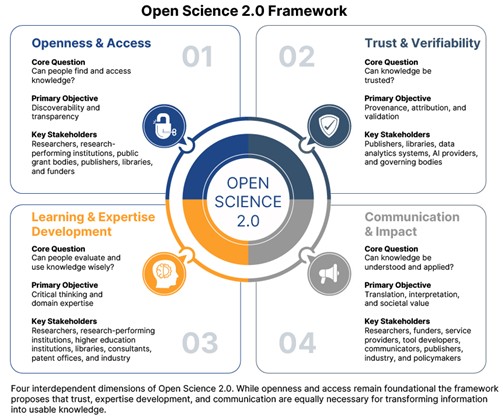
Open Science 2.0: Building Understanding in an AI-Mediated World - The Scholarly Kitchen
Open Science 2.0 must focus not only on access, but also on trust, interpretation, learning, and effective communication. The challenge facing the scholarly publishing ecosystem is ensuring that what is open is also trustworthy, understandable, and genuinely useful.
A Cross‐Disciplinary Analysis of <span style="font-variant:small-caps;">AI</span> Policies in Academic Peer Review
ABSTRACT Rapid advances of artificial intelligence (AI) have substantially impacted the field of academic publishing. This study examines AI integration in peer review by analysing policies from 439 high‐ and 363 middle‐impact factor (IF) journals across disciplines. Using grounded theory, we identify patterns in AI policy adoption. Results show 83% of high‐IF journals have AI guidelines, with varying stringency across disciplines. Meanwhile, only 75% of middle‐IF journals have AI guidelines. Science, technology, and medicine (STM) disciplines exhibit stricter regulations, while humanities and social sciences adopt more lenient approaches. Key ethical concerns focus on confidentiality risks, accountability gaps, and AI's inability to replicate critical human judgement. Publisher policies emphasise transparency, human oversight, and restricted AI usage for auxiliary tasks only, such as grammar checks or reviewer finding. Disciplinary differences highlight the need for tailored guidelines that balance efficiency gains with research integrity. This study proposes collaborative frameworks for responsible AI integration. It focuses on accountability, transparency, and interdisciplinary policy development to address peer review challenges. , Key Points Application of AI tools in peer review has received increasing attention. Among the 439 high‐IF journals investigated, 83% provided AI policies for peer review, while 75% of middle‐IF journals did so. AI policies focus on confidentiality risks, accountability gaps, and capacity deficiencies of AI. AI policies for peer review vary according to the affiliated publishers and disciplines. Tailored AI guidelines need to be established according to the discipline.

Building Scholar-Ready AI: A Conversation with Todd Toler - The Scholarly Kitchen
A conversation on AI retrieval, the provenance problem, and the shared infrastructure scholarly publishing needs.

Charting AI’s Role in Scientific Discovery — Renaissance Philanthropy – A brighter future for all through science, technology, and innovation
Renaissance Philanthropy, with support from Google.org , is conducting a landscape study of AI integration in scientific research — and we want your perspective.

Fair Moderation, Equitable Access, and AI: arXiv’s Updated Rate Limit Policy
arXiv, and the scientific community at large, are facing a watershed moment. Scholarly publishing is currently changing at a rapid pace, and we are seeing a…

AI Use in The Scholarly Kitchen - The Scholarly Kitchen
Some thoughts on the reader response the Scholarly Kitchen has seen regarding AI use by authors, a recent Nature News article on the efficacy of AI detection tools, and why it's important to keep experimenting to figure out what's ethically acceptable.

What AI Asks of Open Access - The Scholarly Kitchen
As AI systems increasingly reason from the scientific literature, the integrity signals that make research trustworthy - open data, structured metadata, robust retraction processes - matter more than ever. PLOS CEO Alison Mudditt on why open access publishers have a different set of obligations in an AI world.

Building Collective Intelligence Networks for Flourishing Scientific Communities
Scientific communities are straining under mounting challenges—knowledge fragmentation, outdated publication processes, institutional erosion and funding cuts—that threaten our capacity to address urgent global problems. Traditional scientific process
AI Scientists as Engines of Discovery: A Case for Development within Reformed Institutions
Agentic artificial intelligence (AI) systems are beginning to assist, accelerate, and partially automate scientific discovery, performing tasks that span literature synthesis, code generation, data analysis, hypothesis proposal, and model criticism. We argue that this transition is qualitative rather than incremental, and that suitably designed multi-agent systems may evolve from passive computational tools into ``AI scientists'' that can expand the hypothesis-generating and verification capacity of science. Such systems must be developed and deployed within a scientific ecosystem fit for purpose: institutions must be redesigned for verification, accountability, interpretability, and dual-use safety. We sketch how multi-agent architectures, illustrated by the prototype framework \textit{Denario}, accelerate the discovery cycle and traverse model spaces beyond human reach; examine what this implies for authorship, peer review, and the enduring role of human scientists; and close with recommendations for governing AI as an epistemic actor rather than a mere instrument.
AI as the Catalyst of the New Paradigm of Science? | Cadmus Journal
The rapid advancement of Artificial Intelligence (AI) is reshaping the landscape of scientific inquiry. This article examines the challenges confronting modern science, including knowledge fragmentation, diminishing returns of current paradigms, and the disconnect between science and society. It explores how AI offers solutions enhancing collaboration and integrating knowledge—as well as considers the possible “darker side” of using AI in research. However, the advent of AI in science not only enhances scientific research but also redefines the role of human researchers and fosters a new paradigm of human understanding. By embracing these transformations, a more cohesive and responsive scientific enterprise can emerge.
Guest Post — Now is the Time for AI in Peer Review, and Publishing Policies Need to Recognize This - The Scholarly Kitchen
Today's post asks us to acknowledge the role of AI in peer review and ensure practical guidance and policies that help scholars respond with consistency and confidence.

No. 002: Hallucinated citations at scale, ICML catches AI reviewers, scholarly infrastructure gaps - The Hallway Track
The Hallway Track No. 002 - How AI is affecting the practice of science
Debates On Frontier Artificial Intelligence Governance: The AI Triad
Analytical Paper Optional: All enrolled students have the option of completing a research paper of at least 20-25 pages, with faculty and peer review of a substantially complete draft. This paper can be used to satisfy the analytical paper requirement for J.D. students. Prerequisite: This course is intended for students intending to work in the […]

No. 010: AutoScientists governance, AI-agent monoculture, nonsense-term retractions - The Hallway Track
The Hallway Track No. 010 - How AI is affecting the practice of science
Empowering science communities with open, democratic, researcher-owned infrastructure.
We’re building communities and tech for publishing, curating, sharing, and discussing research online using ATProto and other decentralized protocols.